
What Is the Tree Diameter Calculator?
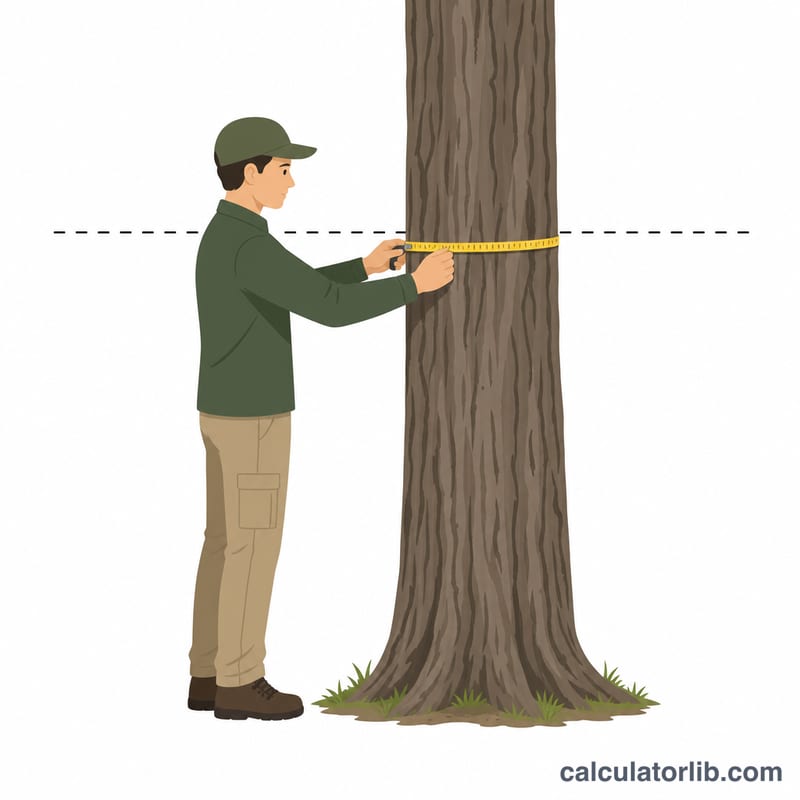
The Tree Diameter Calculator converts a tree's trunk circumference into its diameter, commonly recorded as DBH (Diameter at Breast Height — measured about 1.3 m or 4.5 ft above ground). Foresters, arborists and gardeners measure circumference with a simple tape because it is far easier than measuring diameter directly, then convert it using a constant: pi. This universal geometry works with any unit of length.
How to Use It
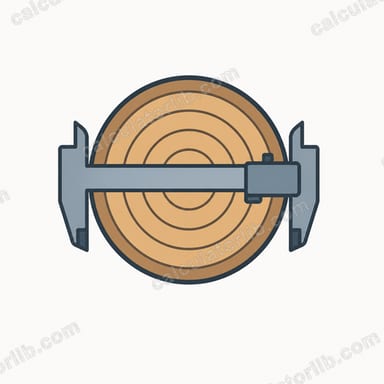
Wrap a flexible tape measure around the trunk at breast height and read the circumference. Enter that number, choose centimeters or inches, and the calculator instantly returns the diameter and radius. Keep the tape level and snug for the most accurate reading.
The Formula Explained
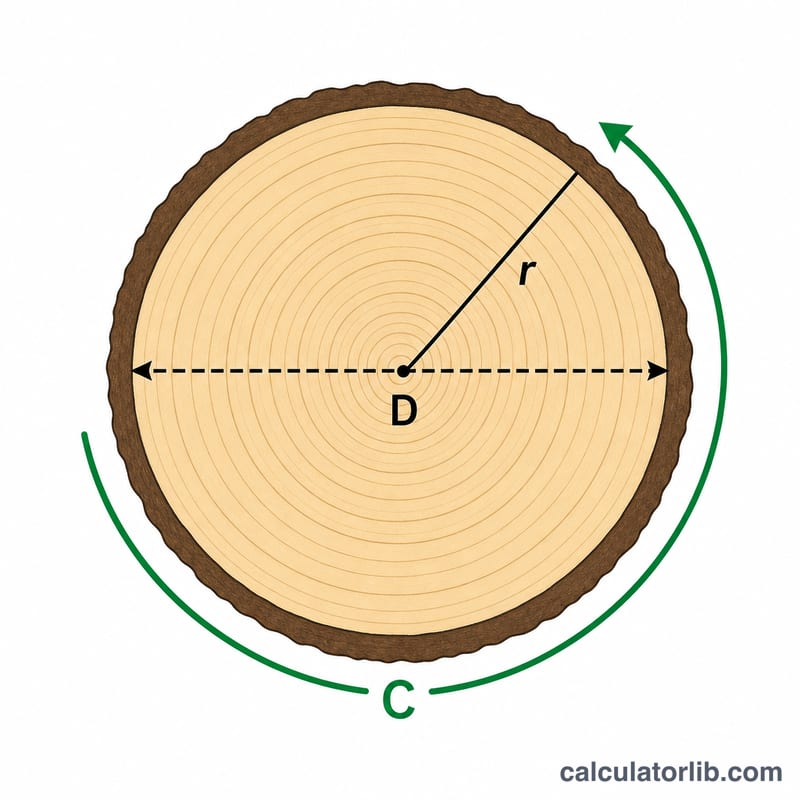
A tree trunk cross-section is approximately circular, so its circumference equals pi times its diameter (\(C = \pi D\)). Rearranging gives $$\text{Diameter} = \dfrac{\text{Circumference}}{\pi}$$ where \(\pi \approx 3.14159\). The radius is simply half the diameter.
Worked Example
Suppose you measure a trunk circumference of 100 cm. $$\text{Diameter} = \frac{100}{3.14159} = 31.83 \text{ cm}$$ The radius is \(31.83 \div 2 = 15.92\) cm. So this tree has a DBH of about 31.8 cm.
FAQ
What is DBH? DBH stands for Diameter at Breast Height, the standard point (≈1.3 m / 4.5 ft) where tree diameter is measured for forestry and inventory work.
Why divide by pi? Because \(\text{circumference} = \pi \times \text{diameter}\) for a circle, dividing the measured circumference by \(\pi\) recovers the diameter.
Does the unit matter? No — the formula is identical for any unit. Enter centimeters or inches and the result comes back in the same unit.