
What Is the Protein Molecular Weight Calculator?
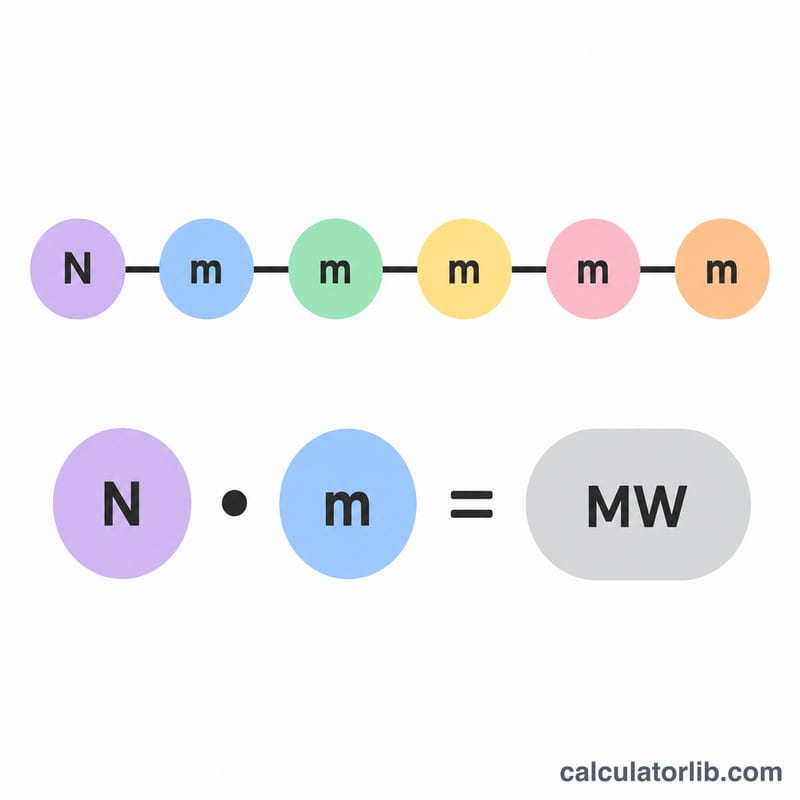
This tool gives a fast, first-order estimate of a protein's molecular weight (MW) based only on its length — the number of amino acid residues in the chain. Because the 20 common amino acids have residue masses that average out to roughly 110 Daltons (Da), you can approximate MW by multiplying the residue count by this average. The result is reported in both Daltons and kilodaltons (kDa).
How to Use It
Enter the number of amino acids in your protein (its sequence length). Leave the average residue mass at the default of 110 Da for a standard estimate, or change it if you know a more specific average for your protein. Click calculate to see the estimated molecular weight.
The Formula Explained
The calculation is simply $$\text{MW} = N \times \bar{m}_{\text{residue}}$$ where \(N\) is the number of residues and \(\bar{m}\) is the average residue mass. The widely used rule of thumb is \(\bar{m} \approx 110\ \text{Da}\). This already accounts for the water molecule lost during each peptide bond formation, so you do not subtract anything extra. Dividing the Dalton value by 1000 converts it to kDa, the unit most often quoted in biochemistry.
Worked Example
Consider a protein with 300 amino acids. Using the average residue mass of 110 Da: $$\text{MW} = 300 \times 110 = 33{,}000\ \text{Da}$$ or 33 kDa. That places it in the typical range for a medium-sized globular protein.
FAQ
How accurate is the 110 Da approximation? It is usually within a few percent of the true mass. For an exact value, sum the actual residue masses from the sequence and add one water molecule (~18 Da).
What is a Dalton? A Dalton (Da) is the unified atomic mass unit, equal to 1/12 the mass of a carbon-12 atom — essentially the mass of one hydrogen atom.
Why use kilodaltons? Proteins are large, so masses are commonly reported in kDa (\(1\ \text{kDa} = 1000\ \text{Da}\)) for convenience, e.g. "a 50 kDa protein."