
What Is Effective Nuclear Charge?
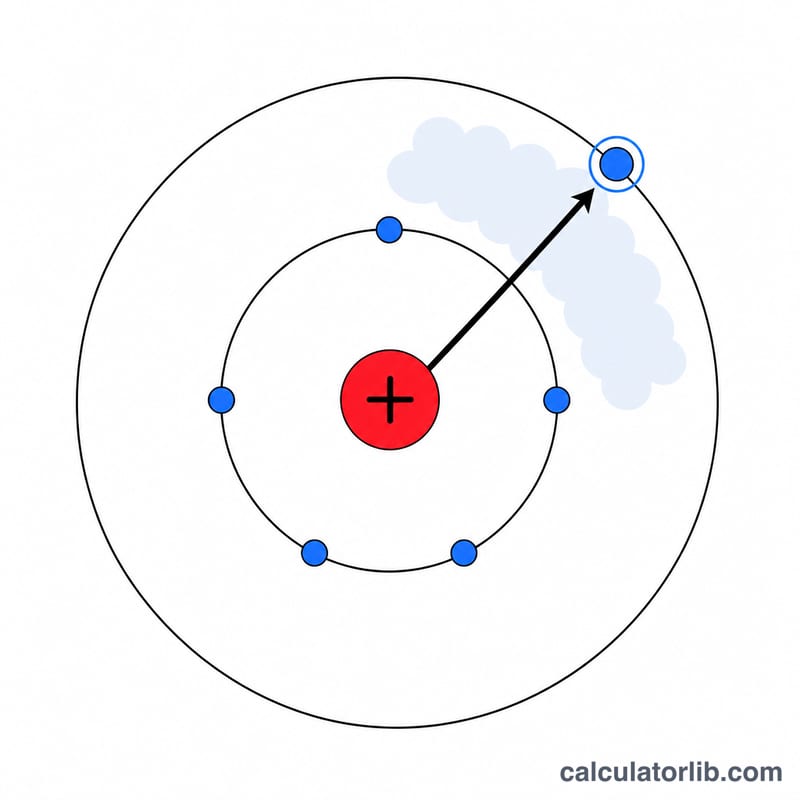
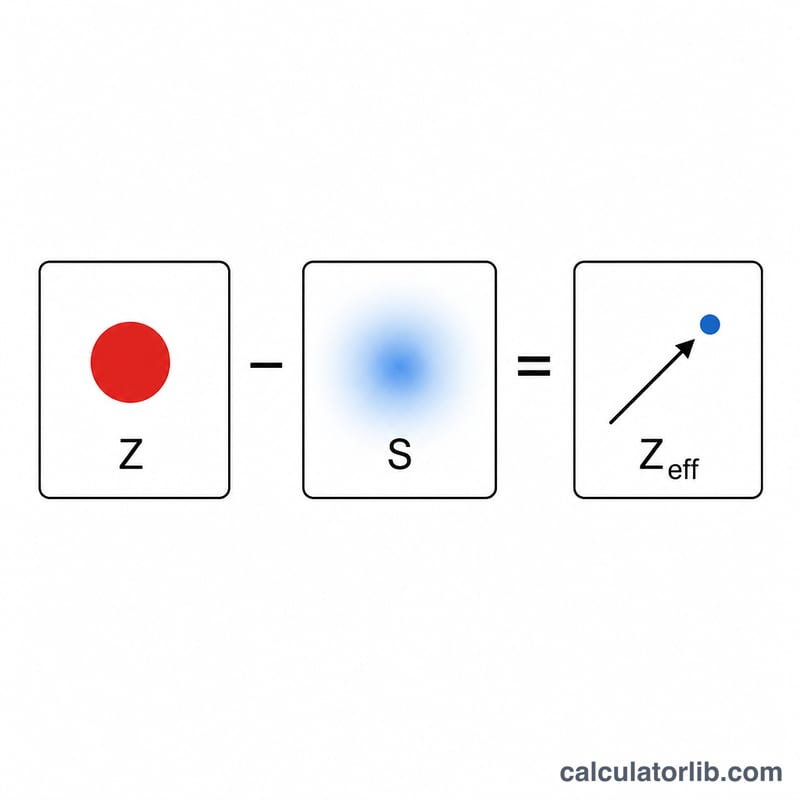
The effective nuclear charge (Zeff) is the net positive charge actually experienced by a particular electron in a multi-electron atom. While the nucleus carries a full charge equal to the atomic number Z, inner electrons partially "screen" or shield the outer electrons from that pull. This calculator computes Zeff using the simple relationship \(Z_{\text{eff}} = Z - S\), where S is the shielding (screening) constant.
How to Use the Calculator
Enter the atomic number Z of the element (for example, 11 for sodium) and the shielding constant S for the electron of interest. S is often estimated with Slater's rules. The calculator instantly returns Zeff, the effective charge felt by that electron. A higher Zeff means the electron is held more tightly, which correlates with smaller atomic radius and higher ionization energy.
The Formula Explained
The governing equation is $$Z_{\text{eff}} = Z - S.$$ Z is a whole number equal to the number of protons. S accounts for repulsion from other electrons: core electrons shield strongly, electrons in the same shell shield partially, and electrons in outer shells contribute essentially nothing. Slater's rules provide systematic values for S, so the precision of Zeff depends on the chosen shielding estimate.
Worked Example
Consider a 3s valence electron in sodium (Z = 11). Using Slater's rules, the shielding constant is approximately S = 8.8. Then $$Z_{\text{eff}} = 11 - 8.8 = 2.2.$$ So the valence electron in sodium feels an effective charge of about +2.2, far less than the full nuclear charge of +11.
FAQ
Why is Z_eff less than Z? Because inner electrons partially block the attraction between the nucleus and an outer electron, reducing the charge that electron actually feels.
Where do I get the shielding constant S? Most commonly from Slater's rules, which assign screening contributions based on the electron's shell and subshell relative to the others.
Can Z_eff be negative? In practice no — S never exceeds Z for a real electron, so Zeff remains positive, though crude estimates can occasionally produce small values.