

What Is a Formal Charge Calculator?
A Formal Charge Calculator is a chemistry tool that helps you determine the formal charge on an individual atom within a molecule or polyatomic ion. Formal charge is a bookkeeping method used to track electrons and predict the most stable arrangement of atoms in a Lewis structure. By comparing the number of electrons an atom "owns" in a molecule with the number it has as a neutral free atom, chemists can identify which resonance structures are most favorable and where charges are likely to sit. This calculator works for any element and is used worldwide in general, organic, and inorganic chemistry courses.
How to Use the Calculator
To find the formal charge of an atom, you only need three pieces of information from your Lewis structure:
- Valence electrons – the number of electrons in the outer shell of the neutral atom (from its group on the periodic table).
- Nonbonding electrons – the number of lone-pair (unshared) electrons on the atom.
- Bonding electrons – the total number of electrons in bonds connected to the atom (each single bond = 2, double = 4, triple = 6).
Enter these values and the calculator instantly returns the formal charge.
The Formula Explained
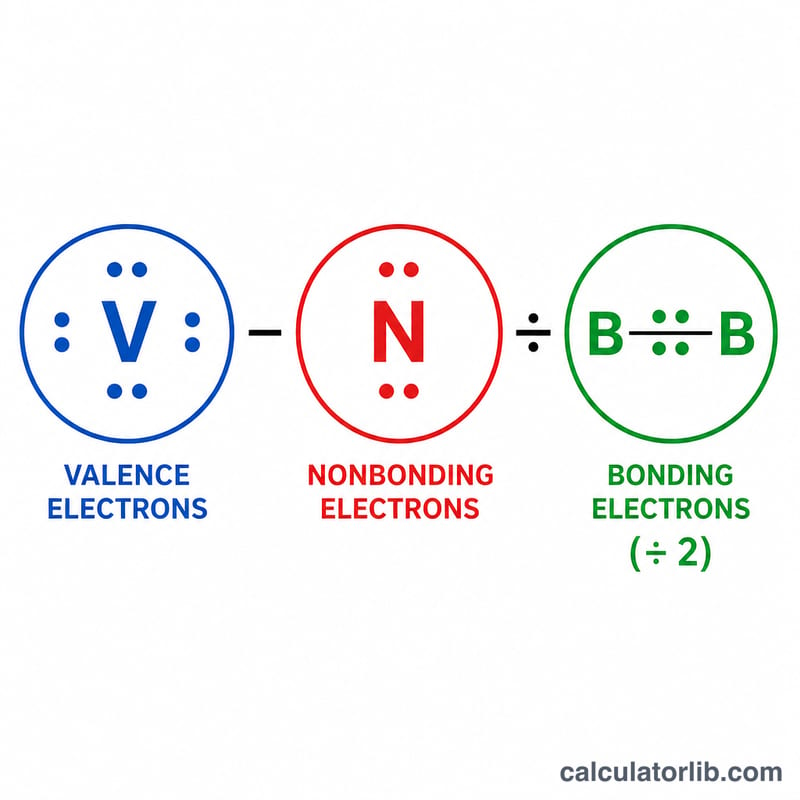
The formal charge formula is:
Formal Charge = Valence electrons − Nonbonding electrons − (Bonding electrons ÷ 2)
You subtract all the lone-pair electrons (the atom keeps these entirely) and half of the shared bonding electrons (each bond is split equally between two atoms). The result tells you how the electron distribution compares to the neutral atom.
Worked Example
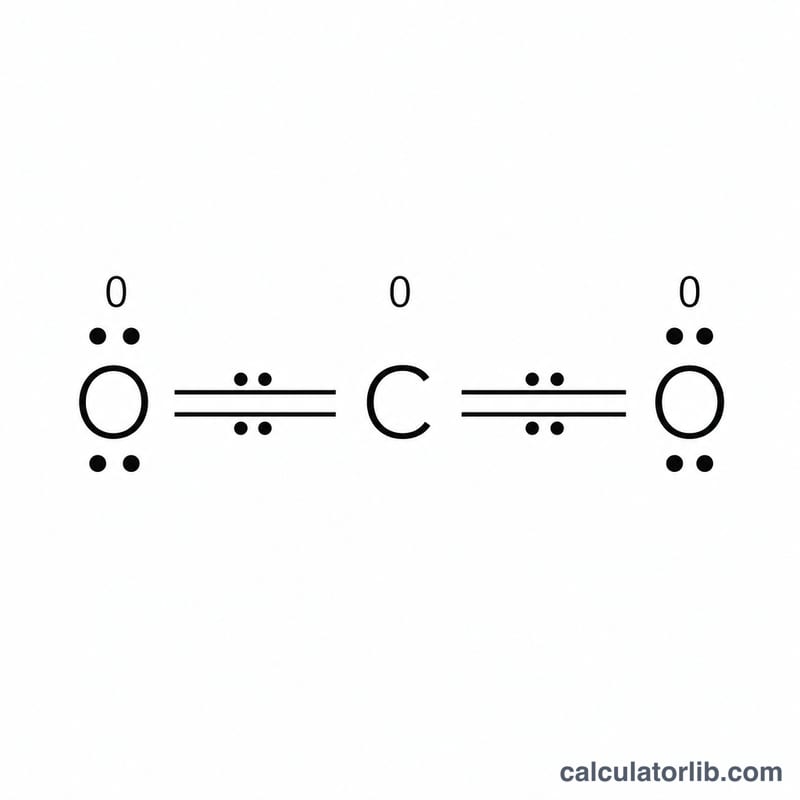
Consider the oxygen atom in the carbonate ion (CO₃²⁻) that forms a double bond with carbon:
- Valence electrons of oxygen = 6
- Nonbonding electrons = 4 (two lone pairs)
- Bonding electrons = 4 (one double bond)
Formal Charge = 6 − 4 − (4 ÷ 2) = 6 − 4 − 2 = 0
The single-bonded oxygens, however, have 6 nonbonding electrons and 2 bonding electrons, giving a formal charge of −1 each.
Frequently Asked Questions
Is formal charge the same as oxidation number? No. Formal charge assumes electrons in bonds are shared equally, while oxidation number assigns shared electrons to the more electronegative atom.
What does a formal charge of zero mean? A structure where most atoms carry a formal charge of zero is usually the most stable and preferred Lewis structure.
Should formal charges add up to anything? Yes. The sum of all formal charges in a molecule or ion equals the overall charge of that species.
Related calculators
- Molecular Weight Calculator — molar mass from a formula.
- Empirical Formula Calculator — empirical formula from percentages.