
What the Percent Ionization Calculator Does
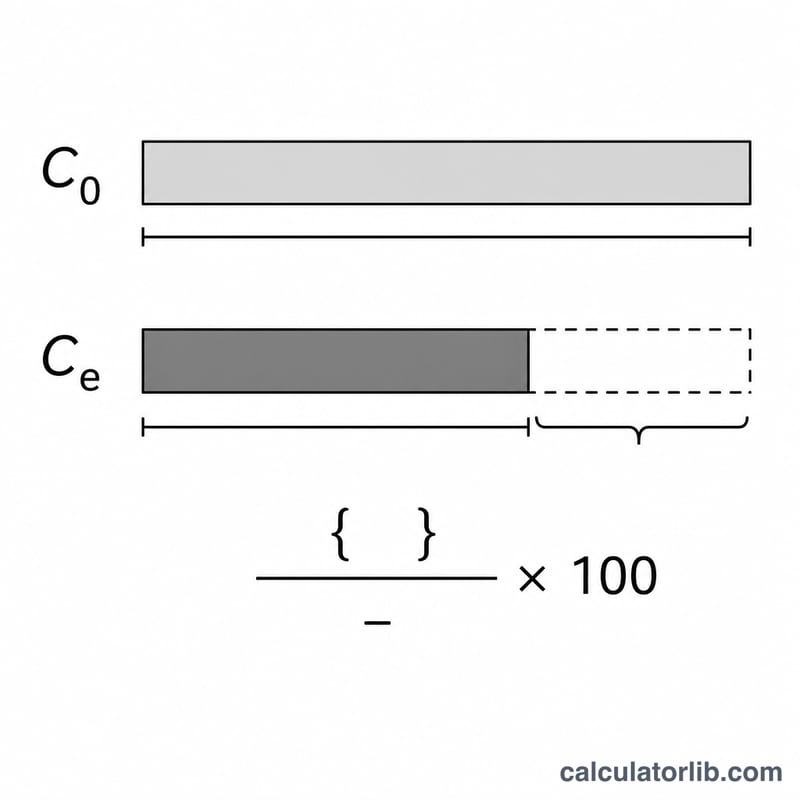
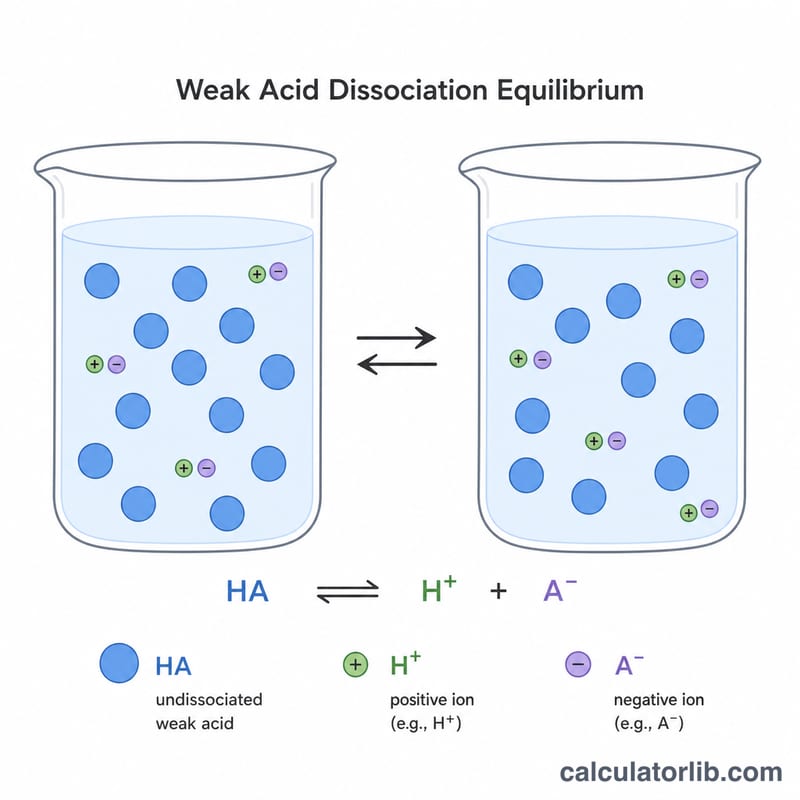
This calculator works out how much of a weak acid or weak base has actually ionized (dissociated) when it reaches equilibrium in solution. Weak electrolytes only partially break apart into ions, so the fraction that dissociates — expressed as a percentage — tells you how "strong" that weak acid or base behaves under the given conditions. The tool needs just two numbers: the concentration you started with and the concentration of un-ionized molecules left at equilibrium.
The Inputs You Enter
- Initial Concentration (mol/L): the total starting concentration of the acid or base before any ionization occurs.
- Equilibrium Concentration (mol/L): the concentration of the still-intact (un-ionized) species once the reaction has settled at equilibrium.
The difference between these two values is the amount that has ionized. Both must be entered in moles per litre (mol/L) so the units cancel cleanly.
The Formula
The calculator applies a single, direct equation:
$$\text{Percent Ionization} = \frac{\text{Initial Concentration} - \text{Equilibrium Concentration}}{\text{Initial Concentration}} \times 100\%$$
It also reports the ionized concentration \(= \text{Initial Concentration} - \text{Equilibrium Concentration}\), which is the amount of dissociated species in mol/L. No equilibrium constant (Ka or Kb) is required — you supply the equilibrium concentration directly.
Worked Example
Suppose you dissolve acetic acid to an initial concentration of 0.100 mol/L. At equilibrium, the concentration of un-ionized acetic acid is measured at 0.9866 mol/L… let's use realistic figures: initial = 0.100 mol/L, equilibrium = 0.9866 is impossible, so equilibrium = 0.0987 mol/L.
- Ionized concentration \(= 0.100 - 0.0987 = 0.0013 \text{ mol/L}\)
- Percent Ionization \(= \left( \dfrac{0.0013}{0.100} \right) \times 100\% =\) 1.3%
So only about 1.3% of the acetic acid molecules dissociate — confirming it is a weak acid.
Frequently Asked Questions
Is percent ionization the same as degree of dissociation? Yes. The degree of dissociation (often written as α) is simply the percent ionization divided by 100 — a decimal fraction rather than a percentage.
Can I use this for strong acids? You can, but strong acids ionize almost completely, so the equilibrium concentration is near zero and the result approaches 100%. The calculator is most useful for weak acids and bases where ionization is partial.
Why might I get a result over 100% or below 0%? That means your equilibrium concentration is either greater than the initial concentration or negative. Double-check your values — the equilibrium concentration must be smaller than the initial concentration and both should be positive.