
What Is the Partial Pressure Calculator?
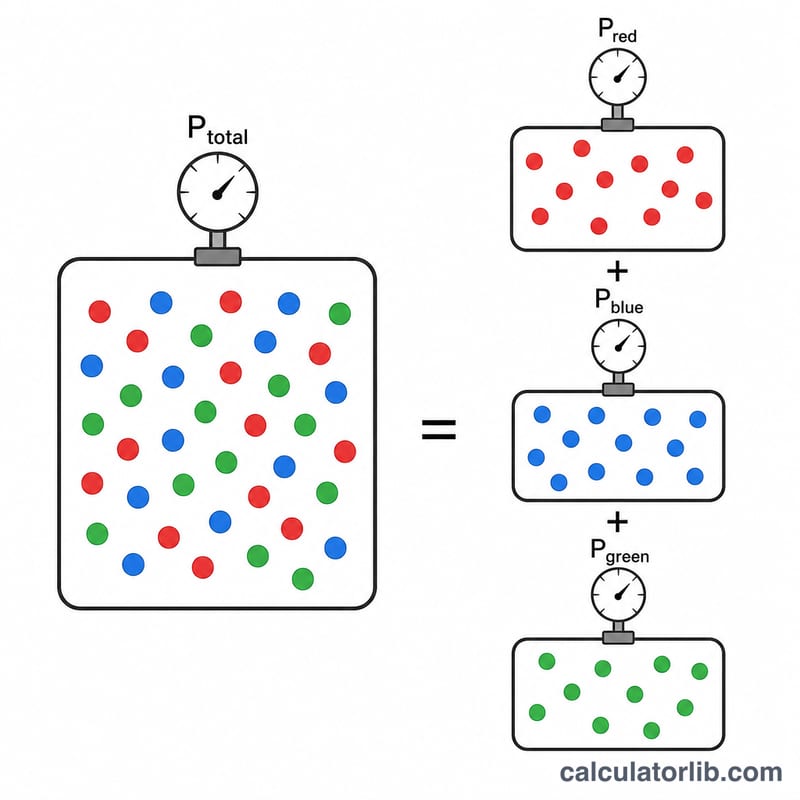
The Partial Pressure Calculator works out the pressure contributed by a single gas within a mixture of gases. It is based on Dalton's Law of Partial Pressures, a universal principle in chemistry and physics (not specific to any one country). When several gases share a container, each gas exerts its own pressure as if it occupied the space alone. This tool lets you find that individual share quickly using just two values: the total pressure of the mixture and the mole fraction of the gas you care about.
How to Use It
Enter the two required inputs, then read the result:
- Total Pressure (atm) — the combined pressure of all gases in the mixture, measured in atmospheres.
- Mole Fraction (0–1) — the proportion of the gas in question, expressed as a decimal between 0 and 1 (for example, 0.21 for oxygen in air).
The calculator returns the partial pressure of that gas in atm, and also converts the mole fraction into a percentage so you can see the gas composition at a glance.
The Formula Explained
The tool applies this equation:
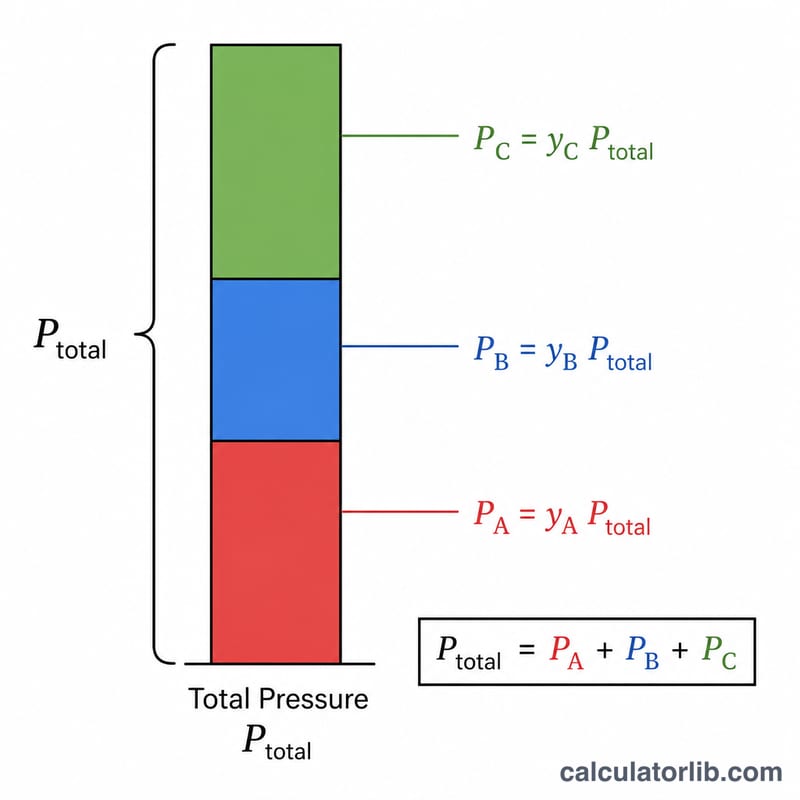
Pi = Xi × Pt
Where Pi is the partial pressure of the gas, Xi is its mole fraction (0–1), and Pt is the total pressure of the mixture. The percentage shown is simply the mole fraction multiplied by 100.
Worked Example
Suppose a gas mixture has a total pressure of 2.5 atm, and nitrogen makes up a mole fraction of 0.78. Plugging these in:
Pi = 0.78 × 2.5 = 1.95 atm
So the partial pressure of nitrogen is 1.95 atm, and it accounts for 78% of the mixture's composition.
Frequently Asked Questions
What is a mole fraction? It is the number of moles of one gas divided by the total moles of all gases in the mixture. Because it is a ratio, it always falls between 0 and 1, and all the mole fractions in a mixture add up to 1.
Can I use pressure units other than atm? The formula itself is unit-independent — your partial pressure comes out in whatever unit you enter for total pressure. This calculator labels inputs in atmospheres (atm), so for consistent results, convert other units (kPa, mmHg, bar) to atm first.
What if the mole fractions of all gases don't add up to 1? They should. If they don't, you've likely made a measurement or rounding error. Each calculated partial pressure should sum back to the total pressure you entered.