
What the Electronegativity Calculator Does
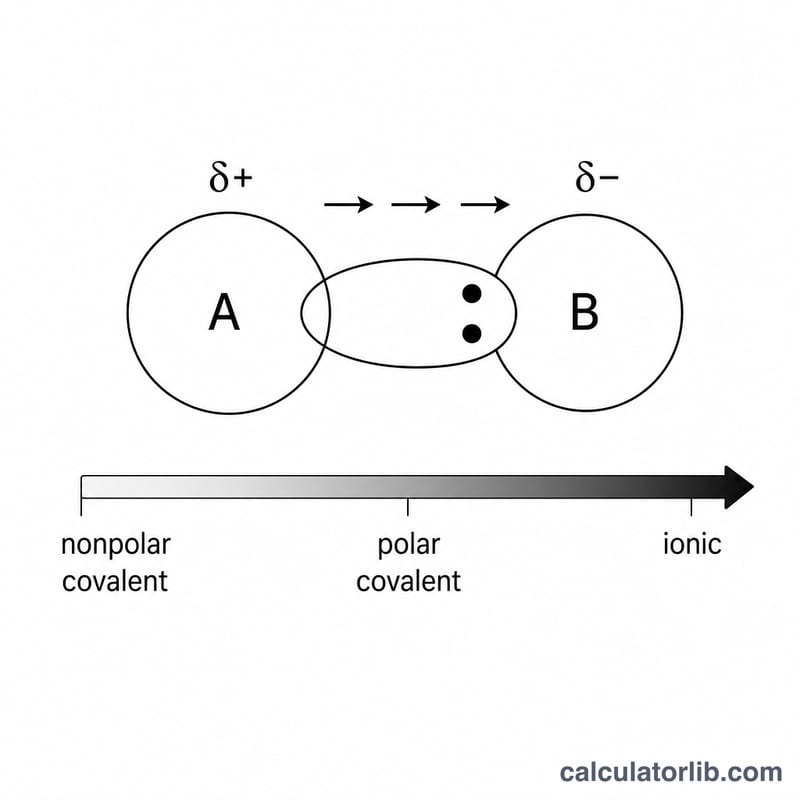
This tool compares the electronegativity of two chemical elements and predicts what kind of bond they form. Electronegativity is a measure of how strongly an atom attracts the shared electrons in a chemical bond, expressed here on the Pauling scale (where fluorine is the highest at 3.98). By calculating the difference between two atoms, you can classify a bond as nonpolar covalent, polar covalent, or ionic — a core skill in introductory chemistry.
How to Use It
The calculator has two inputs:
- Element 1 — select the first element from the dropdown.
- Element 2 — select the second element you want to bond.
The calculator supports 19 common elements (H, Li, Be, B, C, N, O, F, Na, Mg, Al, Si, P, S, Cl, K, Ca, Br, I), each with its standard Pauling electronegativity value built in.
The Formula Explained
Three calculations run automatically once you pick both elements:
- Electronegativity difference: \(\Delta\text{EN} = \left| \text{EN}_{1} - \text{EN}_{2} \right|\) (the absolute value, so order does not matter).
- Bond type: \(\Delta\text{EN}\) below 0.4 = Nonpolar Covalent; 0.4 up to 1.7 = Polar Covalent; 1.7 or higher = Ionic.
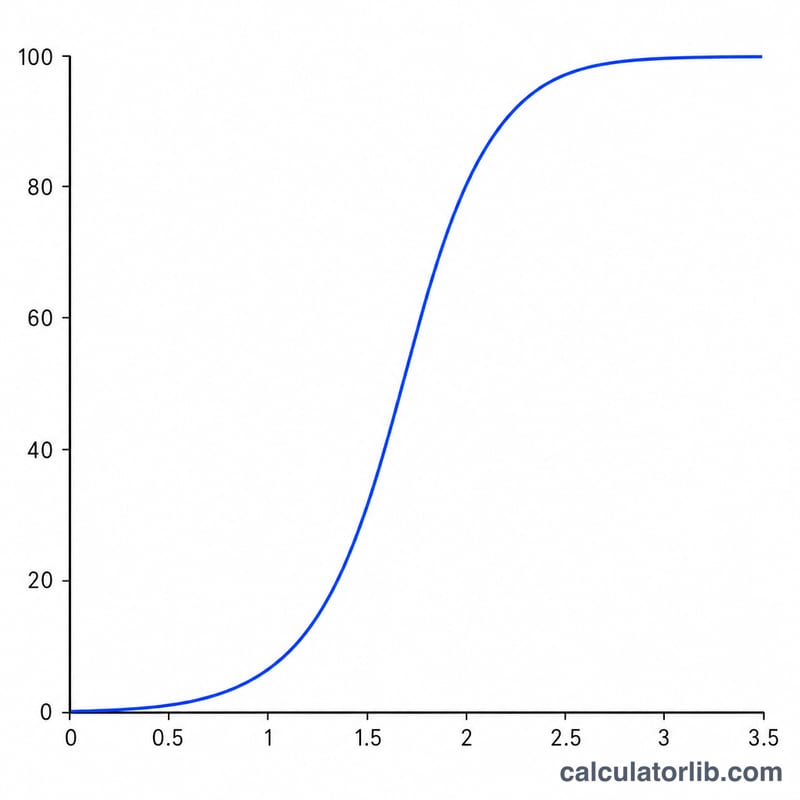
- Percent ionic character: \(\%_{\text{ionic}} = \left(1 - e^{-\left(\Delta\text{EN}/2\right)^{2}}\right)\times 100\), the Pauling estimate of how ionic the bond is.
Worked Example: Sodium and Chlorine
Choose Sodium (Na, EN = 0.93) and Chlorine (Cl, EN = 3.16).
- Difference: $$\left| 0.93 - 3.16 \right| = 2.23$$
- Since 2.23 ≥ 1.7, the bond type is Ionic.
- Percent ionic character: $$\left(1 - e^{-\left(2.23/2\right)^{2}}\right)\times 100 = \left(1 - e^{-1.243}\right)\times 100 \approx 71\%.$$
This matches reality: NaCl (table salt) is a classic ionic compound.
Frequently Asked Questions
Why does selecting two of the same element give zero? Identical atoms (like O–O) have a difference of 0, which is purely nonpolar covalent — the electrons are shared equally.
Is a 1.7 cutoff for ionic bonds exact? No. The 0.4 and 1.7 thresholds are common teaching guidelines, not hard physical laws. Many real bonds sit in a continuum, which is why the percent ionic character figure is useful.
What scale are these values on? All values use the Pauling electronegativity scale, the most widely taught system in chemistry courses worldwide.