
What Is the Molarity Calculator?
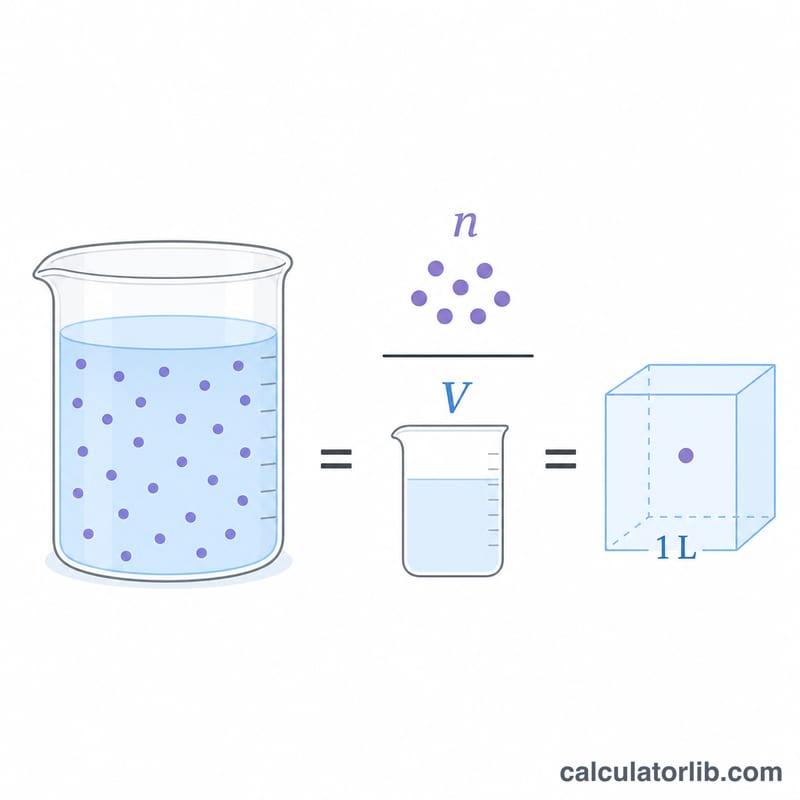
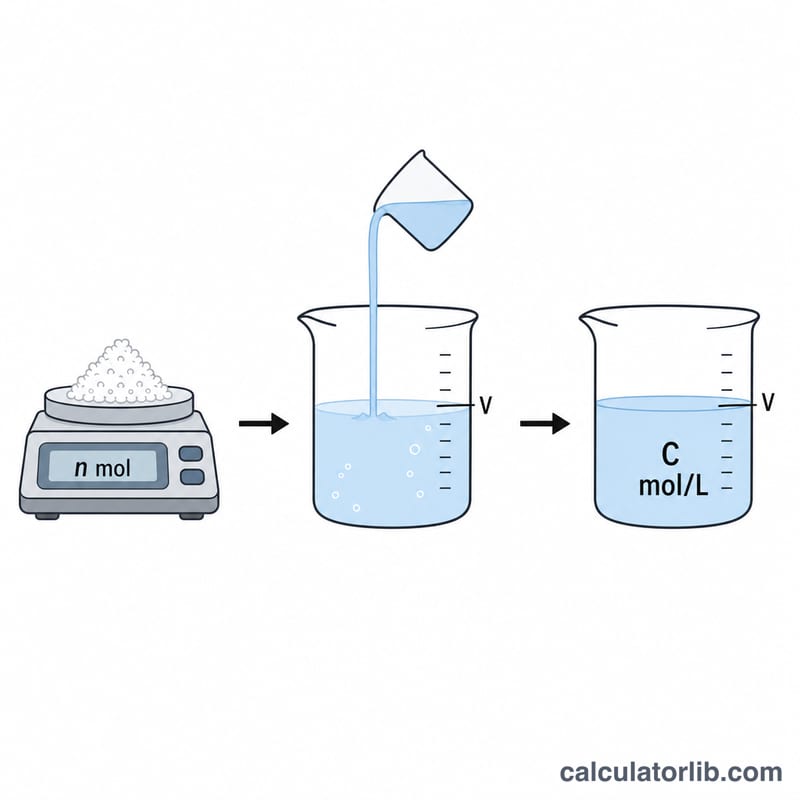
The Molarity Calculator is a quick chemistry tool that works out the molar concentration of a solution. Molarity (symbol M) is one of the most common ways chemists express concentration, and it tells you how many moles of a dissolved substance (the solute) are present in each litre of solution. This calculator takes two simple values — the amount of solute in moles and the total solution volume in litres — and instantly returns the concentration in moles per litre (mol/L).
How to Use It
You only need to fill in two input fields:
- Number of Moles: the amount of solute dissolved, measured in moles (mol).
- Volume (in litres): the total volume of the solution, measured in litres (L). If your volume is in millilitres, divide by 1000 first.
Enter both numbers and the calculator divides the moles by the volume to give the molarity. Note that the volume must be greater than zero — if you leave it at zero, the tool returns a result of 0, because dividing by zero has no meaning.
The Formula Explained
The calculation follows the standard definition of molarity:
$$M = \frac{\text{Moles (mol)}}{\text{Volume (L)}}$$
Here, moles is the quantity of solute and volume is in litres. The result is expressed in mol/L, often written simply as M. Because the formula is a straight division, doubling the moles doubles the concentration, while doubling the volume halves it.
Worked Example
Suppose you dissolve 0.5 moles of sodium chloride (table salt) in enough water to make 2 litres of solution. Plug the values in:
- Number of Moles = 0.5
- Volume = 2 litres
$$M = \frac{0.5}{2} = \mathbf{0.25 \text{ mol/L}}$$ So the solution is 0.25 M sodium chloride.
Frequently Asked Questions
What units does the result use? The concentration is in moles per litre (mol/L), which is the standard unit for molarity, abbreviated M.
Why do I get 0 when I enter a volume of zero? Division by zero is undefined, so the calculator safely returns 0 whenever the volume is not greater than zero. Always use a real, positive volume.
How do I find moles if I only know the mass? Divide the mass in grams by the molar mass (g/mol) of the substance first, then enter that result as the number of moles here.