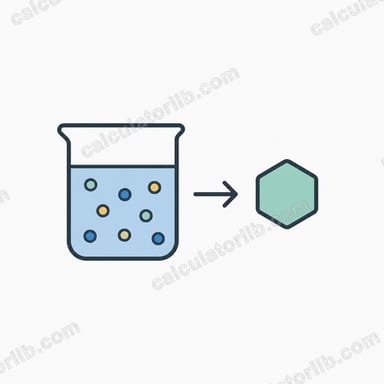

What is the % w/w to Molarity Calculator?
This tool converts a concentration expressed as percent by weight (% w/w) into molarity (mol/L, abbreviated M). Reagent bottles — concentrated acids, bases, and stock solutions — usually list strength as weight percent together with a density. To prepare molar solutions you need molarity, and this calculator bridges that gap instantly.
How to use it
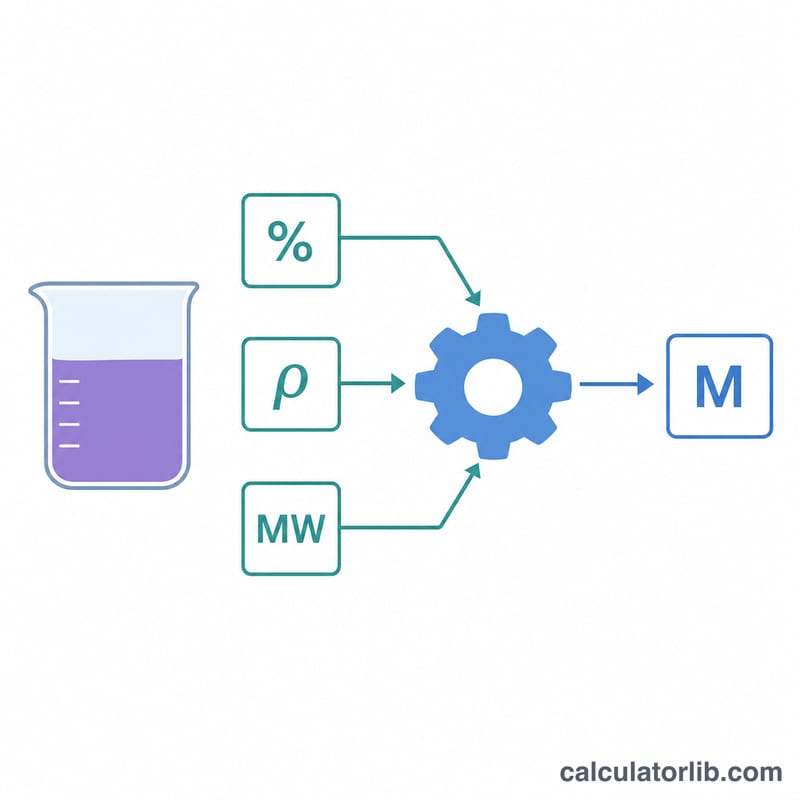
Enter three values: the concentration as a percentage by weight, the density of the solution in grams per milliliter, and the molecular (molar) mass of the dissolved compound in grams per mole. The calculator returns the molarity in mol/L.
The formula explained
The conversion is:
$$M = \frac{10 \times \%w/w \times \rho}{MW}$$
The factor of 10 arises from unit bookkeeping: % w/w is grams of solute per 100 g of solution, and density \(\rho\) (g/mL) scales that to grams per liter. Multiplying %w/w by \(\rho\) gives grams of solute per 100 mL, so \(\times 10\) converts to grams per liter. Dividing by molecular weight \(MW\) converts grams per liter to moles per liter.
Worked example
Concentrated hydrochloric acid is 37% w/w with a density of 1.19 g/mL and HCl has a molar mass of 36.46 g/mol. $$M = \frac{10 \times 37 \times 1.19}{36.46} = \frac{440.3}{36.46} \approx 12.08 \text{ M}$$ This matches the familiar ~12 M concentrated HCl.
FAQ
Why is density required? Weight percent has no volume reference. Density links the mass-based percentage to a per-liter (volume) basis needed for molarity.
What units should I use? Density in g/mL and molecular weight in g/mol. The percentage is entered as a number (e.g. 37 for 37%).
Does this work for dilute solutions? Yes, as long as you supply the correct density of the actual solution at your temperature.