What Is the Molarity to mg/mL Calculator?
This tool converts a solution's molar concentration (molarity, in mol/L or M) into a mass concentration expressed in milligrams per milliliter (mg/mL). It is a universal chemistry conversion useful for biology, biochemistry, pharmacology, and any lab where you prepare or dose solutions. All you need is the molarity and the molecular weight (molar mass) of the compound.
How to Use It
Enter the molarity in mol/L and the molecular weight in g/mol. The calculator returns the concentration in mg/mL and also in µg/mL. For example, a 0.1 M glucose solution (MW 180.16 g/mol) gives 18.016 mg/mL.
The Formula Explained
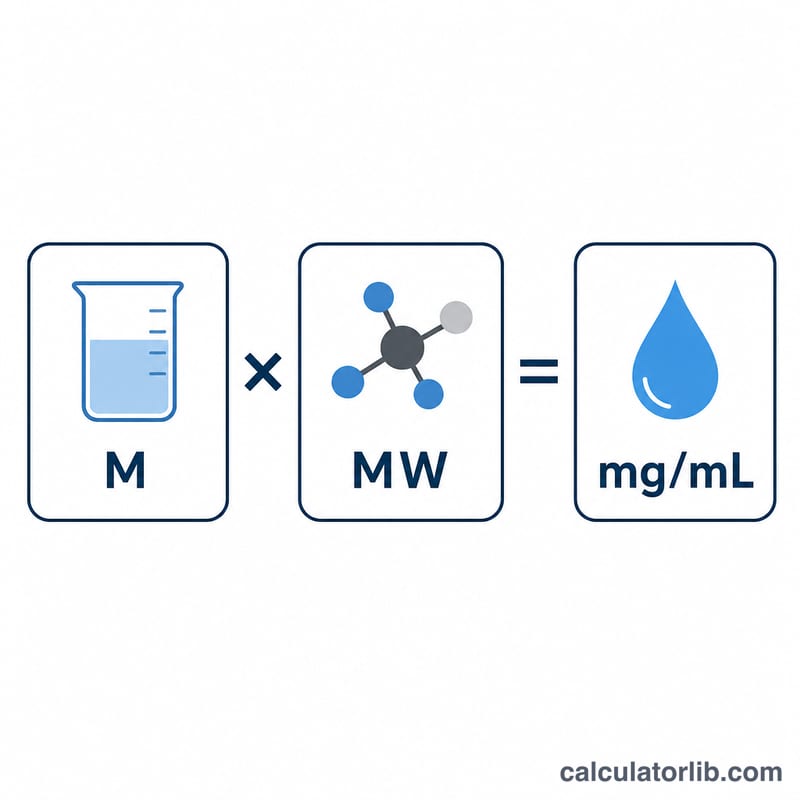
The conversion comes directly from the definition of molarity. Molarity is moles of solute per liter of solution. Multiplying by molecular weight (grams per mole) gives grams per liter:
$$\text{g/L} = \text{M} \times \text{MW}$$
Since 1 g/L equals 1 mg/mL (because grams→mg multiplies by 1000 and liters→mL divides by 1000, the factors cancel), the result simplifies to:
$$\text{mg/mL} = \text{M} \times \text{MW}$$
Worked Example
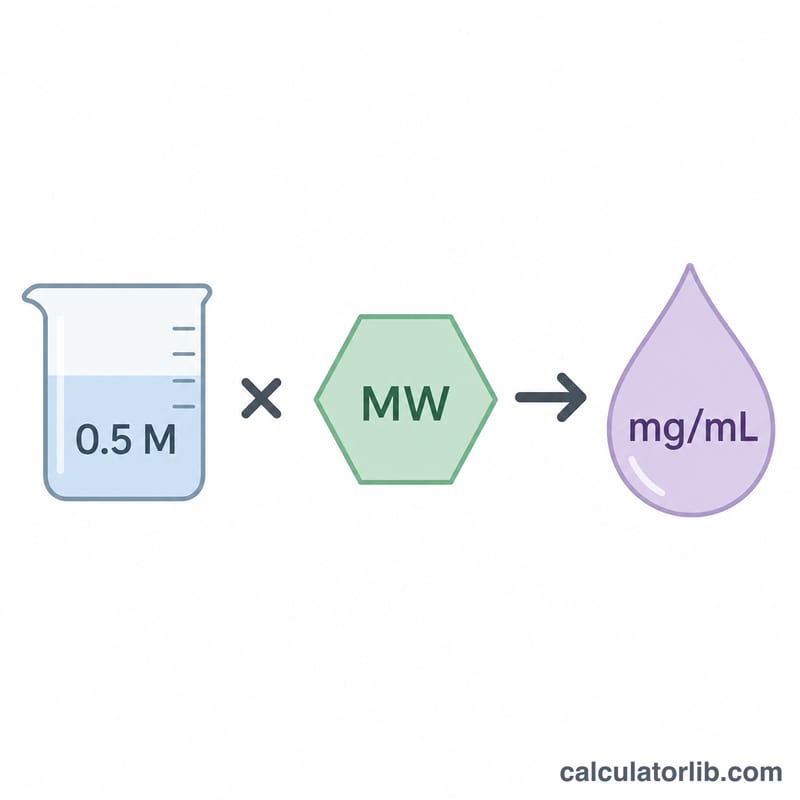
Suppose you have a 0.5 M solution of sodium chloride (NaCl), whose molecular weight is 58.44 g/mol. The concentration is $$0.5 \times 58.44 = 29.22 \text{ mg/mL},$$ or 29,220 µg/mL.
Common Molecular Weights and Molarity-to-mg/mL Values
Because molar mass in g/mol multiplied by molarity in mol/L gives g/L, and 1 g/L is exactly 1 mg/mL, the conversion is simply \(\text{mg/mL} = M \times MW\). A 1 M solution therefore has the same number of mg/mL as the molecular weight, and a 1 mM solution has one-thousandth of that.
| Compound | MW (g/mol) | 1 M (mg/mL) | 1 mM (mg/mL) |
|---|---|---|---|
| NaCl | 58.44 | 58.44 | 0.05844 |
| KCl | 74.55 | 74.55 | 0.07455 |
| Glucose | 180.16 | 180.16 | 0.18016 |
| Sucrose | 342.30 | 342.30 | 0.3423 |
| Tris base | 121.14 | 121.14 | 0.12114 |
| HEPES | 238.30 | 238.30 | 0.2383 |
| EDTA (free acid) | 292.24 | 292.24 | 0.29224 |
| NaOH | 40.00 | 40.00 | 0.04000 |
| HCl | 36.46 | 36.46 | 0.03646 |
| Tris-HCl | 157.60 | 157.60 | 0.1576 |
| Urea | 60.06 | 60.06 | 0.06006 |
| Glycine | 75.07 | 75.07 | 0.07507 |
Notes: Always use the actual molecular weight printed on your reagent label, especially for hydrates and salts, since it can differ from the values above. The table gives the mass of pure compound per mL; it does not mean every compound dissolves at 1 M (for example, free-acid EDTA dissolves poorly until the pH is raised), and concentrated liquid reagents such as stock HCl are sold as a percentage solution, not as pure compound.
Comparing Different Molarities and Molecular Weights
The first group shows how mg/mL scales with molarity for a single compound (NaCl, MW 58.44 g/mol). The second group holds molarity constant at 10 mM and varies the molecular weight.
| Compound | MW (g/mol) | Molarity | Calculation | mg/mL |
|---|---|---|---|---|
| NaCl | 58.44 | 1 mM | \(0.001 \times 58.44\) | 0.05844 |
| NaCl | 58.44 | 10 mM | \(0.01 \times 58.44\) | 0.5844 |
| NaCl | 58.44 | 100 mM | \(0.1 \times 58.44\) | 5.844 |
| NaCl | 58.44 | 1 M | \(1 \times 58.44\) | 58.44 |
| Glycine | 75.07 | 10 mM | \(0.01 \times 75.07\) | 0.7507 |
| Glucose | 180.16 | 10 mM | \(0.01 \times 180.16\) | 1.8016 |
| Sucrose | 342.30 | 10 mM | \(0.01 \times 342.30\) | 3.423 |
At the same molarity, a heavier molecule requires proportionally more mass per mL: 10 mM sucrose needs about 5.9 times the mass of 10 mM NaCl, because 342.30 / 58.44 ≈ 5.86.
Key Terms: Molarity, Molecular Weight, Mass Concentration
- Molarity (M): the amount of solute in moles per liter of solution (mol/L).
- Molecular weight / molar mass: the mass of one mole of a substance, in g/mol, found by summing the atomic masses in its formula. Strictly, molecular weight is dimensionless and molar mass has units of g/mol, but the terms are used interchangeably in the lab.
- Mass concentration: mass of solute per volume of solution. 1 mg/mL is identical to 1 g/L.
- mM and µM: millimolar is 10-3 mol/L; micromolar is 10-6 mol/L. So 1 mM = 1000 µM.
- Anhydrous vs. hydrated forms: hydrates include water molecules in the crystal, which adds to the molar mass. Using the anhydrous MW for a hydrated reagent (or the reverse) gives a wrong concentration, so check the formula weight on the label. The same applies to different salt forms, such as Tris base versus Tris-HCl.
General formula: \(\text{mg/mL} = M \times MW\), where \(M\) is in mol/L and \(MW\) in g/mol.
FAQ
Is mg/mL the same as g/L? Yes — numerically they are identical, so \(\text{M} \times \text{MW}\) gives both at once.
Where do I find molecular weight? It is the sum of atomic weights of all atoms in the molecule, listed on the chemical's datasheet or container label.
How do I go from mg/mL back to molarity? Divide the mg/mL value by the molecular weight: \(\text{M} = (\text{mg/mL}) \div \text{MW}\).