
What Is the Molarity to g/L Calculator?
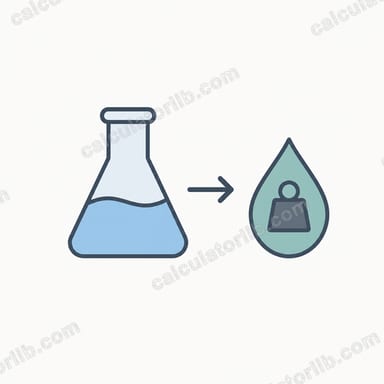
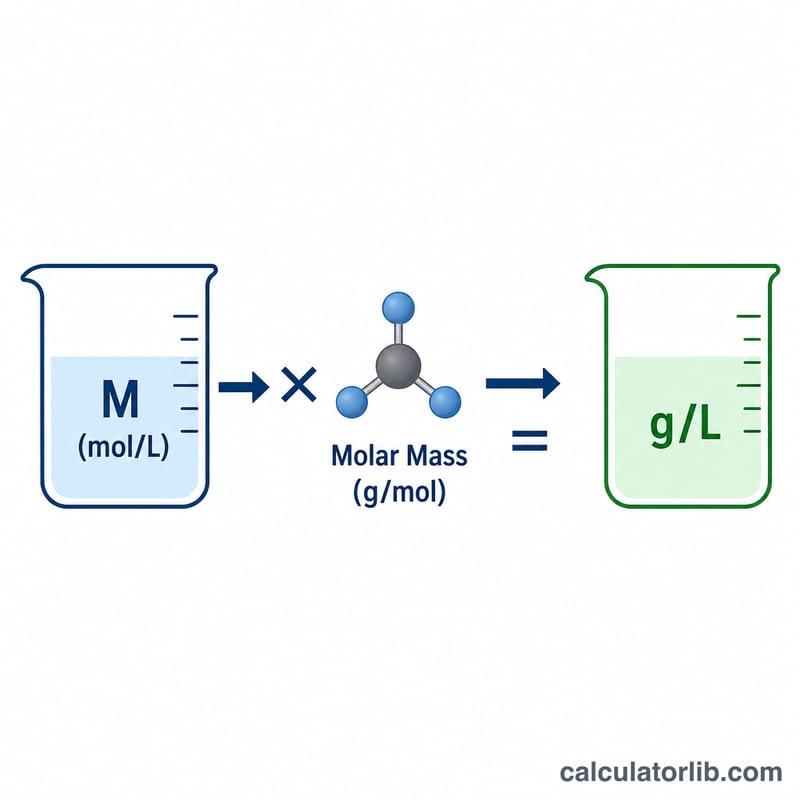
This tool converts a solution's molarity (moles per liter, mol/L) into mass concentration expressed in grams per liter (g/L). Molarity tells you how many moles of solute are dissolved in one liter of solution, while mass concentration tells you how many grams. To switch between them you only need the solute's molar mass.
How to Use It
Enter the molarity of your solution in mol/L, then enter the molar mass of the dissolved compound in g/mol (the molar mass is the sum of the atomic masses of every atom in the formula). The calculator instantly returns the concentration in grams per liter.
The Formula Explained
The conversion is a direct multiplication:
$$\text{Concentration (g/L)} = \text{Molarity (mol/L)} \times \text{Molar Mass (g/mol)}$$
Because 1 mole of a substance weighs exactly its molar mass in grams, multiplying the number of moles per liter by the grams-per-mole gives grams per liter. The units cancel cleanly: \((\text{mol/L}) \times (\text{g/mol}) = \text{g/L}\).
Worked Example
Suppose you have a 0.5 mol/L solution of sodium chloride (NaCl). The molar mass of NaCl is about 58.44 g/mol. Then:
$$\text{g/L} = 0.5 \times 58.44 = 29.22 \text{ g/L}$$
So each liter of that solution contains 29.22 grams of NaCl.
FAQ
Where do I find the molar mass? Add up the atomic masses (from the periodic table) of every atom in the chemical formula. For example, water (H₂O) = \(2(1.008) + 16.00 \approx 18.02\) g/mol.
How do I convert g/L back to molarity? Divide the mass concentration by the molar mass: \(M = (\text{g/L}) \div \text{molar mass}\).
Does temperature matter? Molarity is defined per liter of solution and can vary slightly with temperature because volume changes, but for most lab work this conversion is treated as temperature-independent.