
What Is the mg/L to Molarity Calculator?
This calculator converts a mass concentration expressed in milligrams per liter (mg/L) into a molar concentration, or molarity, expressed in moles per liter (mol/L, also written M). It is widely used in chemistry, biology, environmental science, and pharmacology where measured concentrations are often reported as mg/L (equivalent to parts per million in dilute water solutions) but reactions and calculations require molarity.
How to Use It
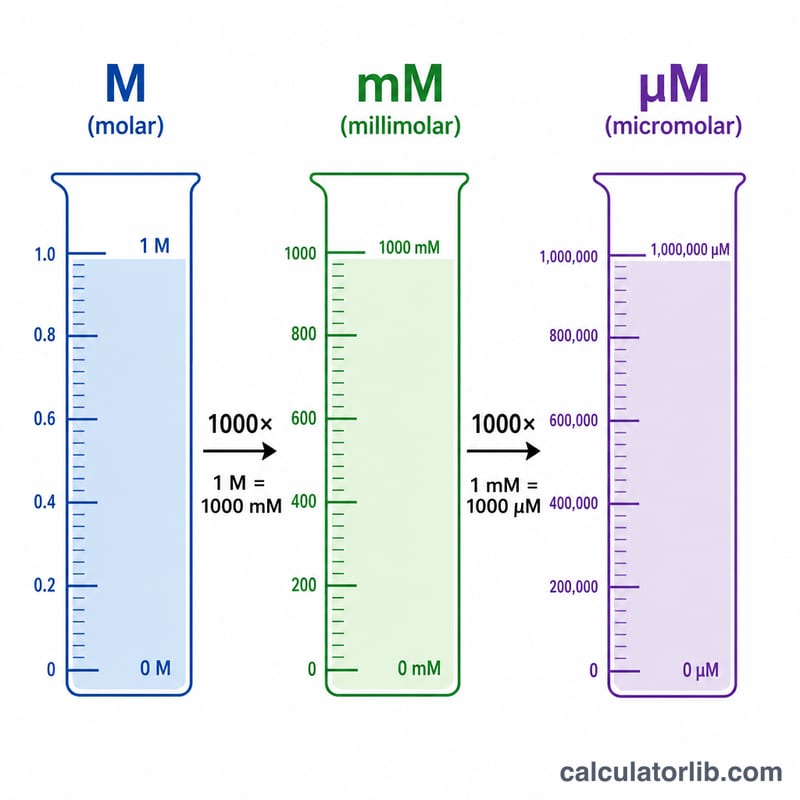
Enter two values: the concentration in mg/L and the molar mass (molecular weight) of the substance in grams per mole (g/mol). The calculator returns the molarity in mol/L, along with convenient millimolar (mM) and micromolar (µM) equivalents.
The Formula Explained
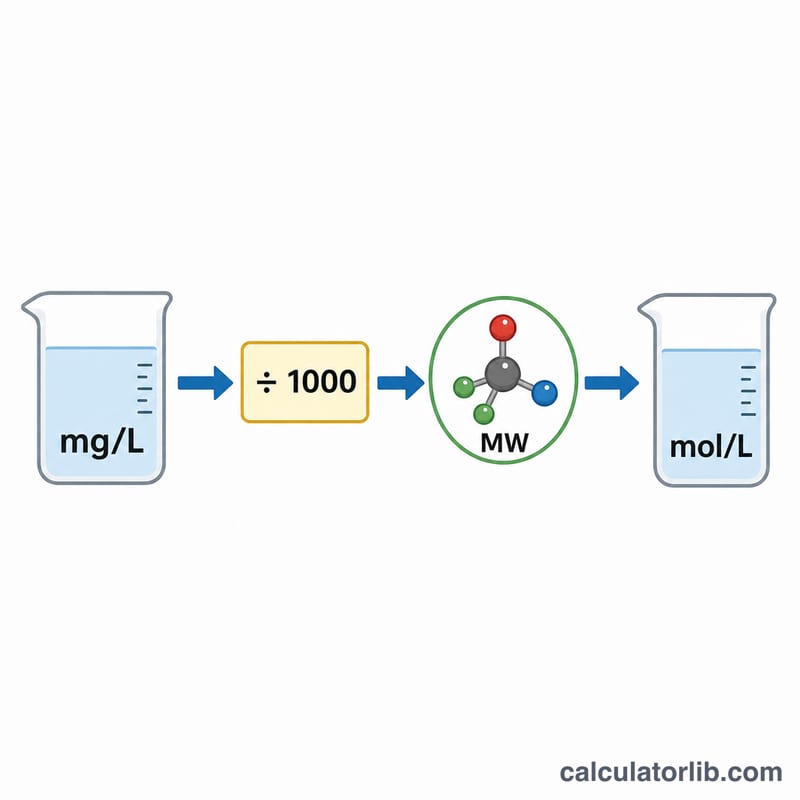
The conversion is based on the definition of molarity: moles of solute per liter of solution. Since 1 mg = 0.001 g, dividing the mg/L value by 1000 converts it to g/L. Dividing by the molar mass (g/mol) then yields mol/L:
$$\text{M} = \frac{\text{mg/L}}{1000 \times \text{MW}}$$
Worked Example
Suppose you have a sodium chloride (NaCl) solution at 100 mg/L. The molar mass of NaCl is 58.44 g/mol. Then $$\text{M} = \frac{100}{1000 \times 58.44} = \frac{100}{58440} \approx 0.001711 \text{ mol/L},$$ or about 1.711 mM. This means each liter contains roughly 1.711 millimoles of NaCl.
FAQ
Is mg/L the same as ppm? In dilute aqueous solutions where density ≈ 1 g/mL, mg/L is numerically equal to ppm (mg per kg).
What molar mass should I use? Use the molecular weight of the exact compound, including water of hydration if applicable, in g/mol.
How do I go back from molarity to mg/L? Multiply molarity by 1000 and by the molar mass: \(\text{mg/L} = \text{M} \times 1000 \times \text{MW}\).