
What This Calculator Does
This tool converts the molar concentration (molarity, in mol/L) of a strong acid or strong base into a pH value. Strong acids (such as HCl, HNO₃, H₂SO₄) and strong bases (such as NaOH, KOH) dissociate completely in water, so the concentration of the solution directly equals the concentration of H⁺ or OH⁻ ions, making the pH straightforward to compute.
How to Use It
Select whether your solution is a strong acid or a strong base, then enter the molar concentration in mol/L. The calculator returns the pH (and the complementary pOH). For acids, a higher concentration gives a lower pH; for bases, a higher concentration gives a higher pH.
The Formula Explained
For a strong acid, the hydrogen-ion concentration equals the molarity, so:
$$\text{pH} = -\log_{10}\left(\text{Concentration (mol/L)}\right)$$
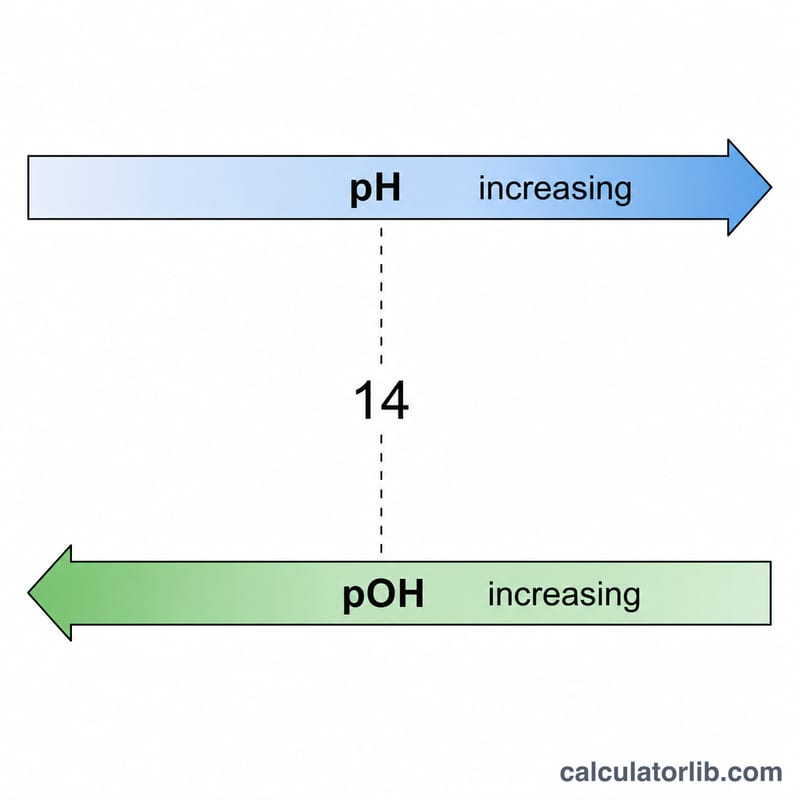
For a strong base, the hydroxide concentration equals the molarity. First find \(\text{pOH} = -\log_{10}(M)\), then use the water relationship \(\text{pH} + \text{pOH} = 14\):
$$\text{pH} = 14 + \log_{10}(M) = 14 - \text{pOH}$$
These relations assume 25 °C, complete dissociation, and ideal dilute behavior.
Worked Example
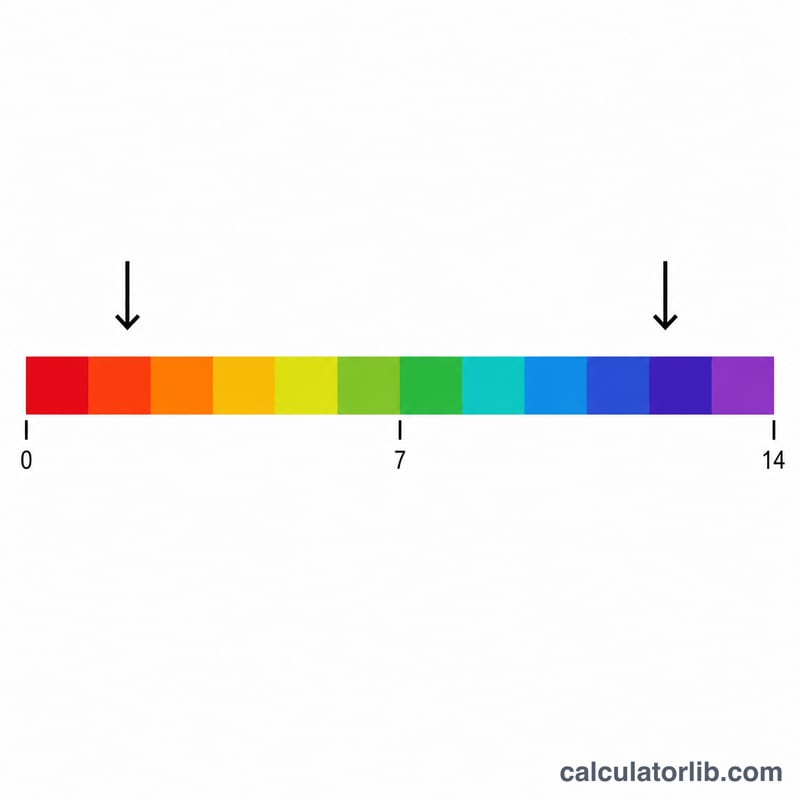
A 0.01 mol/L solution of HCl (a strong acid): $$\text{pH} = -\log_{10}(0.01) = -(-2) = 2$$ For a 0.01 mol/L solution of NaOH (a strong base): \(\text{pOH} = -\log_{10}(0.01) = 2\), so \(\text{pH} = 14 - 2 = 12\).
FAQ
Does this work for weak acids or bases? No. Weak acids and bases only partially dissociate, so their pH depends on an acid/base dissociation constant (Ka or Kb) and requires an equilibrium calculation.
Why might pH go below 0 or above 14? At very high concentrations the simple log formula can give values outside 0–14. Such values are mathematically valid but should be interpreted with caution since activity effects become significant.
What about diprotic acids like H₂SO₄? Multiply the molarity by the number of acidic protons fully released to get the effective H⁺ concentration before applying the formula.