
What this calculator does
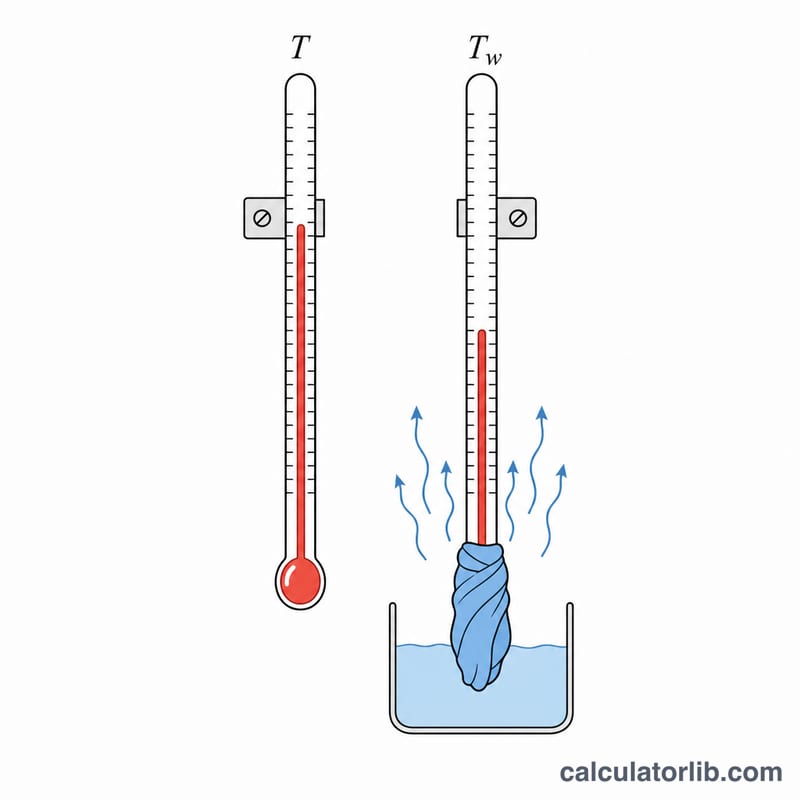
A psychrometer uses two thermometers — a dry bulb that measures the ordinary air temperature and a wet bulb wrapped in a moist wick. Evaporation from the wick cools the wet bulb, and the size of that cooling depends on how dry the air is. This calculator converts those two readings into relative humidity (RH), the percentage of moisture the air holds relative to the maximum it could hold at the dry-bulb temperature.
How to use it
Enter the dry-bulb temperature, the wet-bulb temperature (always equal to or lower than the dry bulb), and the local atmospheric pressure in hectopascals (sea-level standard is 1013.25 hPa). The tool returns the relative humidity along with the saturation vapour pressures and the actual vapour pressure of the air.
The formula explained
The result uses the psychrometric equation:
$$RH = 100 \times \frac{e_{s}(T_w) - A \cdot P \cdot (T - T_w)}{e_{s}(T)}$$
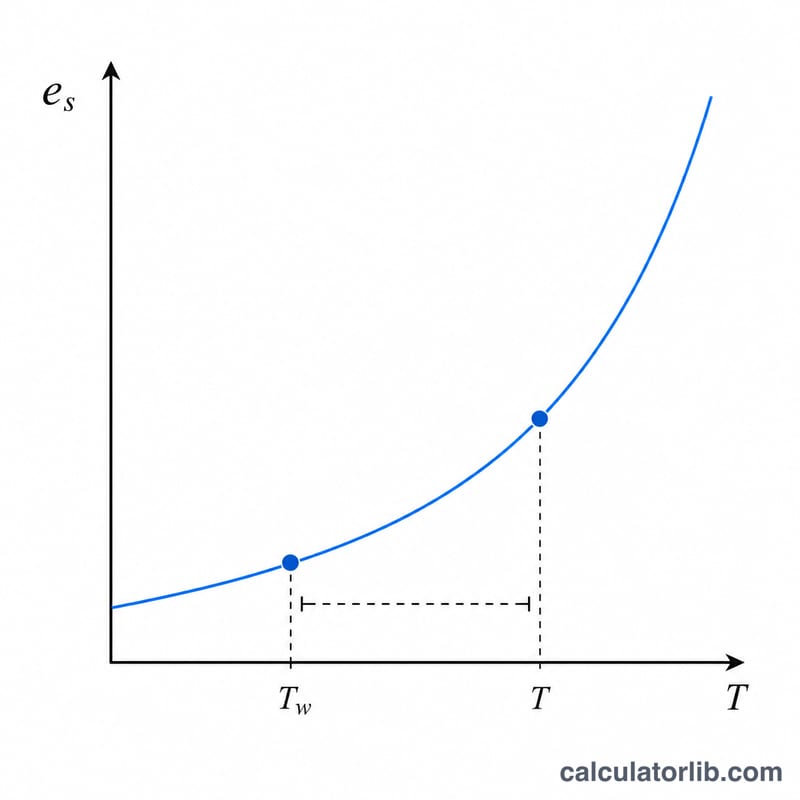
where \(T\) is the dry-bulb temperature, \(T_w\) the wet-bulb temperature, \(P\) the pressure, and \(A \approx 0.000662\ \text{°C}^{-1}\) the psychrometer constant. The saturation vapour pressure \(e_{s}\) at any temperature \(t\) (°C) comes from the Magnus–Tetens relation $$e_{s}(t) = 6.112 \cdot \exp\!\left(\frac{17.67 \cdot t}{t + 243.5}\right)$$ in hPa.
Worked example
For \(T = 25\,\text{°C}\), \(T_w = 18\,\text{°C}\), \(P = 1013.25\,\text{hPa}\): \(e_{s}(25) \approx 31.67\,\text{hPa}\) and \(e_{s}(18) \approx 20.62\,\text{hPa}\). The actual vapour pressure $$e = 20.62 - 0.000662 \times 1013.25 \times (25 - 18) \approx 20.62 - 4.70 = 15.93\,\text{hPa}.$$ So $$RH = 100 \times \frac{15.93}{31.67} \approx 50.3\%.$$
FAQ
Why must the wet bulb be cooler? Evaporation removes heat, so unless the air is fully saturated the wet bulb always reads lower; if the readings are equal, RH is 100%.
What pressure should I enter? Use your local station pressure if known; otherwise the standard 1013.25 hPa is a good approximation near sea level.
How accurate is it? The psychrometer constant assumes a properly ventilated (aspirated) wet bulb; poor airflow can bias results, so results are accurate to a few percent in normal conditions.