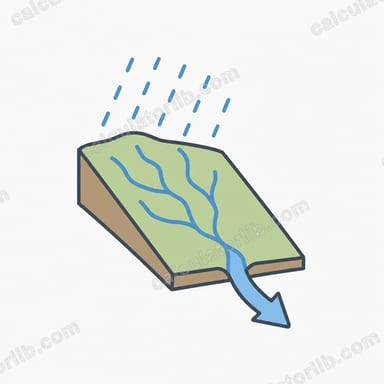

What the Rainfall Calculator Does
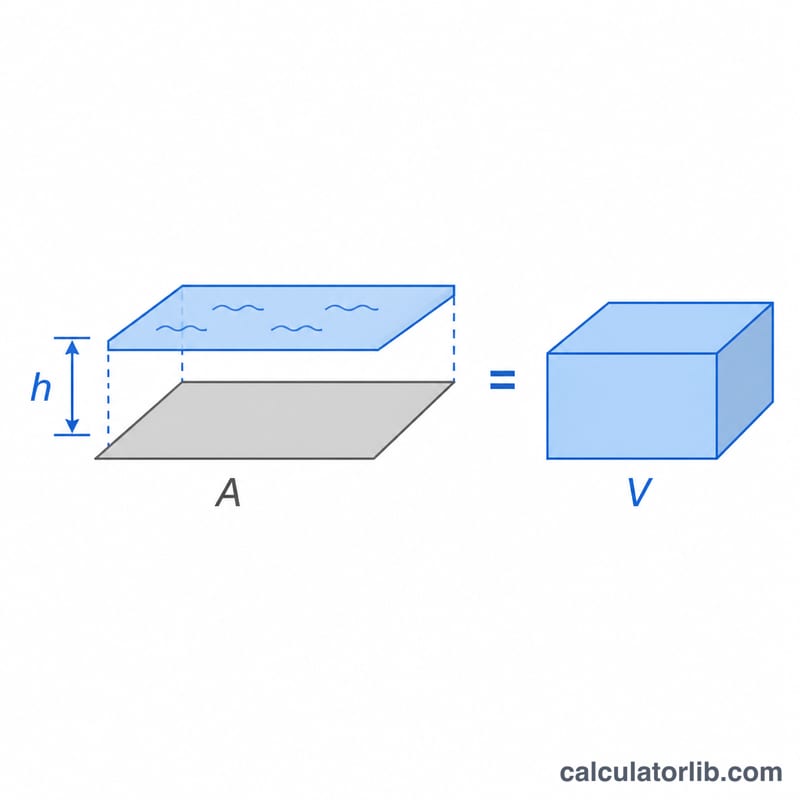
This Rainfall Calculator estimates how much water you can collect from a surface during a rain event. You enter two values — the rainfall amount in millimetres (mm) and the catchment area in square metres (m²) — and it returns the collected water volume in cubic metres (m³), along with the equivalent volume in litres. It uses metric (SI) units, so it works anywhere rainfall is reported in millimetres, which is most of the world outside the United States.

The Inputs Explained
- Rainfall Amount (mm): The depth of rain that falls, as reported by a weather station, forecast, or rain gauge. One millimetre of rain means one litre falls on every square metre.
- Catchment Area (m²): The flat (plan) area of the surface collecting the rain — for example, a roof footprint, a paved yard, or a field. Use the horizontal projected area, not the sloped surface area.
The Formula
The calculator applies a simple, exact relationship:
$$V = \frac{\text{Rainfall (mm)} \times \text{Area (m}^2\text{)}}{1000}$$
The division by 1000 converts millimetres to metres so the units line up to cubic metres. To express the result in litres, the tool multiplies the volume by 1000:
$$\text{Litres} = \text{Volume (m}^3\text{)} \times 1000 = \text{Rainfall (mm)} \times \text{Area (m}^2\text{)}$$
That means a quick mental shortcut: litres of water equals rainfall in mm multiplied by area in m².
Worked Example
Suppose 25 mm of rain falls on a roof with a footprint of 80 m².
- $$\text{Volume} = \frac{25 \times 80}{1000} = \frac{2000}{1000} = \mathbf{2 \text{ m}^3}$$
- $$\text{Litres} = 2 \times 1000 = \mathbf{2000 \text{ litres}}$$
So a single 25 mm downpour could fill a 2,000-litre tank from that roof.
Frequently Asked Questions
Does the calculator account for losses? No. It gives the theoretical maximum. In practice, evaporation, splash, first-flush diversion, and gutter overflow reduce real collection, so multiply the result by a runoff coefficient (typically 0.8–0.9 for a good roof) for a realistic figure.
What if I only know rainfall in centimetres or inches? Convert first: \(1 \text{ cm} = 10 \text{ mm}\), and \(1 \text{ inch} = 25.4 \text{ mm}\). Enter the converted millimetre value.
Should I use sloped roof area? No — use the horizontal footprint (the area seen from directly above). The slope does not increase the rain captured, since rain falls vertically.