What This Calculator Does
The Torque to Horsepower Calculator converts an engine's rotational force (torque) at a given speed into power output, expressed in both horsepower (hp) and kilowatts (kW). It works with the two most common torque units worldwide — pound-feet (lb-ft), typical in the United States and the UK, and newton-metres (N-m), used across most metric countries. Whether you are tuning an engine, comparing dyno results, or studying for a mechanics exam, this tool gives you a quick, accurate power figure from torque and RPM.
The Inputs You Enter
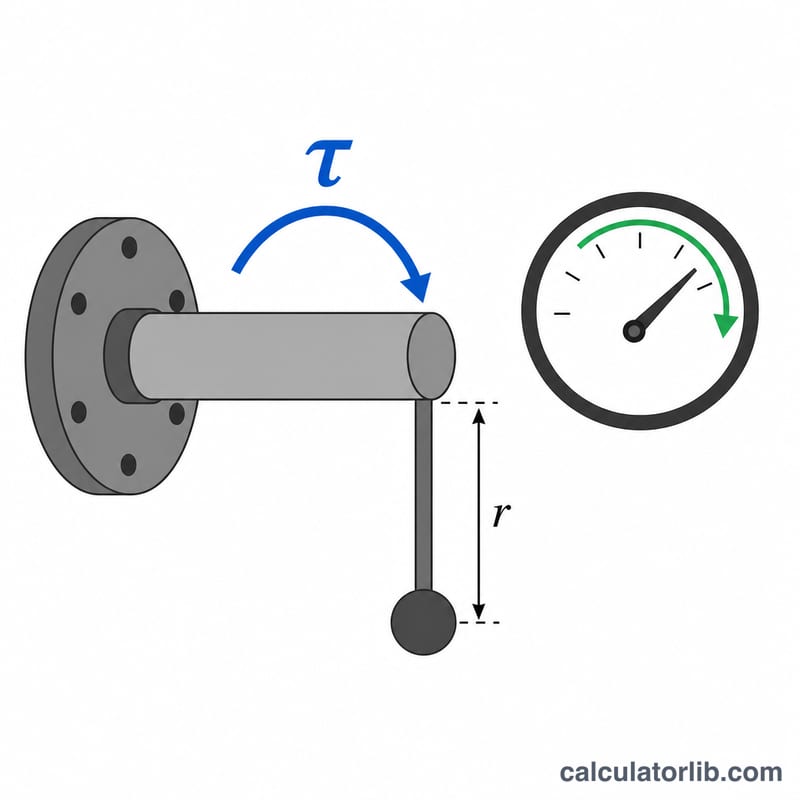
- Torque — the twisting force your engine produces, measured at a specific speed.
- Engine Speed (RPM) — revolutions per minute at which that torque is measured.
- Torque Unit — choose lb-ft or N-m; the calculator applies the correct constant for whichever you select.
The Formula Explained
For pound-feet, the calculator uses the classic relationship:
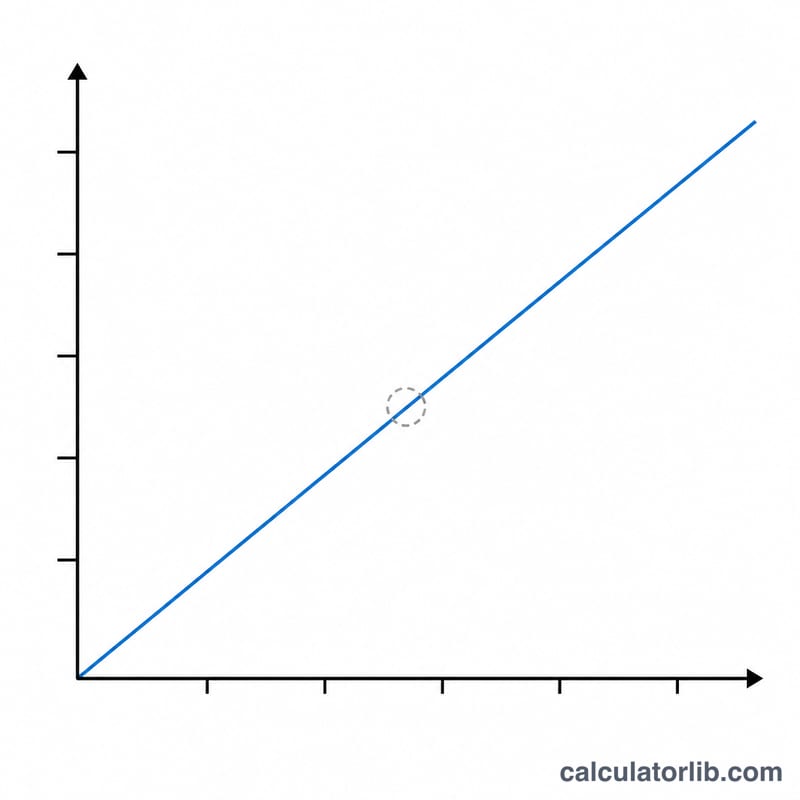
$$\text{HP} = \frac{\text{Torque (lb-ft)} \times \text{RPM}}{5252}$$The number 5252 comes from dividing the conversion between work and power (33,000 ft-lb/min per hp) by \(2\pi\). It is also why torque and horsepower curves cross at 5252 RPM on a dyno chart that plots lb-ft and hp on the same scale (plotted in N·m and kW, they cross at about 9549 RPM).
When you select N-m, the tool divides by 7120.91 instead, which is the equivalent constant for metric torque. Finally, the result is converted to kilowatts by multiplying horsepower by 0.7457.
Worked Example
Suppose your engine produces 300 lb-ft of torque at 4000 RPM:
- $$\text{Horsepower} = \frac{300 \times 4000}{5252} = 228.5 \text{ hp}$$
- $$\text{Kilowatts} = 228.5 \times 0.7457 = 170.4 \text{ kW}$$
If you had entered 407 N-m (the same torque in metric) at 4000 RPM, dividing by 7120.91 gives roughly the same 228 hp.
Torque and Power Unit Conversion Table
Torque and power are reported in different units depending on the market: pound-feet (lb-ft) and mechanical horsepower (hp) are standard in the United States and, historically, the United Kingdom, while newton-metres (N·m) and kilowatts (kW) are the SI units used in European type-approval and most of the rest of the world. "PS" (Pferdestärke, metric horsepower, also written CV or ch) is the traditional metric power unit still quoted in Germany, Japan and much of continental Europe — it is not the same as mechanical horsepower. The factors below are exact-to-the-digits shown conversions.
| Quantity | From | To | Multiply by | Worked example |
|---|---|---|---|---|
| Torque | 1 lb-ft | N·m | 1.355818 | 300 lb-ft × 1.355818 = 406.7 N·m |
| Torque | 1 N·m | lb-ft | 0.737562 | 500 N·m × 0.737562 = 368.8 lb-ft |
| Torque | 1 kgf·m | N·m | 9.80665 | 40 kgf·m = 392.3 N·m |
| Torque | 1 kgf·m | lb-ft | 7.23301 | 40 kgf·m = 289.3 lb-ft |
| Power | 1 hp (mechanical) | kW | 0.745700 | 300 hp × 0.7457 = 223.7 kW |
| Power | 1 kW | hp (mechanical) | 1.341022 | 150 kW × 1.341022 = 201.2 hp |
| Power | 1 PS (metric hp) | hp (mechanical) | 0.98632 | 200 PS × 0.98632 = 197.3 hp |
| Power | 1 PS (metric hp) | kW | 0.735499 | 200 PS × 0.735499 = 147.1 kW |
| Power | 1 kW | PS (metric hp) | 1.35962 | 150 kW × 1.35962 = 203.9 PS |
Because both sides of the power equation scale linearly, the same conversions can be applied before or after the calculation. Converting 300 lb-ft to 406.7 N·m and then computing power in kW gives exactly the same physical result as computing hp first and multiplying by 0.7457 — the difference will only ever be in the last displayed decimal.
Torque, RPM and Power: Scenario Comparison
Power is torque and speed together, which is why a heavy-duty diesel with three times the torque of a sports car can end up making similar horsepower, and why a motorcycle with modest torque still produces a lot of power. Every row below is computed with the same formula, \(\text{hp} = (T \times \text{RPM}) \div 5252.113\), then converted to kW with the 0.7457 factor. Figures are representative of each engine class rather than any specific model.
| Engine / scenario | Torque (lb-ft) | Torque (N·m) | Engine speed (rpm) | Power (hp) | Power (kW) |
|---|---|---|---|---|---|
| Heavy-duty truck diesel | 1,000 | 1,355.8 | 1,600 | 304.6 | 227.2 |
| Small turbocharged petrol car | 200 | 271.2 | 5,000 | 190.4 | 142.0 |
| Litre-class sport bike | 80 | 108.5 | 11,000 | 167.6 | 125.0 |
| Naturally aspirated V8 (crossover point) | 400 | 542.3 | 5,252 | 400.0 | 298.3 |
| Electric traction motor | 250 | 339.0 | 3,000 | 142.8 | 106.5 |
Row-by-row substitution
- Truck diesel: \(\dfrac{1000 \times 1600}{5252.113} = \dfrac{1{,}600{,}000}{5252.113} = 304.6\) hp
- Turbo car: \(\dfrac{200 \times 5000}{5252.113} = \dfrac{1{,}000{,}000}{5252.113} = 190.4\) hp
- Sport bike: \(\dfrac{80 \times 11000}{5252.113} = \dfrac{880{,}000}{5252.113} = 167.6\) hp
- V8 at 5,252 rpm: \(\dfrac{400 \times 5252}{5252.113} = 400.0\) hp — torque and power are numerically identical at this speed
- Electric motor: \(\dfrac{250 \times 3000}{5252.113} = \dfrac{750{,}000}{5252.113} = 142.8\) hp
How to read the comparison
- Below 5,252 rpm, torque exceeds horsepower numerically; above it, horsepower exceeds torque. The truck diesel makes 1,000 lb-ft but only 305 hp because it turns slowly; the bike makes 80 lb-ft but 168 hp because it revs almost seven times faster.
- Peak torque and peak power rarely occur at the same speed. A single calculation gives power at one operating point, not the engine's rated maximum — that is the highest value of the curve across the whole rev range.
- Gearing multiplies torque, not power. Wheel torque can be many times crank torque, but power (minus driveline losses) is what stays constant, which is why power determines acceleration and top speed.
- Electric motors deliver near-peak torque from zero rpm, so a modest 250 lb-ft available instantly can feel stronger from a standstill than a petrol engine that must rev to reach its peak.
- These are crankshaft (gross) figures. Chassis-dyno numbers measured at the wheels are typically lower because of transmission and driveline losses; the exact deduction depends on the drivetrain and cannot be assumed.
Frequently Asked Questions
Why is the constant always 5252? It is fixed by the definition of horsepower and the math of converting rotational torque into power. Because of it, horsepower and torque are equal at 5252 RPM for any engine measured in lb-ft.
Does more torque always mean more horsepower? Not necessarily. Horsepower depends on both torque and RPM. A high-torque engine spinning slowly can make less power than a lower-torque engine that revs higher.
Can I convert horsepower back to torque? Yes — rearrange the formula: \(\text{Torque} = \frac{\text{Horsepower} \times 5252}{\text{RPM}}\) for lb-ft. This calculator focuses on the torque-to-power direction with automatic kW output.