What the QUICKI Calculator Does
QUICKI stands for Quantitative Insulin Sensitivity Check Index. It is a simple mathematical index used by researchers and clinicians (globally, with reference ranges based on US/international studies reported in µIU/mL and mg/dL) to estimate how sensitive your body is to insulin from a single fasting blood sample. This calculator turns two routine lab values into one easy-to-read number, then tells you whether your result suggests high, normal, or low insulin sensitivity.
The Two Inputs You Need
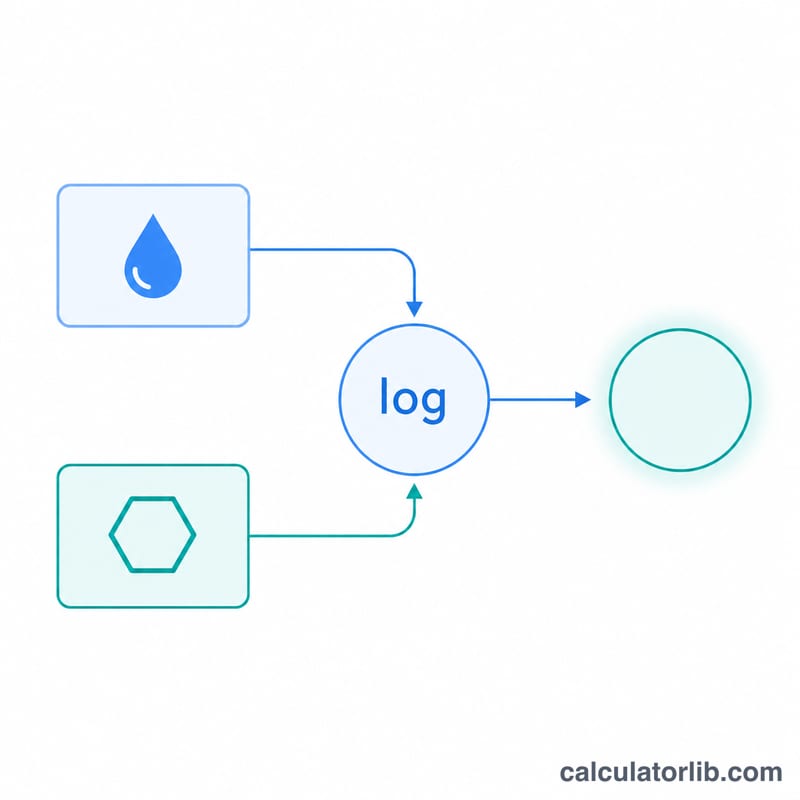
- Fasting Insulin (µIU/mL) — your insulin level after at least 8 hours without eating.
- Fasting Glucose (mg/dL) — your blood sugar measured at the same fasting time.
Both values must come from a true fasting sample for the result to be meaningful. The calculator does not require weight, age, or any other field — just these two numbers.
The Formula Explained
QUICKI is calculated from the base-10 logarithms of your two values:
$$\text{QUICKI} = \frac{1}{\log_{10}\!\left(\text{Fasting Insulin}\right) + \log_{10}\!\left(\text{Fasting Glucose}\right)}$$
Because the logarithms sit in the denominator, higher insulin and glucose levels produce a larger denominator and therefore a lower QUICKI — which signals poorer insulin sensitivity. A higher QUICKI score means better sensitivity.
The calculator then interprets the result:
- Above 0.45 — High insulin sensitivity
- 0.38 to 0.45 — Normal insulin sensitivity
- Below 0.38 — Low insulin sensitivity (insulin resistance)
Worked Example
Suppose your fasting insulin is 10 µIU/mL and your fasting glucose is 90 mg/dL.
- \(\log_{10}(10) = 1.000\)
- \(\log_{10}(90) = 1.954\)
- Sum = 2.954
- $$\text{QUICKI} = \frac{1}{2.954} = 0.339$$
A QUICKI of 0.339 falls below 0.38, so this result would be flagged as low insulin sensitivity (insulin resistance).
Unit Conversion Table (SI ↔ Conventional)
The QUICKI formula uses conventional units: fasting insulin in µIU/mL (equivalent to mU/L) and fasting glucose in mg/dL. Many lab reports outside the United States use SI units (glucose in mmol/L, insulin in pmol/L), so convert before entering values.
| Analyte | SI → Conventional | Conventional → SI |
|---|---|---|
| Glucose | mg/dL = mmol/L × 18.0 | mmol/L = mg/dL ÷ 18.0 |
| Insulin | µIU/mL = pmol/L ÷ 6.0 | pmol/L = µIU/mL × 6.0 |
Worked examples:
- Glucose 5.0 mmol/L × 18.0 = 90 mg/dL
- Glucose 6.1 mmol/L × 18.0 ≈ 110 mg/dL
- Insulin 60 pmol/L ÷ 6.0 = 10.0 µIU/mL
- Insulin 10 µIU/mL × 6.0 = 60 pmol/L
Note: µIU/mL and mU/L are numerically identical for insulin, so no conversion is needed between those two labels.
Interpreting Your QUICKI Score
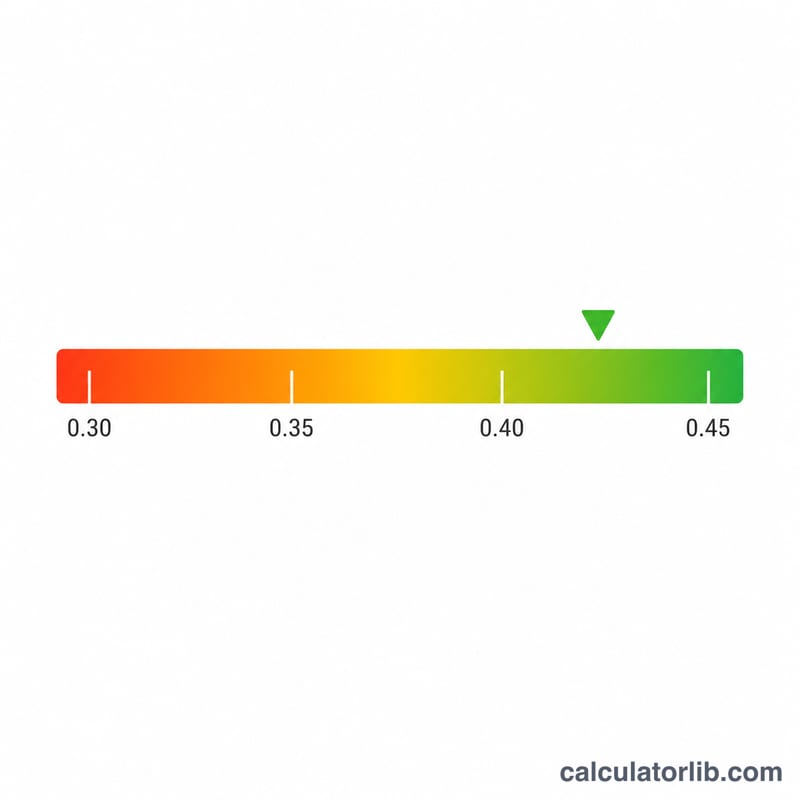
QUICKI (Quantitative Insulin Sensitivity Check Index) transforms fasting insulin and glucose onto a log scale so that higher values indicate greater insulin sensitivity and lower values indicate insulin resistance. Because both inputs sit inside a logarithm and reciprocal, the index compresses into a narrow range — most adults fall between roughly 0.30 and 0.45.
| Approximate QUICKI | Interpretation |
|---|---|
| ≥ 0.45 | High insulin sensitivity (typical of lean, healthy individuals) |
| 0.34 – 0.44 | Normal insulin sensitivity |
| 0.30 – 0.33 | Reduced sensitivity / insulin resistance (often seen with obesity) |
| ≤ 0.30 | Marked insulin resistance (frequently reported in type 2 diabetes) |
What the numbers mean physiologically. A high QUICKI means the pancreas keeps glucose controlled with relatively little circulating insulin — the tissues respond efficiently. As insulin resistance develops, the body compensates by secreting more insulin to hold glucose steady; fasting insulin rises (and eventually glucose too), and QUICKI falls. Published studies place healthy non-diabetic adults near 0.38–0.45, obese non-diabetic adults near 0.33, and people with type 2 diabetes near 0.30 or lower.
Screening index, not a diagnosis. QUICKI is a validated fasting surrogate that correlates well with the gold-standard hyperinsulinemic-euglycemic clamp, but it is only an estimate. It cannot diagnose diabetes, prediabetes, or metabolic syndrome. A low score should prompt a conversation with a clinician and confirmatory testing (fasting glucose, HbA1c, or an oral glucose tolerance test) rather than self-treatment. This is general educational information, not medical advice.
Frequently Asked Questions
Is QUICKI the same as HOMA-IR? No. Both use fasting insulin and glucose, but QUICKI uses logarithms and yields a single sensitivity index, while HOMA-IR estimates resistance differently. QUICKI is often considered more linearly correlated with clamp studies.
Why do my units matter? This calculator expects insulin in µIU/mL and glucose in mg/dL. Using mmol/L for glucose or pmol/L for insulin will give an incorrect score, so convert first if your lab reports different units.
Can QUICKI diagnose diabetes? No. It is a screening and research estimate of insulin sensitivity, not a diagnostic test. Discuss any concerning result with your healthcare provider.
Related calculators
- HOMA-IR Calculator — insulin resistance from fasting glucose & insulin.
- eGFR Calculator — kidney function from creatinine.
- BMI Calculator — body mass index from height & weight.