
What is the eGFR Calculator?
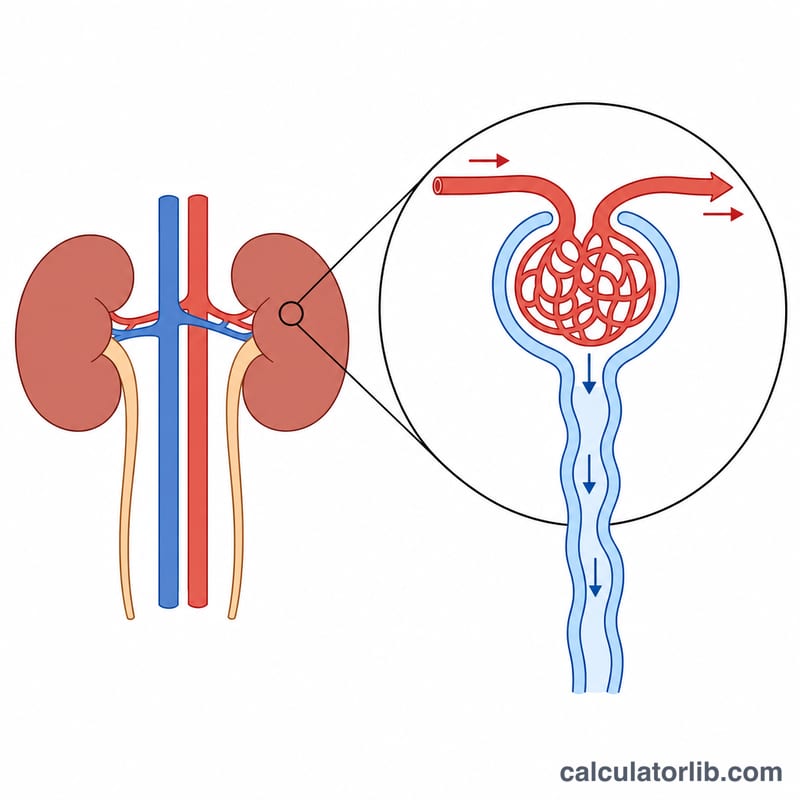
The estimated glomerular filtration rate (eGFR) is the single most useful number for assessing how well the kidneys are filtering blood. This tool uses the 2021 CKD-EPI creatinine equation, the race-free formula recommended by the National Kidney Foundation and the American Society of Nephrology. It estimates eGFR in mL/min/1.73 m² from a routine serum creatinine result together with age and sex — no race coefficient is used.
How to use it
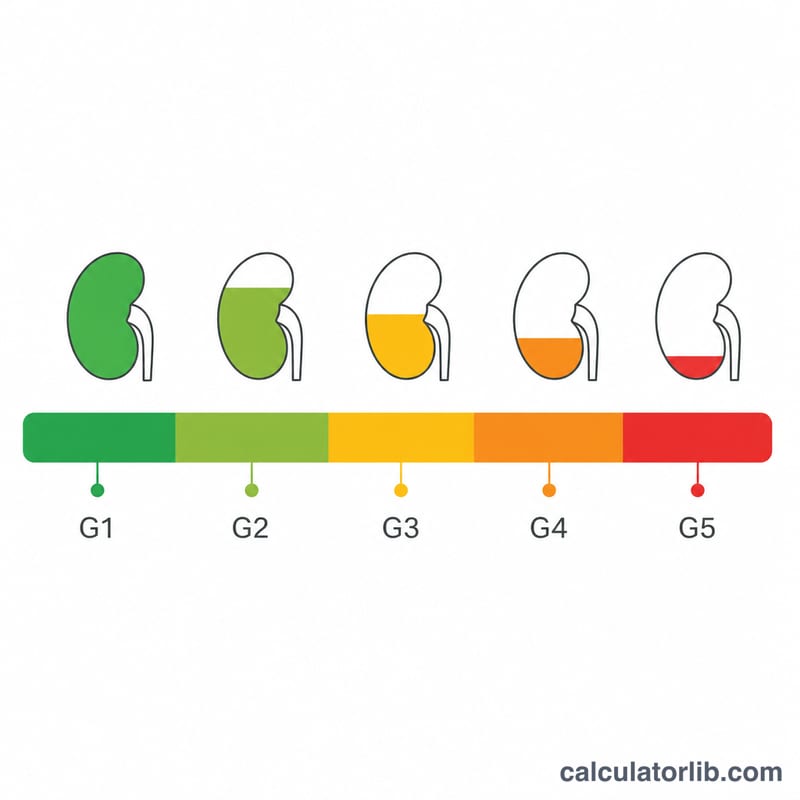
Select sex, enter the patient's age in years, and type the serum creatinine value in mg/dL (the standard US unit). The calculator returns the eGFR and the corresponding chronic kidney disease (CKD) stage from G1 (normal, ≥90) to G5 (kidney failure, <15). If your lab reports creatinine in µmol/L, divide by 88.4 to convert to mg/dL first.
The formula explained
The equation sets \(\kappa\) to 0.9 for males and 0.7 for females, and \(\alpha\) to -0.302 for males and -0.241 for females. The ratio \(\text{Scr}/\kappa\) is split into a "min" term (raised to \(\alpha\)) and a "max" term (raised to -1.200), which together create a smooth two-slope curve. The result is multiplied by 0.9938 raised to the age, and by an extra 1.012 factor for females.
$$\begin{gathered} \text{eGFR} = 142 \times \min\!\left(\tfrac{\text{Scr}}{\kappa},1\right)^{\alpha} \times \max\!\left(\tfrac{\text{Scr}}{\kappa},1\right)^{-1.200} \times 0.9938^{\,\text{Age}} \\[1.5em] \text{where (male)}\quad \left\{ \begin{aligned} \text{Scr} &= \text{Creatinine (mg/dL)} \\ \kappa &= 0.9,\quad \alpha = -0.302 \end{aligned} \right. \end{gathered}$$$$\begin{gathered} \text{eGFR} = 142 \times \min\!\left(\tfrac{\text{Scr}}{\kappa},1\right)^{\alpha} \times \max\!\left(\tfrac{\text{Scr}}{\kappa},1\right)^{-1.200} \times 0.9938^{\,\text{Age}} \times 1.012 \\[1.5em] \text{where (female)}\quad \left\{ \begin{aligned} \text{Scr} &= \text{Creatinine (mg/dL)} \\ \kappa &= 0.7,\quad \alpha = -0.241 \end{aligned} \right. \end{gathered}$$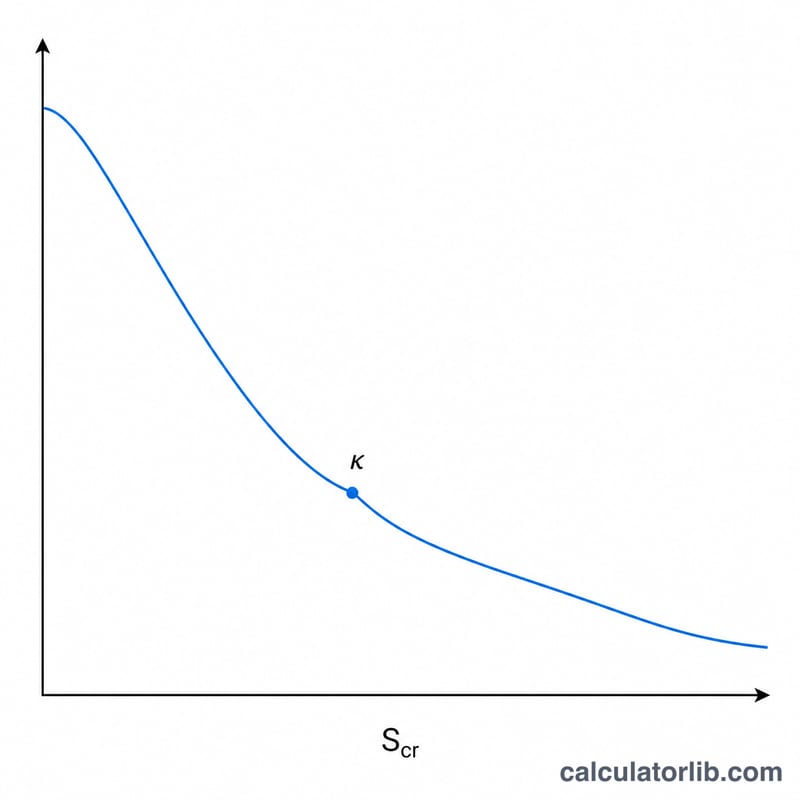
Worked example
A 50-year-old male with creatinine 1.0 mg/dL: ratio = \(1.0/0.9 = 1.111\). \(\min(1.111,1)=1\) so the \(\alpha\) term is 1; \(\max(1.111,1)^{-1.2} = 1.111^{-1.2} \approx 0.8826\). $$\text{eGFR} = 142 \times 1 \times 0.8826 \times 0.9938^{50} \approx 142 \times 0.8826 \times 0.7308 \approx \mathbf{91.6}$$ mL/min/1.73 m² — stage G1.
FAQ
Why race-free? The 2021 update removed the race adjustment to provide a more equitable, consistent estimate across all patients.
What is a normal eGFR? Generally ≥90 in healthy adults, declining gradually with age. Values below 60 for three months or more suggest CKD.
Is this a diagnosis? No. eGFR is an estimate that supports clinical judgement; persistent abnormal values should be evaluated by a clinician.