What Is the Calories to Pounds Calculator?
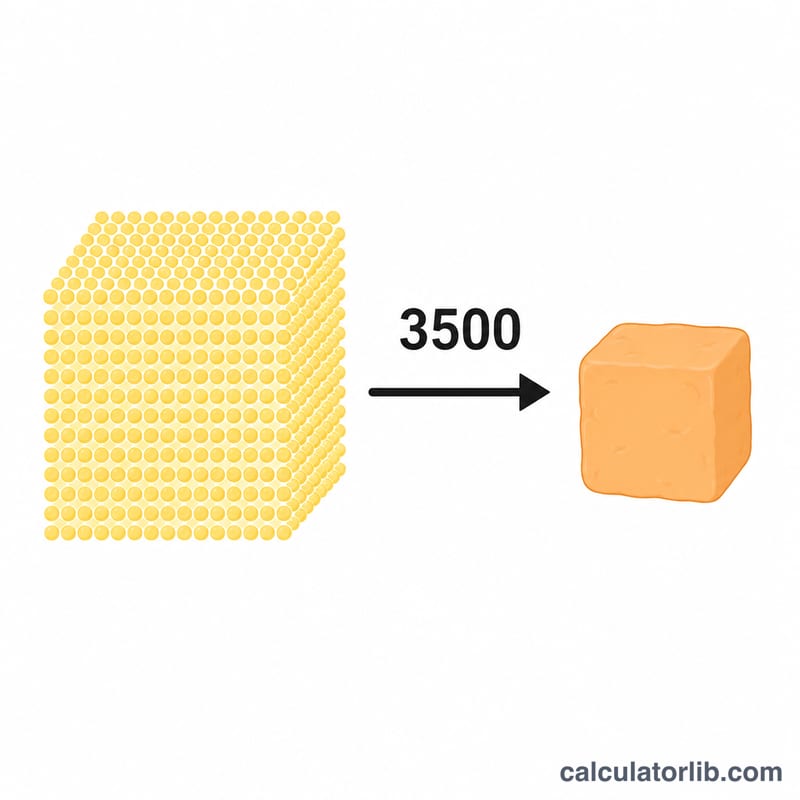
This calculator converts a number of calories into the equivalent amount of body fat, expressed in both pounds and kilograms. It is based on the widely used rule of thumb that one pound of body fat stores about 3,500 calories of energy (and one kilogram about 7,700 calories). Whether you want to understand how big a calorie surplus or deficit is, or estimate how much fat a given calorie figure represents, this tool gives a fast answer.
How to Use It
Enter the total number of calories you want to convert and the calculator instantly shows the equivalent fat mass. To estimate weight loss, use the cumulative calorie deficit over a period of time. For example, a deficit of 500 calories per day for one week equals 3,500 calories, or about one pound of fat.
The Formula Explained
The conversion uses two simple divisions: $$\text{pounds} = \dfrac{\text{calories}}{3500}$$ and $$\text{kilograms} = \dfrac{\text{calories}}{7700}$$. These constants represent the approximate energy density of human body fat. They are estimates — real-world fat loss varies with metabolism, water balance, and muscle changes — but they remain a useful planning benchmark.
Worked Example
Suppose you accumulate a 7,000-calorie deficit. Dividing 7,000 by 3,500 gives 2 pounds.
$$\text{pounds} = \dfrac{7000}{3500} = 2$$Dividing 7,000 by 7,700 gives roughly 0.91 kilograms.
$$\text{kg} = \dfrac{7000}{7700} \approx 0.91$$So a 7,000-calorie deficit corresponds to about 2 pounds (0.91 kg) of body fat.
Interpreting Your Result
The number this calculator returns is an energy-equivalent estimate of body-fat mass — it answers "how much stored fat holds roughly this many calories?" It is not a prediction of what the bathroom scale will show after you have banked that deficit.
The conversion uses the classic rule of thumb that one pound of body fat stores about 3,500 kcal, published by Max Wishnofsky in 1958:
$$\text{Pounds} = \frac{\text{Calories}}{3500} \qquad \text{Kilograms} = \frac{\text{Calories}}{7700}$$Two assumptions are baked into that rule, and both matter:
- It assumes pure adipose tissue. Real weight change is a mix of fat, lean tissue and fluid, so the energy content of a pound actually lost is usually less than 3,500 kcal.
- It assumes your energy expenditure stays constant. It does not. As body mass falls, resting metabolic rate and the calorie cost of moving that mass fall with it, so a fixed daily deficit shrinks over time. This is exactly why the linear 3,500 kcal rule overestimates long-term loss, and why dynamic models — most prominently the NIH Body Weight Planner based on Kevin Hall's work — replace it with curves that flatten toward a new plateau.
Scale weight also moves for reasons that have nothing to do with fat. Glycogen is stored with water at roughly 3 g of water per gram of glycogen, so depleting or refilling glycogen stores can shift several pounds within days. Sodium intake, hydration, gut contents, menstrual-cycle fluid shifts and changes in lean mass from training all show up on the scale and none of them are captured by a calorie-to-fat conversion.
Deficits are cumulative: a 400 kcal daily shortfall is 2,800 kcal over a week and 33,600 kcal over twelve weeks, so the calculator is most useful when you feed it a total accumulated over a period rather than a single day. For context on pacing, the US Centers for Disease Control and Prevention and the National Institutes of Health describe roughly 1–2 lb (0.45–0.9 kg) per week as a typical rate of gradual weight loss, corresponding to about a 500–1,000 kcal per day deficit — a US public-health guideline, not a universal physiological law.
This is general educational information about a unit conversion, not medical or nutritional advice, and it produces no personal prescription. Calorie needs, safe rates of change and appropriate targets differ widely between individuals; discuss your own situation with a qualified healthcare professional.
Calorie Deficit Scenarios Compared
Each row below takes a constant daily deficit, multiplies it by 7, 28 and 84 days, and converts the accumulated calories to fat-mass equivalents by dividing by 3,500 (pounds) and 7,700 (kilograms).
| Daily deficit | 1 week (7 days) | 4 weeks (28 days) | 12 weeks (84 days) |
|---|---|---|---|
| 250 kcal/day | 1,750 kcal → 0.5 lb (0.23 kg) | 7,000 kcal → 2.0 lb (0.91 kg) | 21,000 kcal → 6.0 lb (2.73 kg) |
| 500 kcal/day | 3,500 kcal → 1.0 lb (0.45 kg) | 14,000 kcal → 4.0 lb (1.82 kg) | 42,000 kcal → 12.0 lb (5.45 kg) |
| 750 kcal/day | 5,250 kcal → 1.5 lb (0.68 kg) | 21,000 kcal → 6.0 lb (2.73 kg) | 63,000 kcal → 18.0 lb (8.18 kg) |
| 1,000 kcal/day | 7,000 kcal → 2.0 lb (0.91 kg) | 28,000 kcal → 8.0 lb (3.64 kg) | 84,000 kcal → 24.0 lb (10.91 kg) |
Worked example for the highlighted 12-week row, with the full substitution:
$$500\ \text{kcal/day} \times 84\ \text{days} = 42{,}000\ \text{kcal}$$$$\frac{42{,}000\ \text{kcal}}{3500\ \text{kcal/lb}} = 12.0\ \text{lb} \qquad \frac{42{,}000\ \text{kcal}}{7700\ \text{kcal/kg}} = 5.45\ \text{kg}$$Surpluses convert identically. A row read as "+500 kcal/day" gives the same arithmetic for estimated fat gain — 42,000 surplus calories over 12 weeks is about 12 lb (5.45 kg) of fat-equivalent. The conversion is symmetric because it is only an energy-to-mass conversion; it carries no information about direction.
Expect real results to fall short of these figures. The table assumes the deficit stays exactly constant for the whole period and that every lost gram is adipose tissue. In practice expenditure adapts downward as body mass drops, adherence varies day to day, and early weeks often show a larger scale drop than the table predicts because of glycogen and water loss. Treat these numbers as an upper bound on the trend, not a schedule.
FAQ
Is 3,500 calories per pound exact? No. It is an approximation popularized decades ago; actual results depend on individual physiology, but it is close enough for general planning.
Will I lose exactly this much weight? Not necessarily. Scale weight also includes water and food in transit. The figure estimates fat energy, not day-to-day scale changes.
Can I use it for weight gain? Yes — a calorie surplus converts the same way to estimate potential fat gain.