
What is Maximum Heart Rate?
Maximum heart rate (MHR) is the highest number of times your heart can beat in one minute during all-out physical effort. It is a key reference point for setting safe and effective exercise intensities. Because measuring it directly requires a maximal stress test, most people estimate it from their age using a simple formula.
How to use this calculator
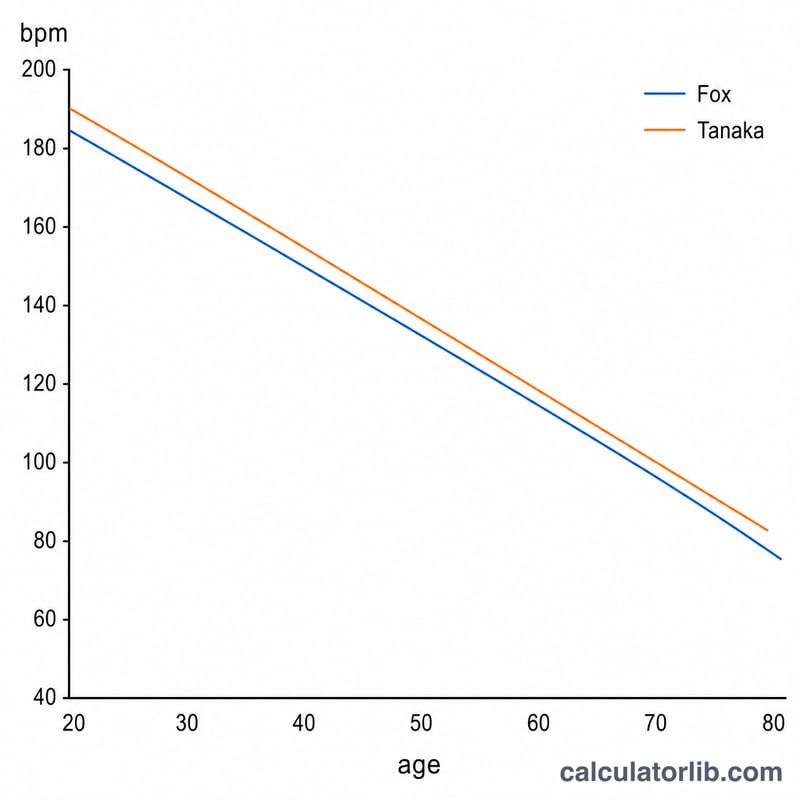
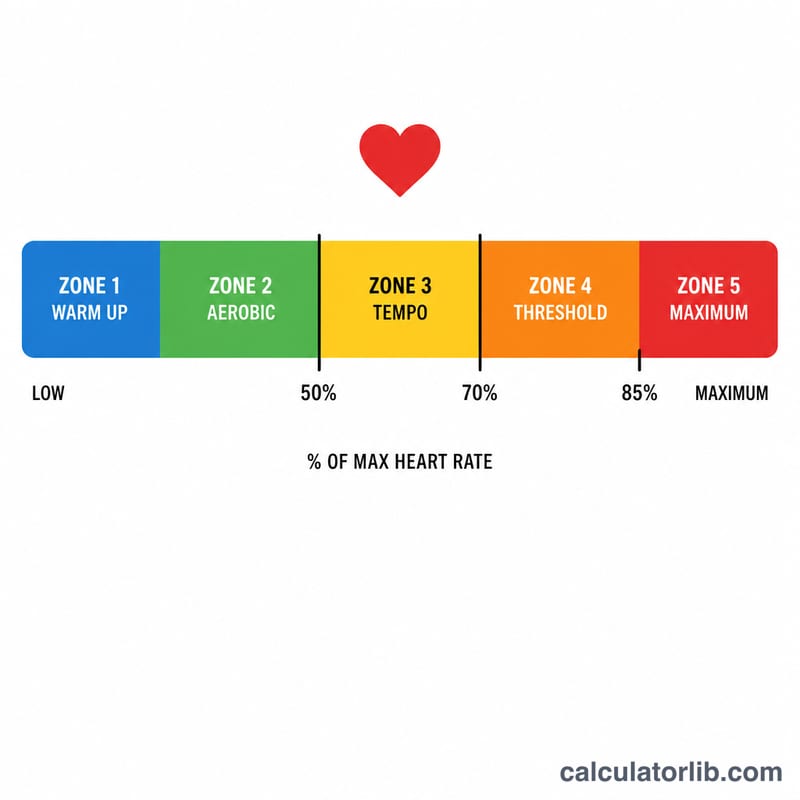
Enter your age in years and choose a formula. The Fox formula (\(220 - \text{age}\)) is the most widely known and quick to remember. The Tanaka formula (\(208 - 0.7 \times \text{age}\)) is based on a large meta-analysis and tends to be more accurate, particularly for adults over 40. The calculator returns your estimated MHR plus common training zones at 50%, 70%, and 85% of that value.
The formula explained
Fox: $$\text{MHR} = 220 - \text{age}$$ Tanaka: $$\text{MHR} = 208 - 0.7 \times \text{age}$$ Training zones are calculated as a percentage of MHR. For example, the moderate "fat-burn" zone is roughly 70% of MHR, while vigorous cardio sits around 85%.
Worked example
For a 40-year-old using the Fox formula: $$\text{MHR} = 220 - 40 = 180 \text{ bpm}$$ The 70% zone is \(180 \times 0.70 = 126\) bpm, and the 85% zone is \(180 \times 0.85 = 153\) bpm. Using Tanaka instead: $$208 - 0.7 \times 40 = 208 - 28 = 180 \text{ bpm}$$
FAQ
Which formula should I use? Tanaka is generally considered more accurate across ages; Fox is fine for a fast estimate. Both are population averages and can be off by ±10–12 bpm for any individual.
Is this a substitute for a medical test? No. These are estimates only. For precise figures or if you have a heart condition, consult a healthcare professional.
How do I use the zones? Aim for 50–70% for general fitness and fat burning, and 70–85% for improving cardiovascular endurance.