
What is the ECG Heart Rate Calculator?
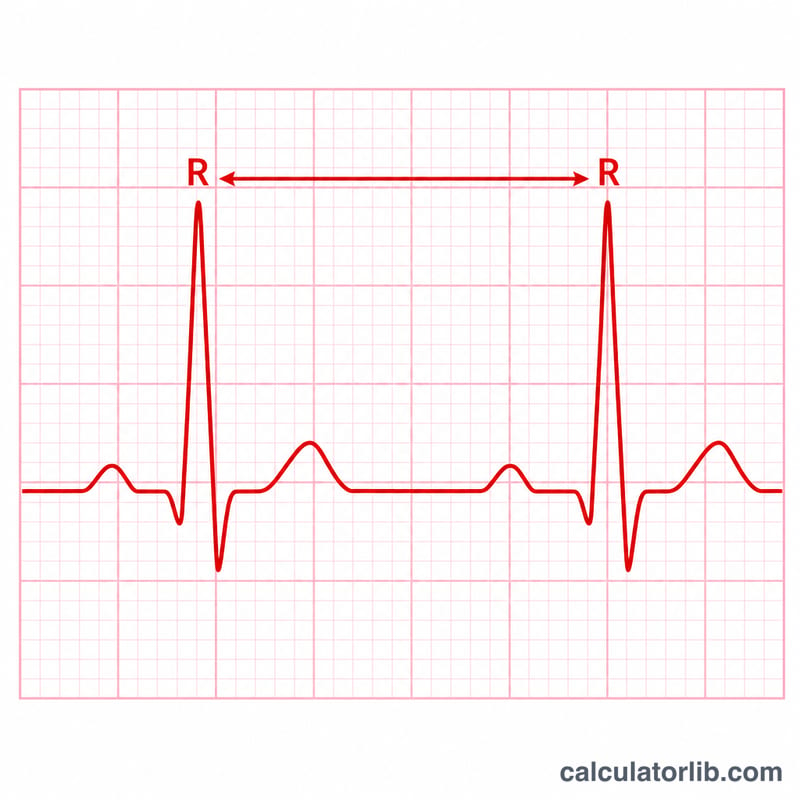
This tool estimates a patient's heart rate directly from an electrocardiogram (ECG/EKG) rhythm strip. Standard ECG paper runs at 25 mm/second, so each small box (1 mm) represents 0.04 seconds and each large box (5 mm) represents 0.20 seconds. By counting the boxes between two consecutive R-wave peaks, you can quickly convert the R–R interval into beats per minute (bpm).
How to use it
Pick a counting method, then enter the number of boxes you measured between two adjacent R waves. Choose Large boxes if you counted whole 5 mm squares (the 300 rule), or Small boxes if you counted individual 1 mm squares (the 1500 rule). The calculator returns the estimated heart rate instantly.
The formula explained
Because there are 300 large boxes or 1500 small boxes in one minute of recording (60 s ÷ 0.2 s = 300; 60 s ÷ 0.04 s = 1500), the heart rate is simply:
$$\text{HR} = \frac{300}{\text{large boxes}} = \frac{1500}{\text{small boxes}}$$ The 1500 rule is more precise because it allows fractional box counts.
Worked example
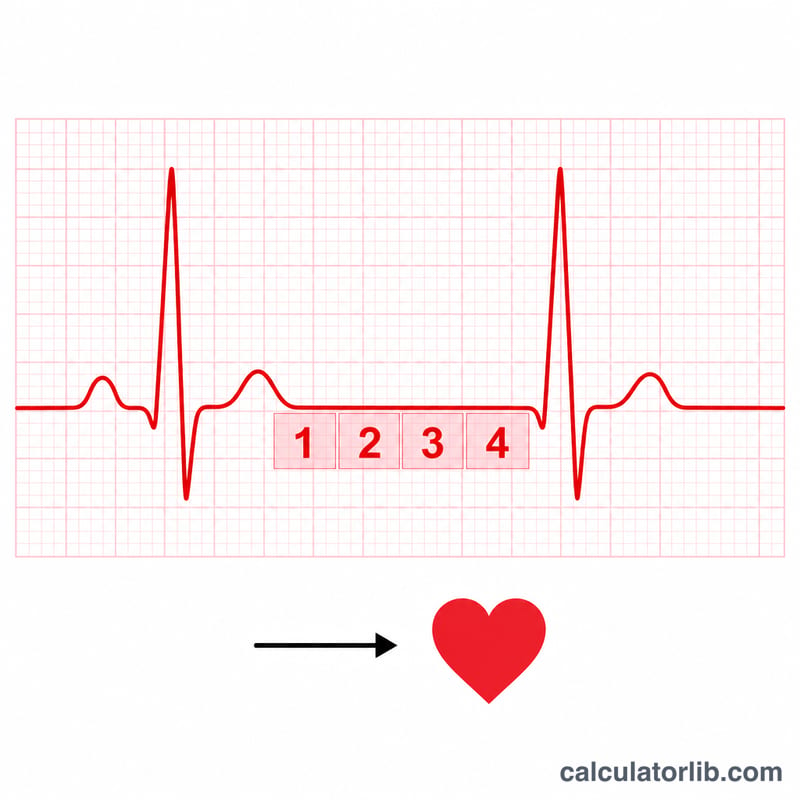
Suppose two R waves are separated by 4 large boxes. Using the 300 rule: $$\frac{300}{4} = 75 \text{ bpm}$$ If instead you counted 20 small boxes for that same interval: $$\frac{1500}{20} = 75 \text{ bpm}$$ — the two methods agree.
FAQ
Which method is more accurate? The 1500 small-box rule, since you can count partial large boxes precisely as small boxes.
Does this work for irregular rhythms? No. For irregular rhythms (e.g. atrial fibrillation), count the number of R waves on a 6-second strip and multiply by 10 instead.
What is a normal heart rate? A normal adult resting heart rate is 60–100 bpm. Below 60 is bradycardia; above 100 is tachycardia.