
What Is the Gorlin Formula?
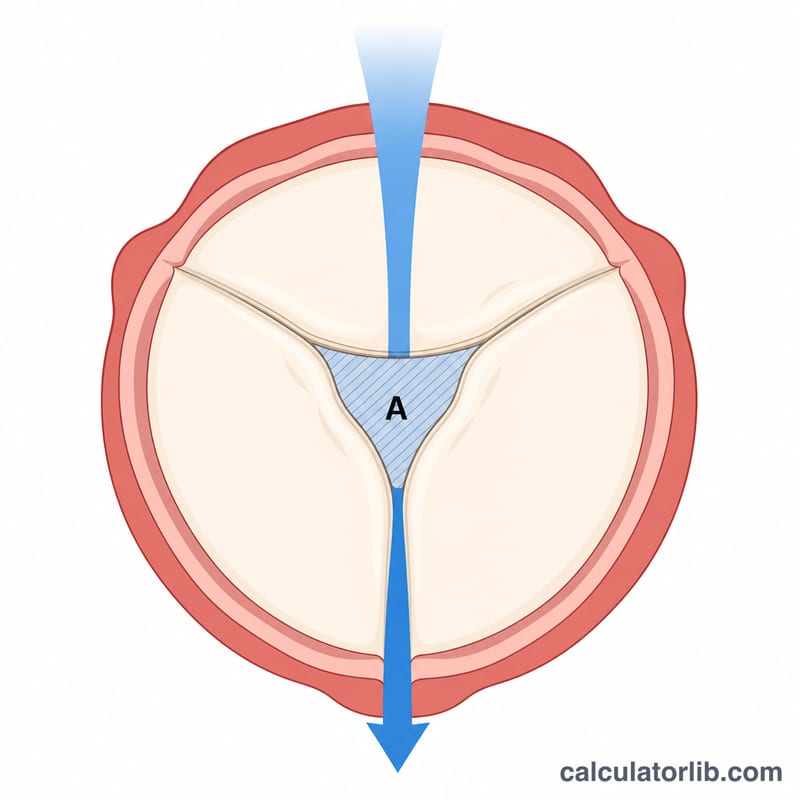
The Gorlin formula is a hemodynamic equation used in cardiac catheterization to estimate the cross-sectional area of a stenotic heart valve. Developed by Richard and Sarah Gorlin in 1951, it relates blood flow across a valve and the pressure gradient driving that flow to the orifice area. It is most commonly applied to the aortic and mitral valves to grade the severity of valvular stenosis.
How to Use This Calculator
Select the valve (aortic or mitral), then enter cardiac output in L/min, heart rate in beats per minute, the systolic ejection period (aortic) or diastolic filling period (mitral) in seconds per beat, and the measured mean pressure gradient across the valve in mmHg. The calculator first converts cardiac output to a per-second valve flow rate, then applies the Gorlin equation.
The Formula Explained
Valve flow Q (mL/s) = CO × 1000 ÷ (HR × SEP). The orifice area A = Q ÷ (44.3 × C × √ΔP), where 44.3 is the Gorlin constant derived from the discharge and velocity coefficients, and C is 1.0 for the aortic valve and 0.85 for the mitral valve.
$$A = \frac{F}{44.3 \cdot C \cdot \sqrt{\text{Gradient}}}$$ $$\text{where}\quad \left\{ \begin{aligned} F &= \frac{1000 \cdot \text{CO (L/min)}}{\text{HR} \cdot \text{SEP}} \\ C &= 1.0 \end{aligned} \right.$$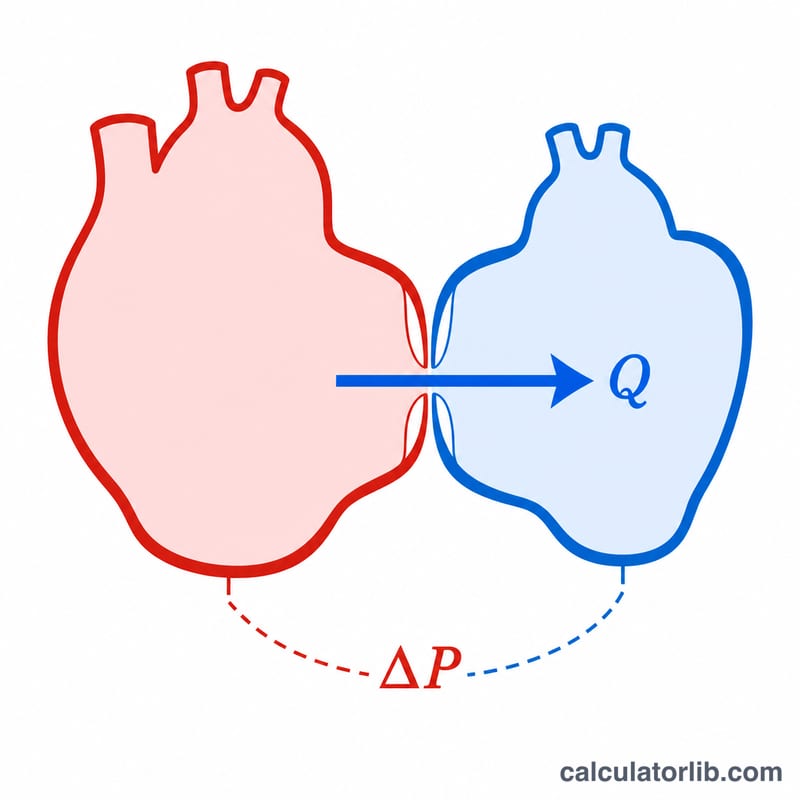
Worked Example
An aortic patient has CO = 5 L/min, HR = 70 bpm, systolic ejection period = 0.33 s/beat, and mean gradient = 40 mmHg. Flow = 5000 ÷ (70 × 0.33) = 216.45 mL/s. Area = 216.45 ÷ (44.3 × 1.0 × √40) = 216.45 ÷ 280.2 ≈ 0.77 cm², indicating severe aortic stenosis.
$$\text{Flow} = \frac{5000}{70 \times 0.33} = 216.45 \ \text{mL/s}$$ $$\text{Area} = \frac{216.45}{44.3 \times 1.0 \times \sqrt{40}} = \frac{216.45}{280.2} \approx 0.77 \ \text{cm}^2$$FAQ
What is a normal aortic valve area? A normal aortic valve area is about 3–4 cm²; severe stenosis is generally below 1.0 cm².
Why is C different for the mitral valve? The mitral valve uses an empirical constant of 0.85 to correct for differences in flow dynamics, while the aortic valve uses 1.0.
Is this a substitute for clinical judgment? No. The Gorlin formula is an estimate that depends on accurate hemodynamic measurements and should be interpreted by a clinician alongside other data.