
What is the Incomplete Beta Function Calculator?
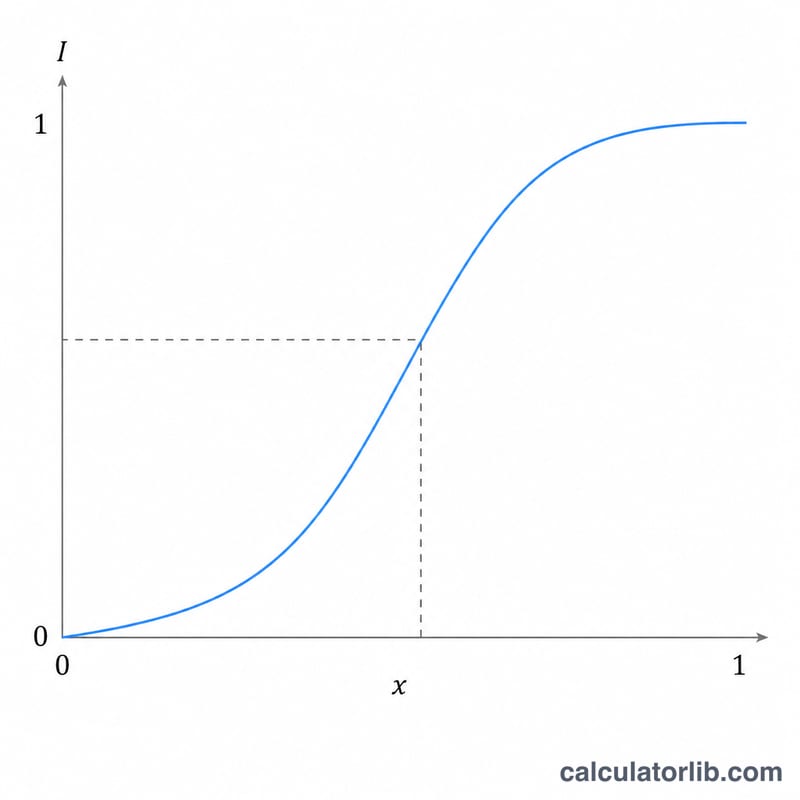
This tool computes the incomplete beta function \(B_{x}(a,b)\) and its normalized form, the regularized incomplete beta function \(I_{x}(a,b)\), for real shape parameters \(a > 0\), \(b > 0\) and an upper limit \(0 \le x \le 1\). It is pure mathematics and applies everywhere with no regional rules. Because \(I_{x}(a,b)\) equals the cumulative distribution function (CDF) of the Beta distribution, it underlies the tails of the Student-t, F and binomial distributions.
How to use it
Enter the two shape parameters \(a\) and \(b\) (both strictly positive) and the upper limit \(x\) between 0 and 1. The calculator returns \(I_{x}(a,b)\) as the headline value, plus the unnormalized \(B_{x}(a,b)\) and the complete beta \(B(a,b)\). Double precision gives roughly 15 reliable significant digits.
The formula explained
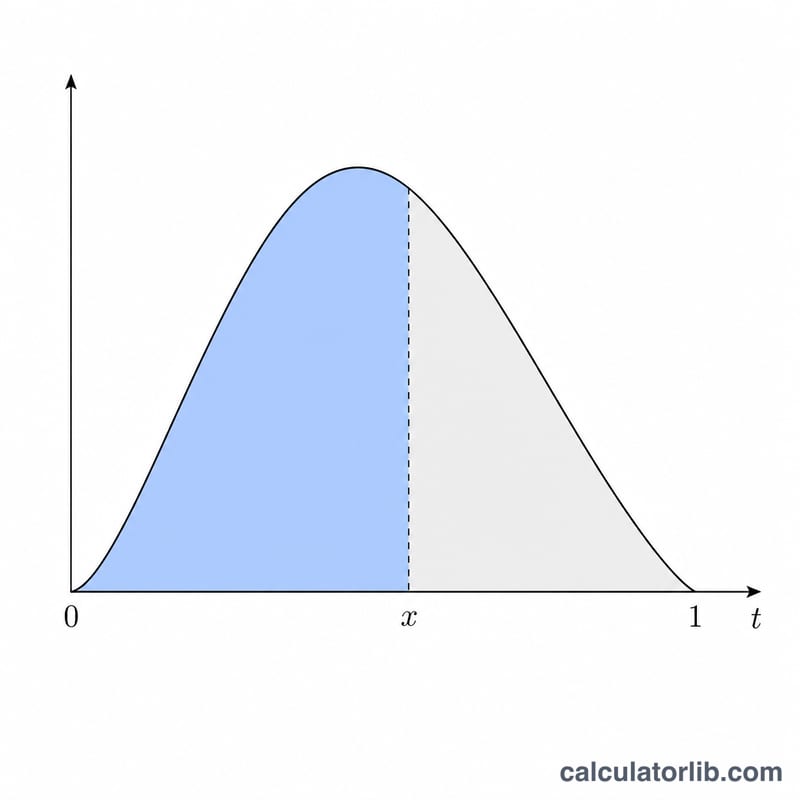
The incomplete beta function is the partial integral $$B_{x}(a,b) = \int_{0}^{x} t^{\,a-1}(1-t)^{\,b-1}\,dt.$$ The complete beta is $$B(a,b) = \frac{\Gamma(a)\,\Gamma(b)}{\Gamma(a+b)}.$$ Dividing gives the regularized form $$I_{x}(a,b) = \frac{B_{x}(a,b)}{B(a,b)},$$ which always lies in \([0,1]\). We evaluate \(I_{x}\) with a numerically stable continued fraction and a Lanczos approximation of the log-gamma function, then recover \(B_{x} = I_{x} \times B(a,b)\).
Worked example
Take \(a = 1\), \(b = 3\), \(x = 0.4\). With \(a = 1\) the integrand is \((1-t)^{2}\), so $$B_{x} = \frac{1 - 0.6^{3}}{3} = \frac{0.784}{3} = 0.26133.$$ The complete beta is \(B(1,3) = \frac{1 \cdot 2}{6} = \frac{1}{3}\). Hence $$I_{x} = \frac{0.26133}{0.33333} = 0.784,$$ matching the identity \(I_{0.4}(1,3) = 1 - (1-0.4)^{3} = 0.784\).
FAQ
What is the difference between \(B_{x}\) and \(I_{x}\)? \(B_{x}\) is the raw partial integral; \(I_{x} = B_{x}/B(a,b)\) is normalized to \([0,1]\).
Why must \(a\) and \(b\) be positive? The gamma function has poles at non-positive integers and the integral diverges otherwise, so \(a > 0\) and \(b > 0\) are required.
What happens at the endpoints? At \(x = 0\) both \(B_{x}\) and \(I_{x}\) are 0; at \(x = 1\), \(I_{x} = 1\) and \(B_{x} = B(a,b)\).