
What Is the Marginal Propensity to Save?
The marginal propensity to save (MPS) is a key concept in Keynesian economics that measures the proportion of an increase in income that a household or economy chooses to save rather than spend. It is expressed as a decimal between 0 and 1, where a value of 0.25 means that 25 cents of every additional dollar earned is saved.
How to Use This Calculator
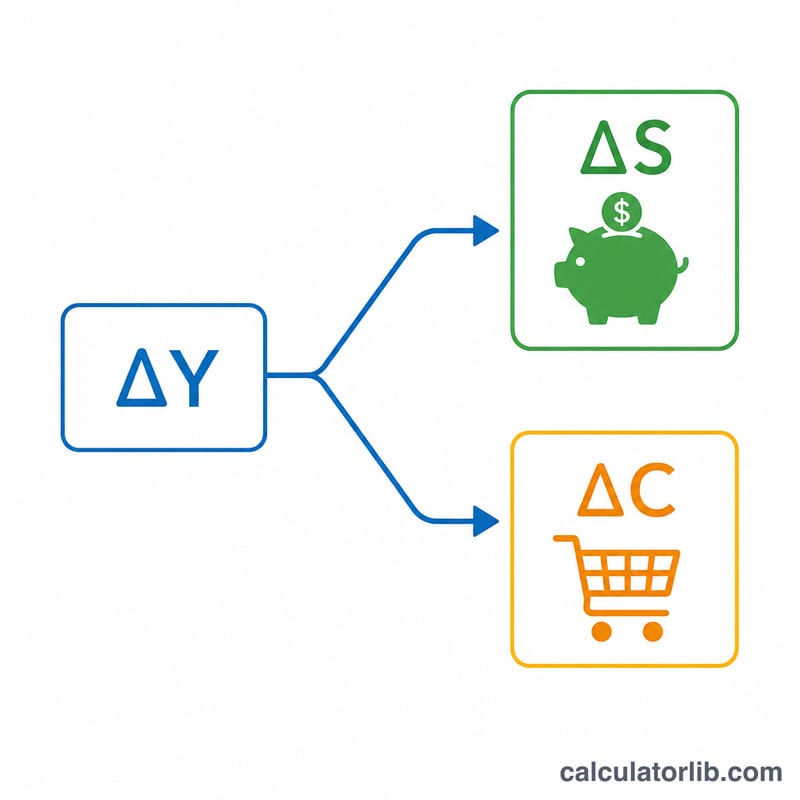
Enter the change in savings (\(\Delta S\)) and the change in income (\(\Delta Y\)) for the period you are analyzing. The calculator divides the two values to return MPS, and also reports the matching marginal propensity to consume (MPC), since the two must add up to 1.
The Formula Explained
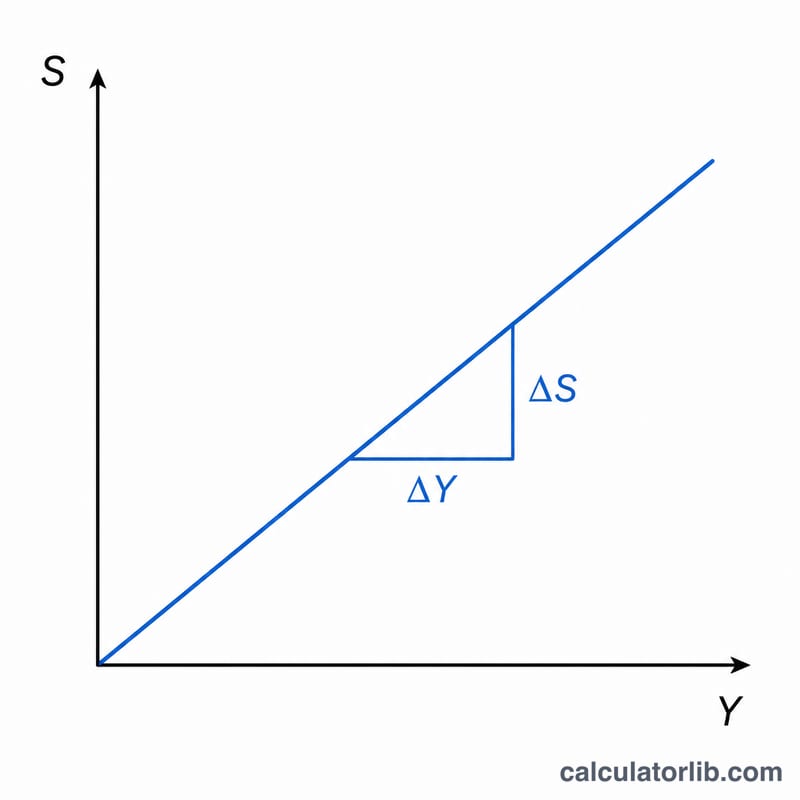
MPS is calculated as the ratio of additional savings to additional income: $$\text{MPS} = \frac{\text{Change in Savings } (\Delta S)}{\text{Change in Income } (\Delta Y)}$$ Because every extra dollar of income is either spent or saved, the marginal propensity to consume is simply \(\text{MPC} = 1 - \text{MPS}\). Together these determine the spending multiplier in macroeconomic models, calculated as \(1 / \text{MPS}\).
Worked Example
Suppose a household's income rises by $1,000 and its savings increase by $200. Then $$\text{MPS} = \frac{200}{1{,}000} = 0.20.$$ This means 20% of the extra income is saved and the remaining 80% (\(\text{MPC} = 0.80\)) is spent. The resulting spending multiplier would be \(1 / 0.20 = 5\).
FAQ
Can MPS be greater than 1? No. In normal cases MPS lies between 0 and 1, since people cannot save more than the extra income they receive.
What is the difference between MPS and the savings rate? The savings rate is total savings divided by total income, while MPS only looks at the change at the margin — how much of the next dollar is saved.
How does MPS relate to the multiplier? The Keynesian spending multiplier equals \(1 / \text{MPS}\); a smaller MPS produces a larger multiplier effect on output.