
What Is the Phillips Curve?
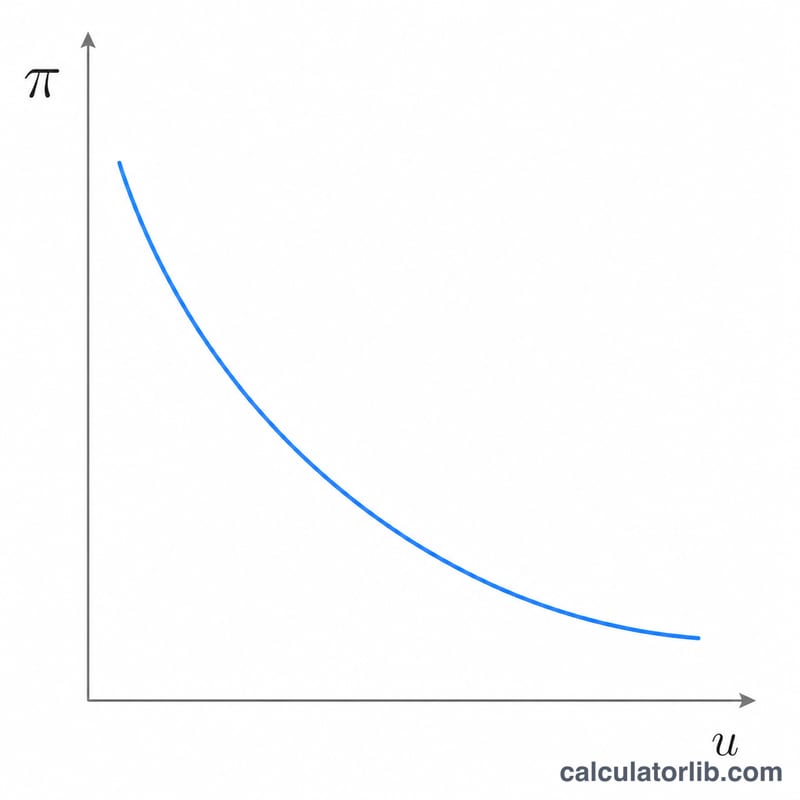
The Phillips curve describes the short-run trade-off between inflation and unemployment. This calculator uses the modern expectations-augmented form, \(\pi = \pi_e - \beta(u - u_n)\), where actual inflation depends on what people expect inflation to be plus pressure from the gap between actual and natural unemployment. When unemployment falls below its natural rate, inflation rises above expectations; when it climbs above, inflation eases.
How to Use It
Enter four values: expected inflation (\(\pi_e\), %), the sensitivity coefficient \(\beta\) (how strongly inflation reacts to the unemployment gap), the actual unemployment rate (\(u\), %), and the natural rate of unemployment (\(u_n\), %). The tool returns the predicted inflation rate along with the unemployment gap so you can see what is driving the result.
The Formula Explained
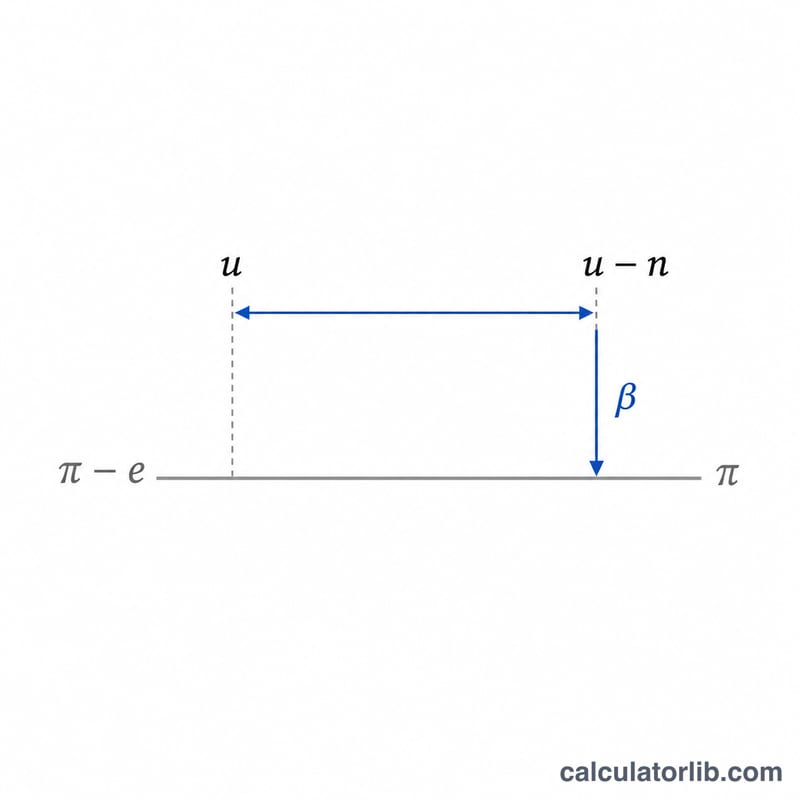
$$\pi = \pi_e - \beta(u - u_n)$$ The term \((u - u_n)\) is the unemployment gap. A positive gap (high unemployment) subtracts from inflation; a negative gap (a hot labor market) adds to it. \(\beta\) scales that effect — a larger \(\beta\) means inflation is more sensitive to labor-market slack. If actual unemployment equals the natural rate, inflation simply equals expectations.
Worked Example
Suppose expected inflation \(\pi_e = 3\%\), \(\beta = 0.5\), actual unemployment \(u = 6\%\), and natural unemployment \(u_n = 5\%\). The gap is \(6 - 5 = 1\) percentage point. $$\text{Inflation} = 3 - 0.5 \times 1 = 2.5\%$$ Because unemployment sits above its natural rate, predicted inflation falls below expectations.
FAQ
What is the natural rate of unemployment? It is the unemployment rate consistent with stable inflation, reflecting structural and frictional factors rather than the business cycle.
Can inflation be negative? Yes. If the unemployment gap is large and \(\beta\) is high, the formula can produce deflation (negative inflation).
What is a typical value for \(\beta\)? Estimates vary by economy and period, but values between 0.2 and 1.0 are common in textbook examples.