
What Is Okun's Law?
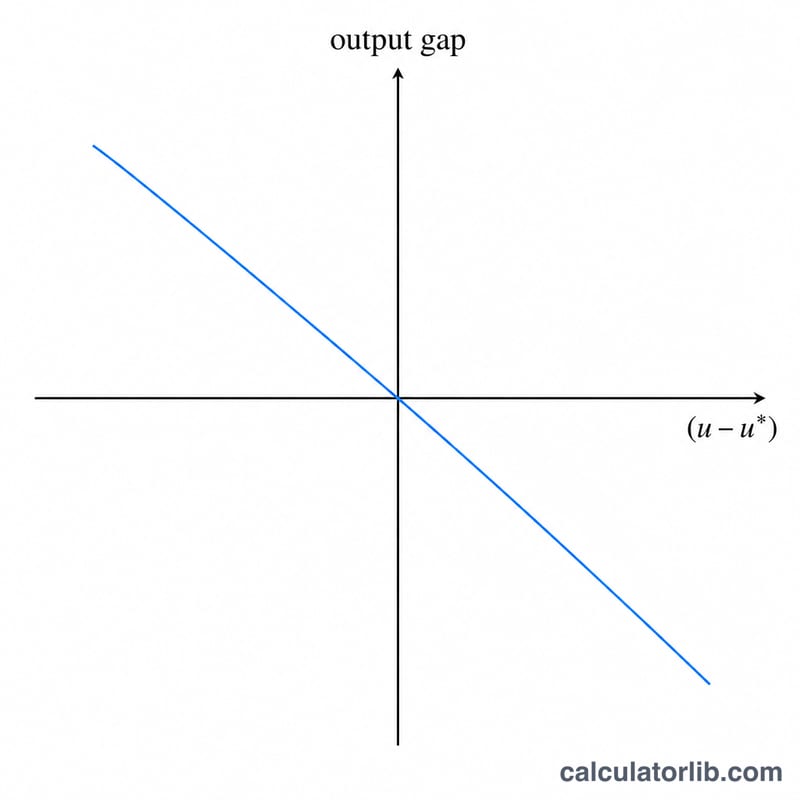
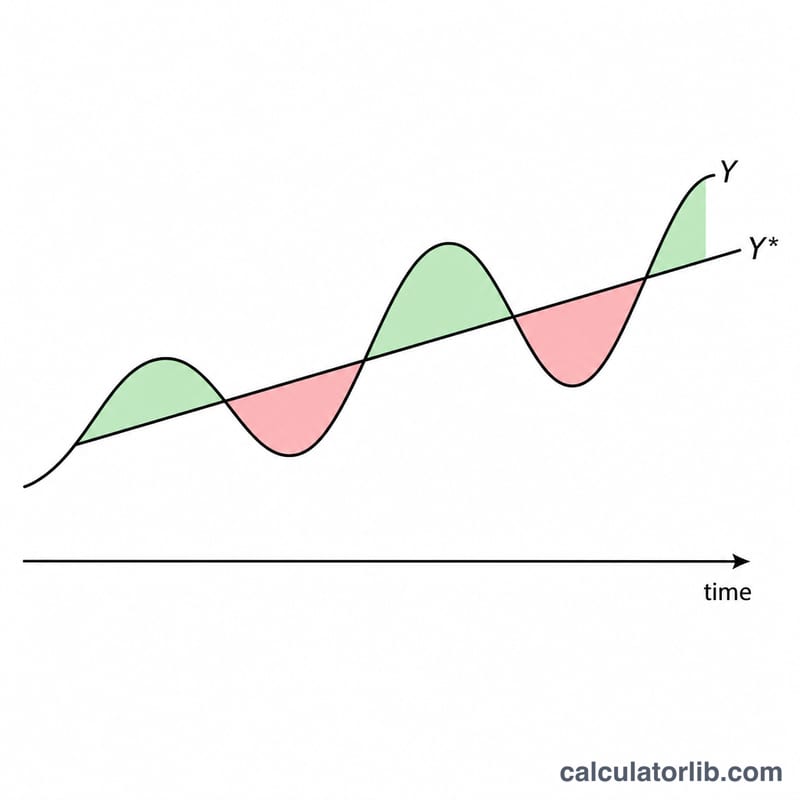
Okun's Law is an empirical relationship in macroeconomics, named after economist Arthur Okun, that links the gap between actual and potential output (the "output gap") to the gap between actual and natural unemployment. In its simplest gap form it states that for every percentage point that unemployment rises above its natural rate, real GDP falls a fixed multiple — the Okun coefficient — below its potential level.
How to Use This Calculator
Enter the actual unemployment rate, the natural (full-employment) unemployment rate, and the Okun coefficient. The natural rate is often estimated near 4–5%, and the coefficient is commonly around 2 for the United States, though it varies by country and time period. The calculator returns the implied output gap as a percentage of potential GDP. A negative value means the economy is producing below its potential.
The Formula Explained
The model used is:
$$\frac{Y - Y^*}{Y^*} = -c \times (u - u^*)$$
Here \(Y\) is actual output, \(Y^*\) is potential output, \(u\) is the actual unemployment rate, \(u^*\) is the natural rate, and \(c\) is the Okun coefficient. The minus sign captures the inverse relationship: when unemployment exceeds its natural rate, output falls below potential.
Worked Example
Suppose actual unemployment is 6%, the natural rate is 5%, and the Okun coefficient is 2. The unemployment gap is \(6 - 5 = 1\) percentage point. The output gap is \(-2 \times 1 = -2\%\). This means real GDP is roughly 2% below its potential level, signalling a recessionary gap and unused economic capacity.
FAQ
What is a typical Okun coefficient? For the US, estimates often cluster around 2, meaning a 1-point rise in unemployment corresponds to about a 2% output shortfall. Other economies use different values.
What does a positive output gap mean? A positive gap indicates the economy is operating above potential (unemployment below natural), which can signal inflationary pressure.
Is Okun's Law exact? No — it is an empirical rule of thumb that approximates the historical relationship and can shift with structural changes in the labor market.