
What this calculator does
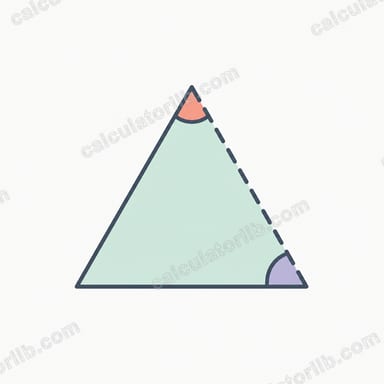
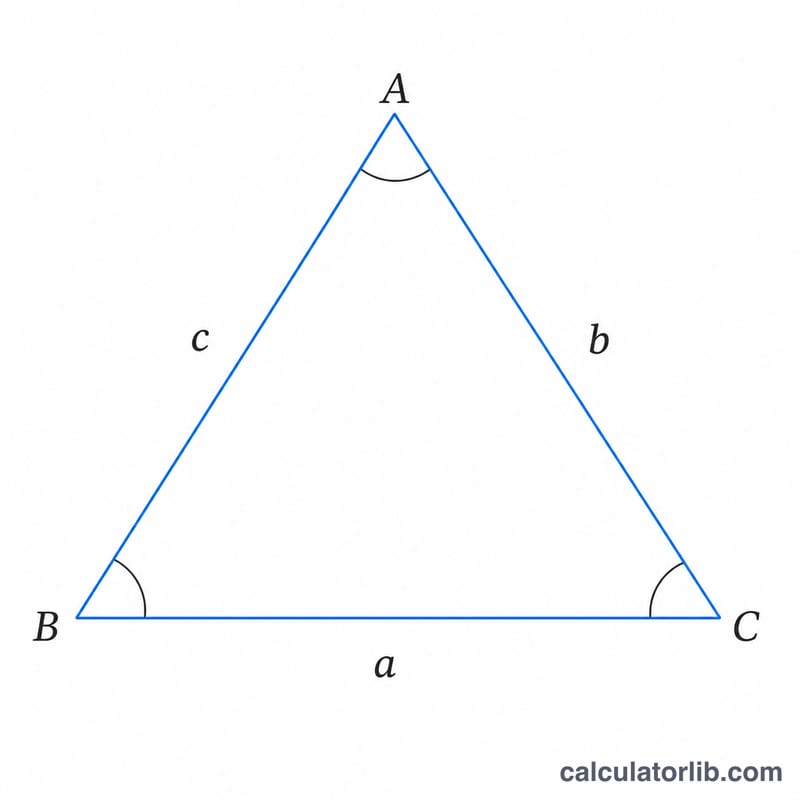
The Law of Sines relates each side of a triangle to the sine of its opposite angle. Using the standard naming convention, side a is opposite angle A, side b is opposite angle B, and side c is opposite angle C. This tool solves for one missing angle or one missing side from three known quantities, then reports the fully solved triangle: all three sides, all three angles, and the derived perimeter, semi-perimeter, area, inradius and circumradius.
How to use it
Pick a calculation mode from the dropdown. The label tells you exactly what is given and what is solved, for example "Angle A from a, B, b" means you supply side a, angle B and side b, and the calculator finds angle A. Only the three relevant fields appear. Choose whether your angles are in degrees or radians, pick a length-unit label (purely cosmetic, since the Law of Sines is scale-free), and set the significant figures for the output.
The formula explained
The Law of Sines states:
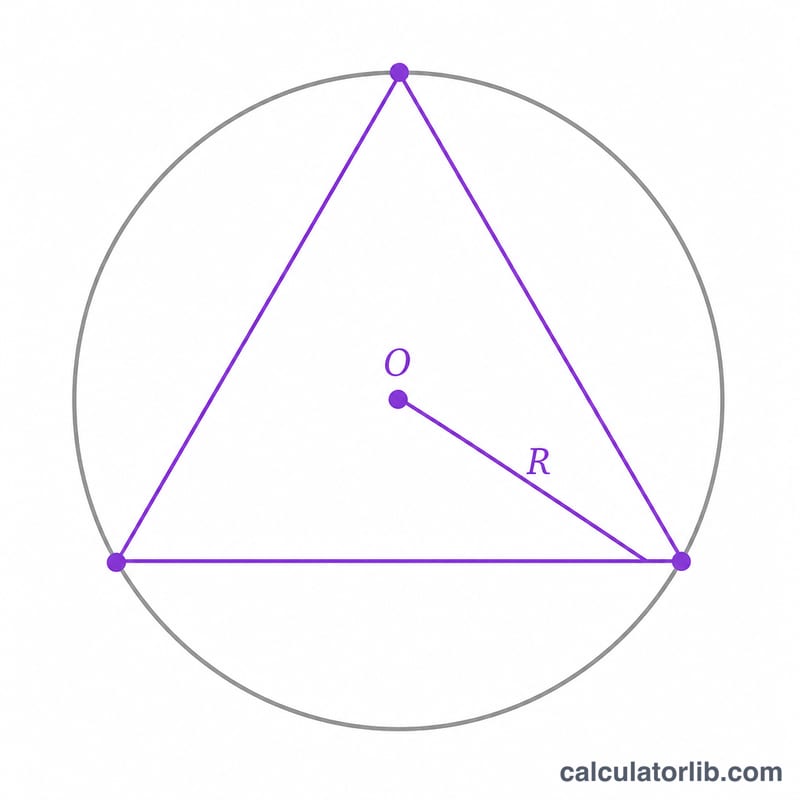
$$\frac{a}{\sin A} = \frac{b}{\sin B} = \frac{c}{\sin C} = 2R$$To find a missing angle X, the calculator uses \(X = \sin^{-1}\!\left(\dfrac{\text{opposite side of } X \times \sin(\text{known angle})}{\text{opposite side of known angle}}\right)\). To find a missing side, it uses \(\text{solved side} = \dfrac{\text{known side} \times \sin(\text{angle opposite solved side})}{\sin(\text{angle opposite known side})}\). The third angle is always \(180^\circ\) minus the sum of the two known angles. Once every side and angle is known, the area comes from Heron's formula:
$$K = \sqrt{s(s-a)(s-b)(s-c)},\quad s=\tfrac{a+b+c}{2}$$the inradius from \(r = K / s\), and the circumradius from \(R = abc / (4K)\).
Worked example
Given side a = 3, angle B = 40° and side b = 4 (mode "Angle A from a, B, b"): \(A = \sin^{-1}(3 \times \sin 40^\circ / 4) = \sin^{-1}(0.482091) = 28.824^\circ\). The third angle \(C = 180 - (28.824 + 40) = 111.176^\circ\). Side \(c = 4 \times \sin(111.176^\circ) / \sin(40^\circ) = 5.80142\). Perimeter = 12.8014, area K = 5.59603, inradius = 0.874281, circumradius = 3.11008.
FAQ
Why might it say "no solution"? In angle-solve modes the value inside arcsin must be 1 or less. If it exceeds 1 no real triangle exists for those measurements.
Does it handle the ambiguous SSA case? When two sides and a non-included angle are given there can be two valid triangles. This calculator returns only the acute (principal arcsin) solution; the second possibility is \(180^\circ\) minus that angle.
Do length units affect the math? No. The Law of Sines uses ratios, so the unit is only a display label and the area is shown in unit squared.