
What this cube calculator does
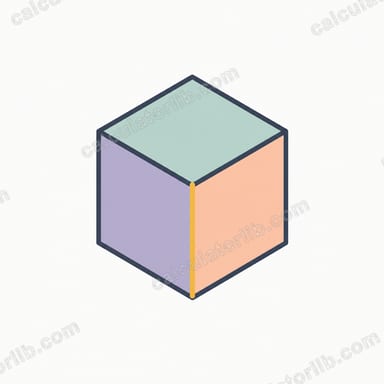
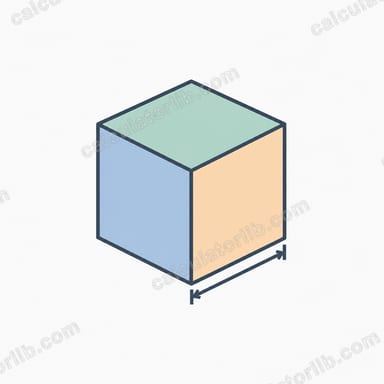
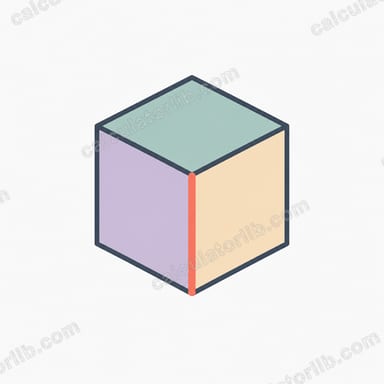
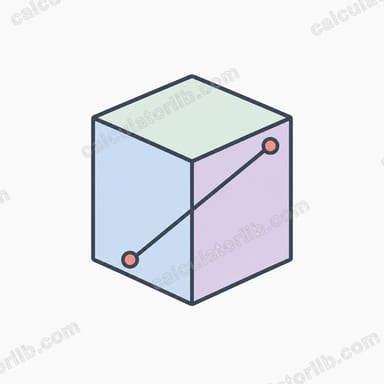
A cube is the most symmetric of the rectangular prisms: all twelve edges share the same length, every face is an identical square, and all angles are right angles. Because of that symmetry, a single measurement fully determines the whole solid. This solver lets you enter exactly one quantity — the side length, the face diagonal, the solid (space) diagonal, the surface area, or the volume — and instantly returns the other four.
How to use it
Pick which value you know from the "Known variable" dropdown, type the number, and choose an optional unit label and a significant-figures setting. The unit is purely cosmetic: linear answers carry the unit, areas carry unit squared and volumes carry unit cubed, but no SI conversion is performed because every output is expressed in the same base unit you supplied.
The formulas explained
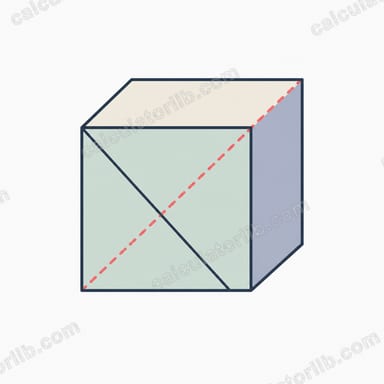
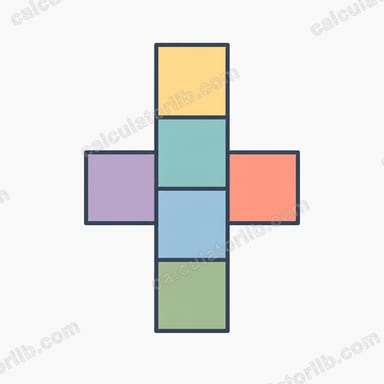
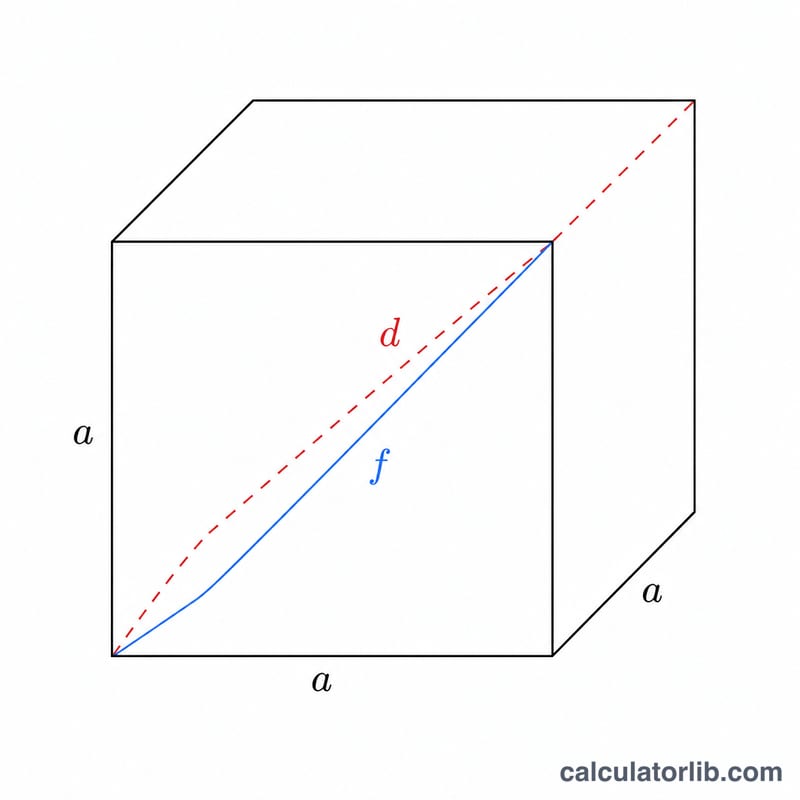
All cube properties derive from the edge length \(a\). The face diagonal runs corner to corner across one square face, so by Pythagoras \(f = a\sqrt{2}\). The solid diagonal pierces the body of the cube from one vertex to the opposite vertex, giving \(d = a\sqrt{3}\). The total surface area sums six identical square faces: \(S = 6a^2\). The volume is \(V = a^3\). When you supply a different variable, the tool first inverts these relations to recover \(a\) (for example \(a = \sqrt{\tfrac{S}{6}}\) or \(a = \sqrt[3]{V}\)) and then re-applies the four formulas.
$$f = a\sqrt{2},\quad d = a\sqrt{3},\quad S = 6a^2,\quad V = a^3$$ $$a = \frac{f}{\sqrt{2}} = \frac{d}{\sqrt{3}} = \sqrt{\tfrac{S}{6}} = \sqrt[3]{V}$$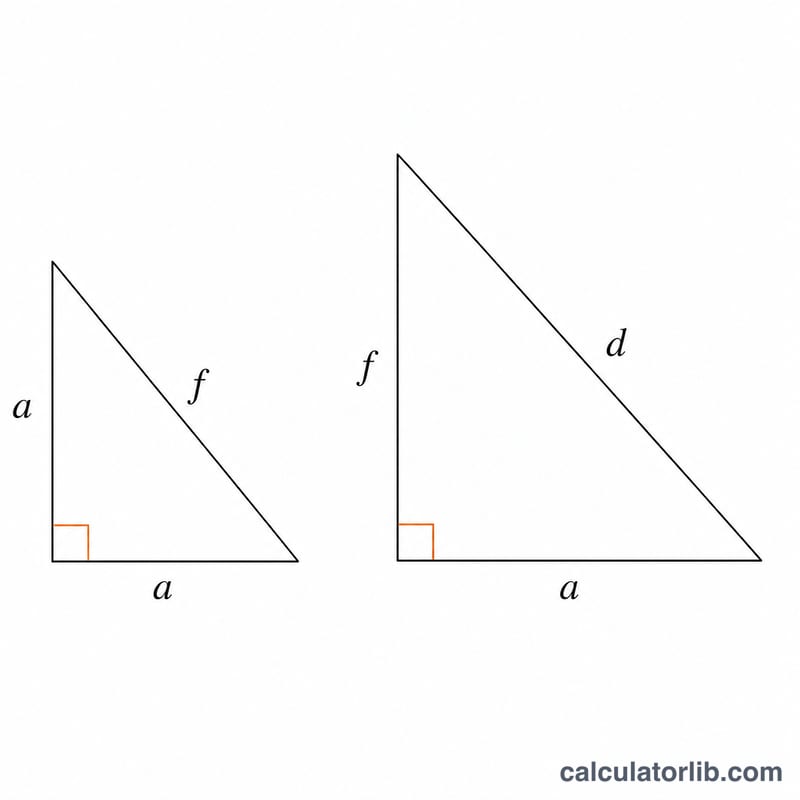
Worked example
Suppose the volume is 64. The side length is \(a = \sqrt[3]{64} = 4\). Then \(f = 4\sqrt{2} \approx 5.65685\), \(d = 4\sqrt{3} \approx 6.92820\), surface area \(S = 6\cdot4^2 = 96\), and volume \(V = 4^3 = 64\). Entering 64 with "Volume" selected reproduces exactly these figures.
FAQ
What is the difference between the face diagonal and the solid diagonal? The face diagonal lies flat on one square face (length \(a\sqrt{2}\)), while the solid or space diagonal travels through the interior of the cube (length \(a\sqrt{3}\)).
Can I enter zero or a negative value? No. A real cube needs a positive dimension, so the input must be greater than 0.
Why does changing the unit not change the numbers? The unit is only a label. Since every output is expressed relative to the same input unit, the arithmetic is identical whether you choose centimeters, meters or none.