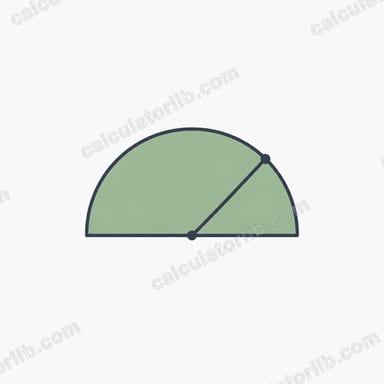
What is a hemisphere?
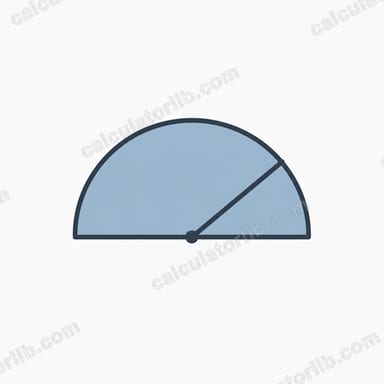
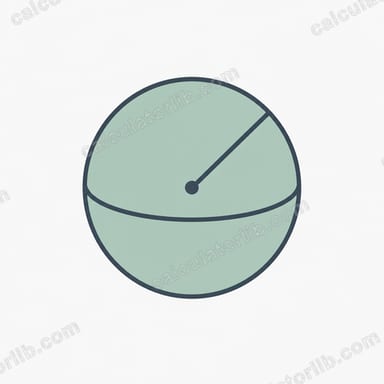
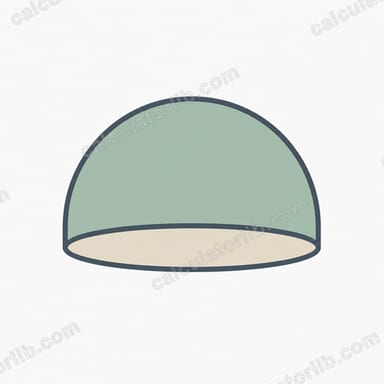
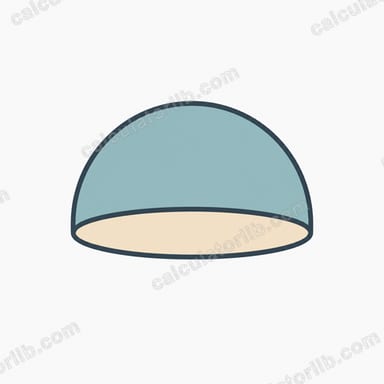
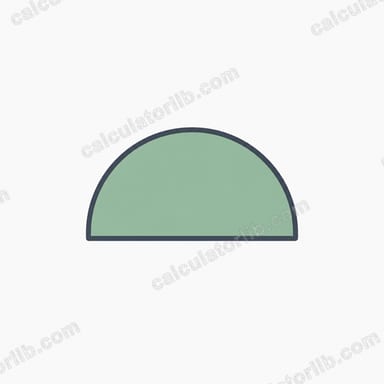
A hemisphere is exactly half of a sphere — picture a ball sliced cleanly through its center. The cut produces a flat circular face (the base) and a domed curved surface. This calculator works out every geometric property of a hemisphere from just one known measurement: the radius, the base circumference, the volume, the curved surface area, or the total surface area.
How to use it
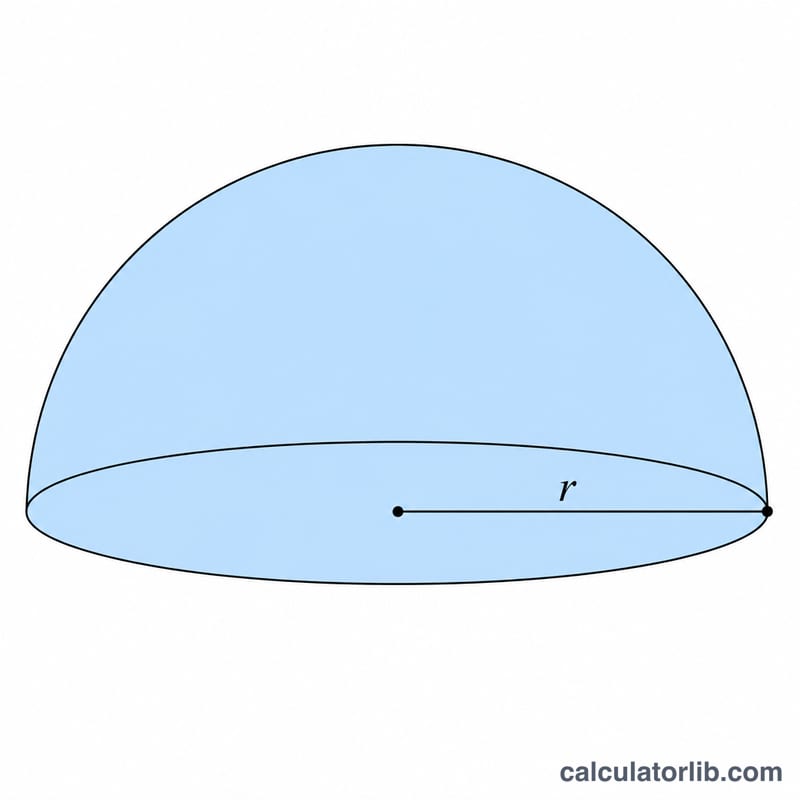
Pick what you already know from the dropdown, type that value, choose a length unit (purely a display label — no unit conversion is performed), set how many significant figures you want, and optionally override the value of pi. The tool first solves for the radius, then derives the base circumference, volume, curved surface area, base surface area, and total surface area. Each result is also shown "in terms of pi" as a coefficient multiplied by pi.
The formulas explained
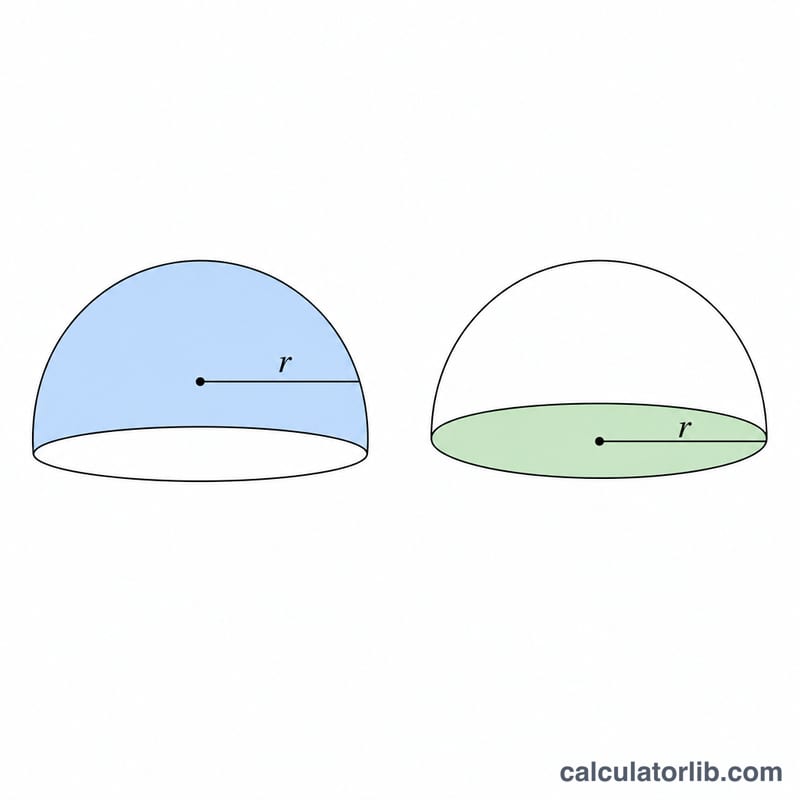
For radius \(r\) and pi the relationships are: base circumference \(C = 2\pi r\); volume \(V = \frac{2}{3}\pi r^3\); curved surface area \(A = 2\pi r^2\) (half the full sphere area \(4\pi r^2\)); flat base area \(B = \pi r^2\); and total surface area \(K = A + B = 3\pi r^2\). When a non-radius value is given, the calculator inverts the matching formula: $$r = \sqrt[3]{\frac{3V}{2\pi}},\quad r = \sqrt{\frac{A}{2\pi}},\quad r = \sqrt{\frac{K}{3\pi}},\quad r = \frac{C}{2\pi}.$$
Worked example
Take radius \(r = 5\) with \(\pi = 3.14159265359\) and 6 significant figures. $$C = 2\pi (5) = 31.4159.$$ $$V = \frac{2}{3}\pi (125) = 261.799.$$ $$A = 2\pi (25) = 157.080.$$ $$B = \pi (25) = 78.5398.$$ $$K = 3\pi (25) = 235.619.$$ Notice \(K = A + B = 157.080 + 78.5398 = 235.619\), confirming the total surface area.
More Worked Examples: Solving from Volume or Surface Area
You do not need the radius to start. Invert the relevant formula to find r, then derive everything else. The formulas are V = (2/3)πr³, A = 2πr² (curved), B = πr² (base), K = 3πr² (total) and C = 2πr (base circumference).
Example 1: Starting from the volume
Suppose a hemisphere has volume \(V = \dfrac{2000\pi}{3} \approx 2094.395\) cubic units. A note on the numbers: 523.599 (exactly 500π/3) is the volume of a full sphere of radius 5. A hemisphere of radius 5 has volume 250π/3 ≈ 261.799. A hemisphere with V = 500π/3 would have \(r=\sqrt[3]{250}\approx 6.300\). The clean example below uses r = 10 instead.
- Solve for r: $$r = \sqrt[3]{\frac{3V}{2\pi}} = \sqrt[3]{\frac{3 \cdot 2000\pi/3}{2\pi}} = \sqrt[3]{1000} = 10$$
- Base circumference: \(C = 2\pi r = 2\pi(10) = 20\pi \approx 62.832\)
- Curved area: \(A = 2\pi r^2 = 2\pi(100) = 200\pi \approx 628.319\)
- Base area: \(B = \pi r^2 = 100\pi \approx 314.159\)
- Total area: \(K = 3\pi r^2 = 300\pi \approx 942.478\)
Example 2: Starting from the total surface area
Suppose the total surface area is \(K = 75\pi \approx 235.619\) square units.
- Solve for r: $$r = \sqrt{\frac{K}{3\pi}} = \sqrt{\frac{75\pi}{3\pi}} = \sqrt{25} = 5$$
- Volume: \(V = \tfrac{2}{3}\pi r^3 = \tfrac{2}{3}\pi(125) = \dfrac{250\pi}{3} \approx\) 261.799
- Base circumference: \(C = 2\pi(5) = 10\pi \approx 31.416\)
- Curved area: \(A = 2\pi(25) = 50\pi \approx 157.080\)
- Base area: \(B = \pi(25) = 25\pi \approx 78.540\)
- Check: \(A + B = 50\pi + 25\pi = 75\pi = K\)
Hemisphere Properties at Different Radii
Each entry shows the coefficient of π (C = 2r, A = 2r², B = r², K = 3r², V = 2r³/3) followed by the decimal value.
| Radius r | Circumference C | Curved area A | Base area B | Total area K | Volume V |
|---|---|---|---|---|---|
| 1 | 2π ≈ 6.283 | 2π ≈ 6.283 | π ≈ 3.142 | 3π ≈ 9.425 | 2π/3 ≈ 2.094 |
| 2 | 4π ≈ 12.566 | 8π ≈ 25.133 | 4π ≈ 12.566 | 12π ≈ 37.699 | 16π/3 ≈ 16.755 |
| 5 | 10π ≈ 31.416 | 50π ≈ 157.080 | 25π ≈ 78.540 | 75π ≈ 235.619 | 250π/3 ≈ 261.799 |
| 10 | 20π ≈ 62.832 | 200π ≈ 628.319 | 100π ≈ 314.159 | 300π ≈ 942.478 | 2000π/3 ≈ 2094.395 |
Scaling rule: doubling r doubles the circumference (r¹), quadruples every area (r²) and multiplies the volume by 8 (r³). Compare r = 5 with r = 10: C goes from 10π to 20π (×2), K from 75π to 300π (×4) and V from 250π/3 to 2000π/3 (×8).
Key Terms and Symbols
- Hemisphere: exactly half of a sphere, cut by a plane through its center. It has one curved surface and one flat circular face.
- Radius (r): the distance from the center of the flat face to any point on its edge, and also to any point on the curved surface. Unit: length (for example m, cm, ft).
- Base: the flat circular face. Its area is B = πr², in length².
- Base circumference (C): the length of the circular edge, C = 2πr. Unit: length.
- Curved (lateral) surface area (A): the area of the dome only, A = 2πr², which is half the surface of a full sphere. Unit: length².
- Total surface area (K): curved area plus base area, K = A + B = 3πr². Unit: length².
- Volume (V): the space enclosed, V = (2/3)πr³. Since a hemisphere is exactly half a sphere, this is half of (4/3)πr³. Unit: length³ (for example m³ or cm³).
- In terms of π: an exact answer that keeps the symbol π, such as 75π, instead of a rounded decimal such as 235.619. It avoids rounding error until the final step.
FAQ
Does it convert units? No. The unit dropdown only labels the answers — linear results carry the unit, areas carry unit squared, and the volume carries unit cubed, all in whatever unit you entered.
Why can I change pi? Some textbooks use 3.14 or 22/7. Overriding pi lets your answer match a specific assignment, though the default gives the most accurate result.
What does "in terms of pi" mean? It is the exact symbolic value, e.g. a volume of 261.799 equals 83.3333 multiplied by pi, which avoids rounding error in further calculations.