
What is a Hemisphere?
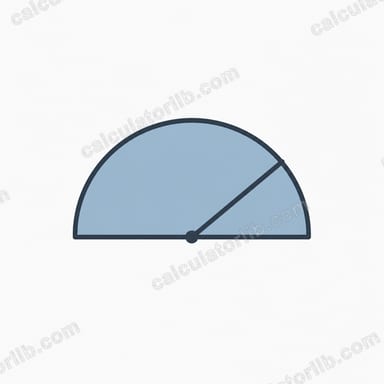
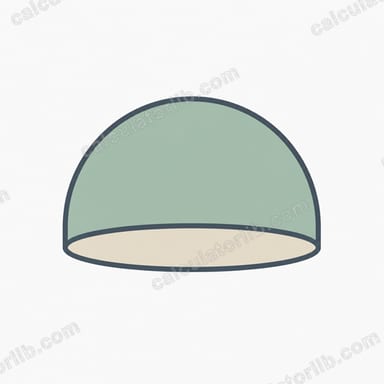
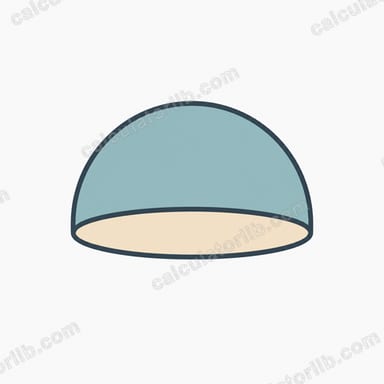
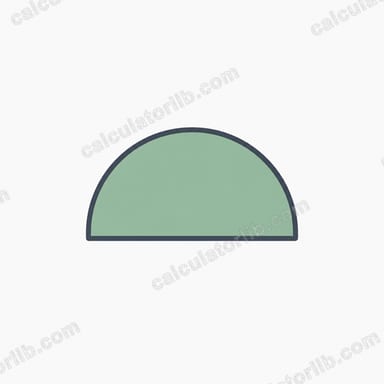
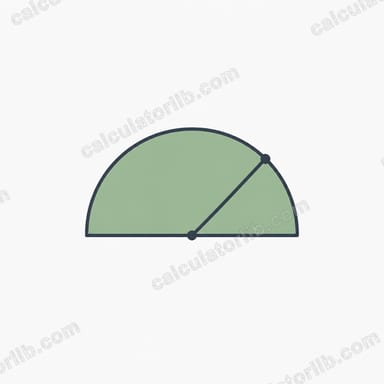
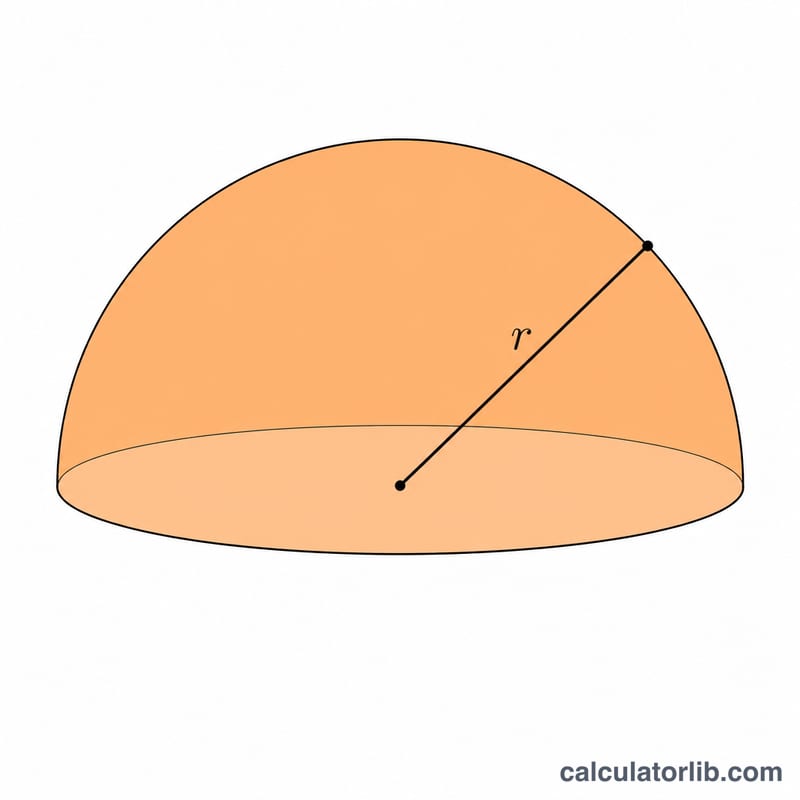
A hemisphere is exactly half of a sphere, formed by cutting a sphere through its center. It has one curved surface and one flat circular base. This calculator works out the key geometric properties — volume, curved surface area, flat base area, total surface area, and base circumference — directly from the radius.
How to Use It
Enter the radius (\(r\)) of the hemisphere in any unit you like. The calculator returns the volume in cubic units and the areas in square units. Because the formulas are pure geometry, they work for any consistent unit — centimeters, inches, meters, and so on.
The Formulas Explained
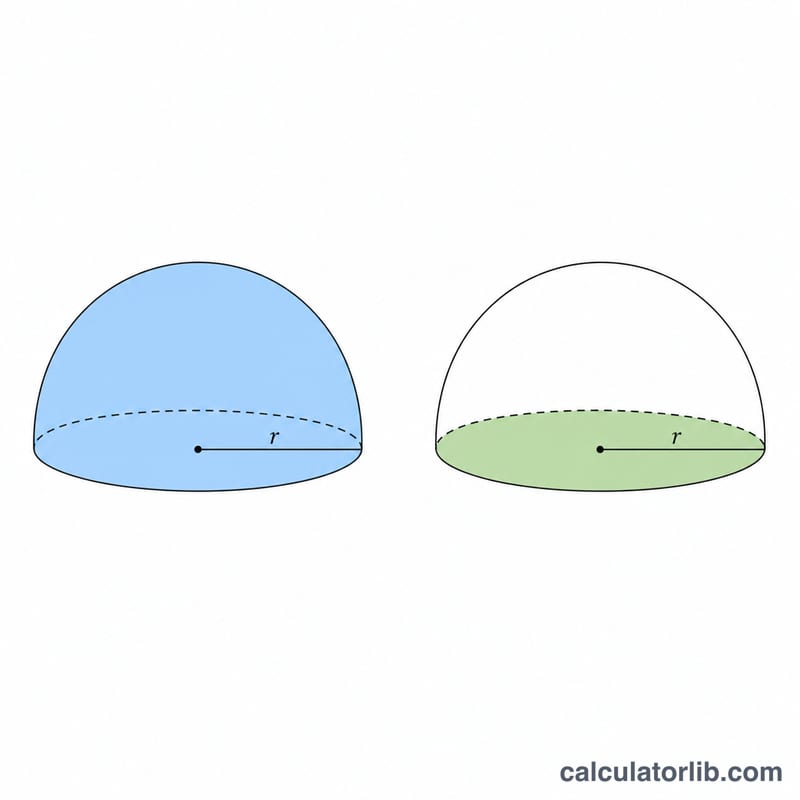
The volume is half that of a full sphere: $$V = \frac{2}{3}\pi r^{3}$$ The curved (dome) surface area is half a sphere's surface: $$A_{curved} = 2\pi r^{2}$$ The flat circular base adds \(\pi r^{2}\), so the total surface area is $$2\pi r^{2} + \pi r^{2} = 3\pi r^{2}$$ The circumference of the circular base is \(C = 2\pi r\).
Worked Example
For a radius of 5 units: $$V = \frac{2}{3}\pi \cdot 5^{3} = \frac{2}{3}\pi \cdot 125 \approx 261.8 \text{ cubic units}$$ Curved area \(= 2\pi \cdot 25 \approx 157.08\), base area \(= \pi \cdot 25 \approx 78.54\), total area \(= 3\pi \cdot 25 \approx 235.62\) square units, and base circumference \(= 2\pi \cdot 5 \approx 31.42\) units.
FAQ
Does total surface area include the flat base? Yes. The total of \(3\pi r^{2}\) adds the flat circular base (\(\pi r^{2}\)) to the curved dome (\(2\pi r^{2}\)). If you only need the dome, use the curved surface area.
What units does it use? Any — just be consistent. If \(r\) is in cm, volume is in cm³ and areas in cm².
How does this compare to a sphere? A hemisphere has exactly half the volume and half the curved surface of a full sphere of the same radius, plus the extra flat base.