
What Is the Hemisphere Volume Calculator?
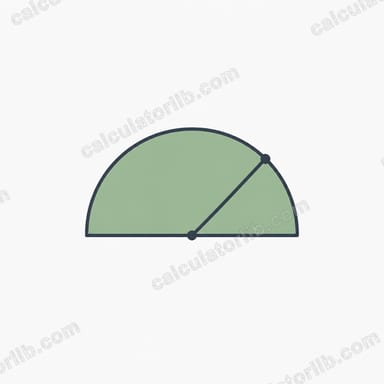
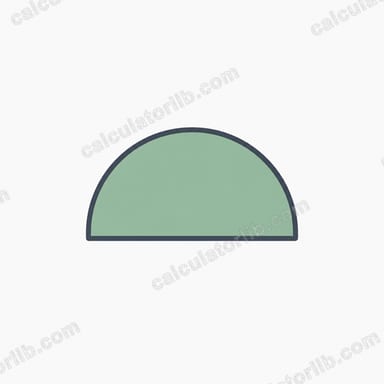
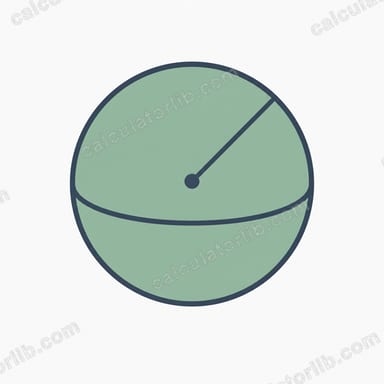
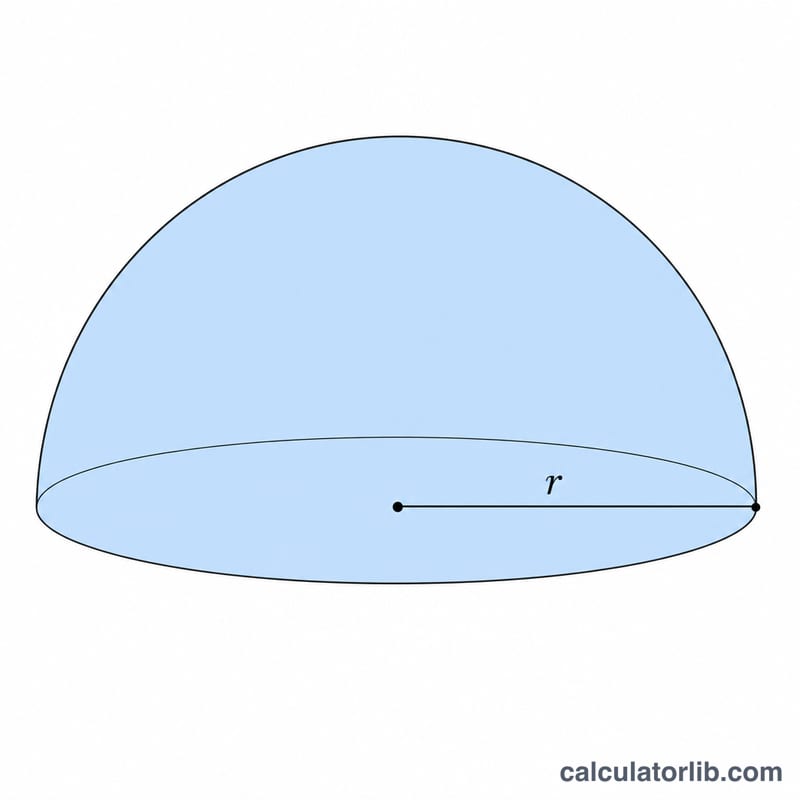
A hemisphere is exactly half of a sphere — picture a sphere sliced straight through its centre, leaving a dome shape with a flat circular base. This calculator works out the volume of that dome from a single measurement: the radius. The radius is the distance from the centre of the flat base to any point on the rounded surface (it is the same as the radius of the original sphere).
Beyond volume, the tool also reports several related measurements derived from the same radius, so you get a complete picture of the shape in one calculation.
How to Use It
- Radius: Enter the radius of the hemisphere in your chosen unit (cm, m, inches, etc.).
- The calculator instantly returns the volume plus the total surface area, curved surface area, base area and base circumference.
Use the same unit throughout. Volume results are in cubic units (e.g. cm³), areas in square units (cm²), and circumference in linear units (cm).
The Formula Explained
The core formula is:
Volume = (2/3) × π × r³
This is exactly half the volume of a full sphere, which is (4/3)πr³. The calculator also computes:
- Total surface area = 3πr² (the curved dome 2πr² plus the flat circular base πr²)
- Curved surface area = 2πr² (the dome only, no base)
- Base area = πr² (the flat circle)
- Base circumference = 2πr (the edge of that circle)
Worked Example
Suppose a hemisphere has a radius of 6 cm.
- Volume = (2/3) × π × 6³ = (2/3) × π × 216 ≈ 452.39 cm³
- Total surface area = 3 × π × 6² = 108π ≈ 339.29 cm²
- Curved surface area = 2 × π × 36 ≈ 226.19 cm²
- Base area = π × 36 ≈ 113.10 cm²
- Base circumference = 2 × π × 6 ≈ 37.70 cm
Frequently Asked Questions
Is a hemisphere's volume half a sphere's volume? Yes. Since a sphere is (4/3)πr³, halving it gives (2/3)πr³ — precisely what this tool calculates.
Why is the total surface area 3πr² and not 2πr²? A hemisphere has two surfaces: the rounded dome (2πr²) and the flat circular base (πr²). Adding them gives 3πr². Use the curved surface area (2πr²) only when the base is open.
What if I only know the diameter? Divide the diameter by 2 to get the radius, then enter that value.