
What the Sphere Volume Calculator Does
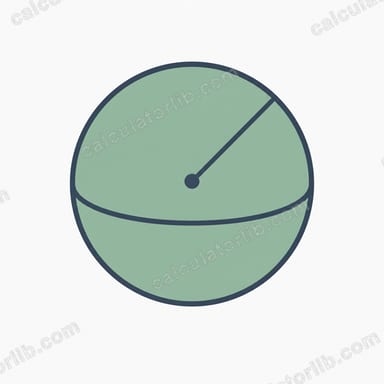
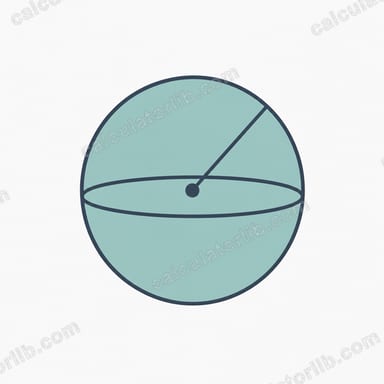
This calculator finds the volume of a perfect sphere from a single measurement: its radius. Enter the radius and the tool instantly returns the enclosed three-dimensional space inside the sphere. As a bonus, it also computes the sphere's surface area using the same radius, so you get two key geometric properties in one step. It works with any unit of length — just keep your units consistent and read the results accordingly (cubic units for volume, square units for surface area).
The Formula Explained
Volume is calculated with the classic geometry formula:
$$V = \frac{4}{3} \times \pi \times r^{3}$$
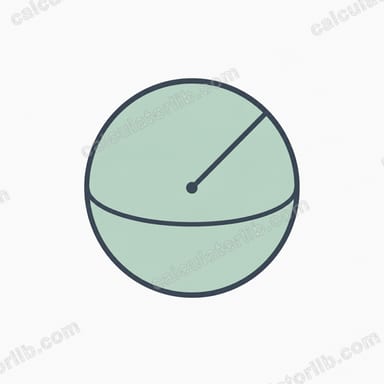
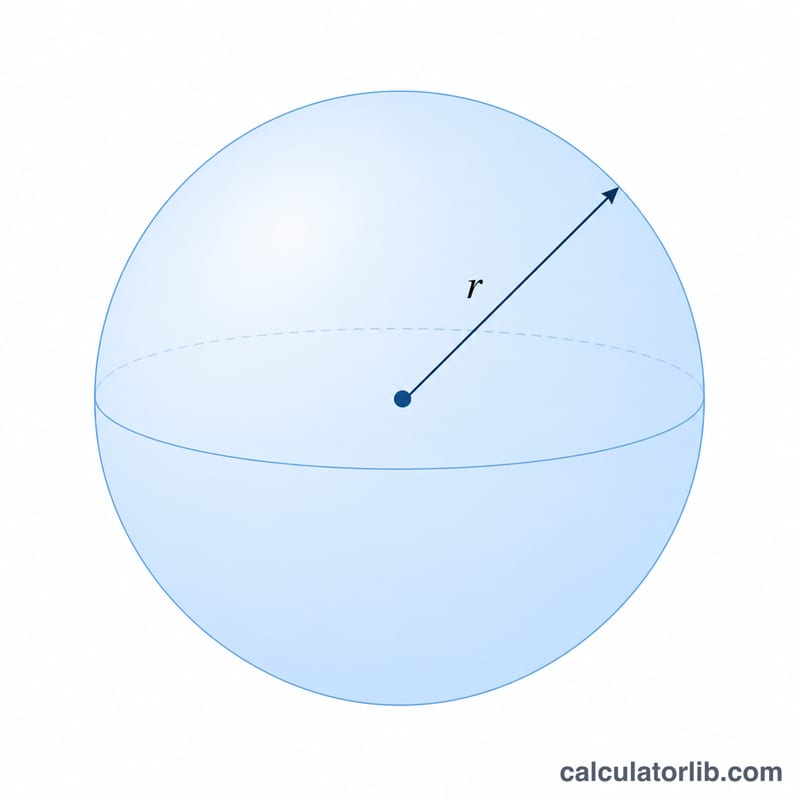
Here r is the radius (the distance from the centre of the sphere to its surface) and \(\pi\) is approximately 3.14159. Because the radius is cubed, volume grows very fast as the sphere gets larger — doubling the radius multiplies the volume by eight.
The calculator also returns the surface area using:
$$A = 4 \times \pi \times r^{2}$$
- Radius (\(r\)): the only input you supply.
- Volume (\(V\)): the main output, in cubic units.
- Surface area (\(A\)): a secondary output, in square units.
Worked Example
Suppose you have a ball with a radius of 5 cm.
- Volume: $$V = \frac{4}{3} \times \pi \times 5^{3} = \frac{4}{3} \times 3.14159 \times 125 \approx 523.60 \text{ cm}^{3}$$
- Surface area: $$A = 4 \times \pi \times 5^{2} = 4 \times 3.14159 \times 25 \approx 314.16 \text{ cm}^{2}$$
So a 5 cm sphere holds about 523.6 cubic centimetres and has a surface of roughly 314.2 square centimetres.
Frequently Asked Questions
What if I only know the diameter? Divide the diameter by two to get the radius, then enter that value. A 10 cm diameter ball has a 5 cm radius.
Which units does it use? The calculator is unit-agnostic. If you enter the radius in metres, the volume comes out in cubic metres; enter inches and you get cubic inches. Always match your input unit to your intended output.
Does this work for a hemisphere? Not directly. For half a sphere, calculate the full sphere volume here and divide the result by two.