
What This Calculator Does
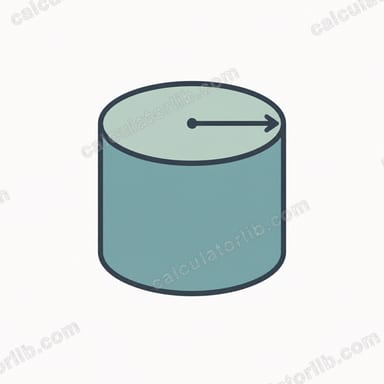
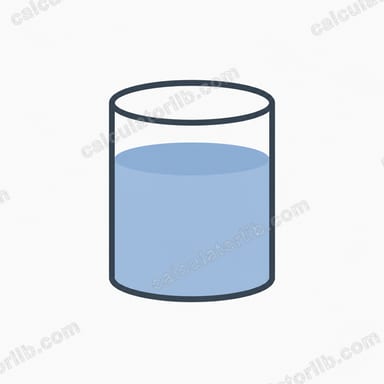
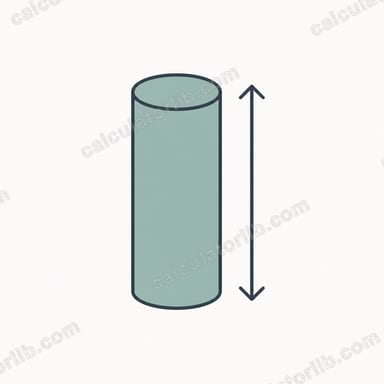
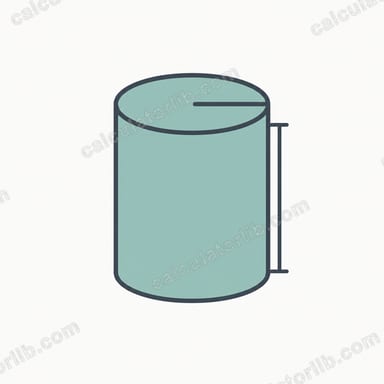
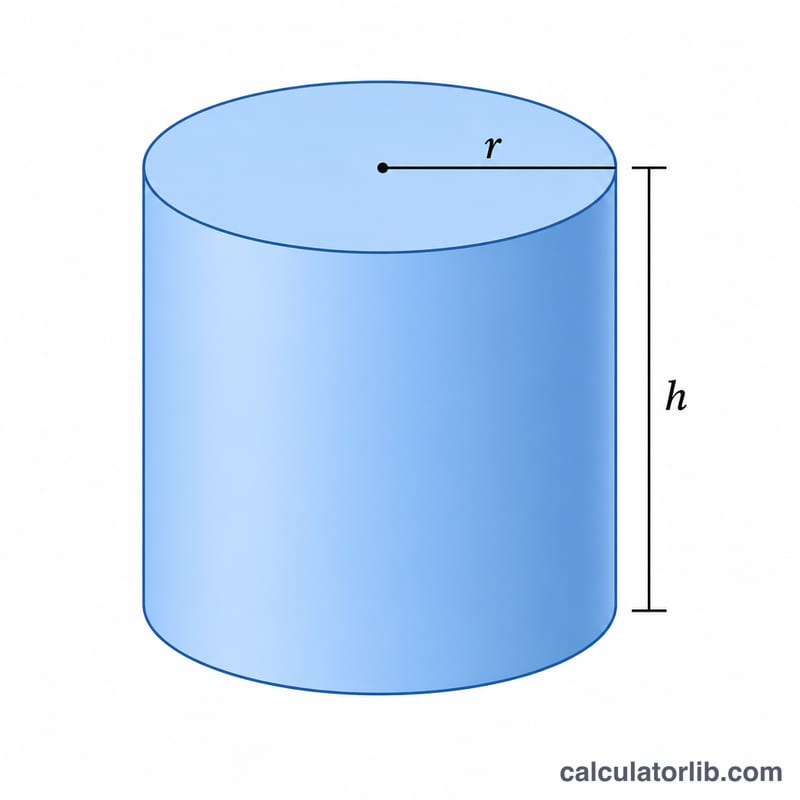
The Right Circular Cylinder Volume Calculator works out how much space a cylinder holds using just two measurements: its radius and its height. A "right circular cylinder" simply means a tube with circular ends where the side stands perpendicular (at 90°) to the base — think of a can, a pipe, or a water tank. Enter the two values and the tool instantly returns the volume, and it also computes the base area, lateral (side) surface area and total surface area in the same pass.
The Inputs You Provide
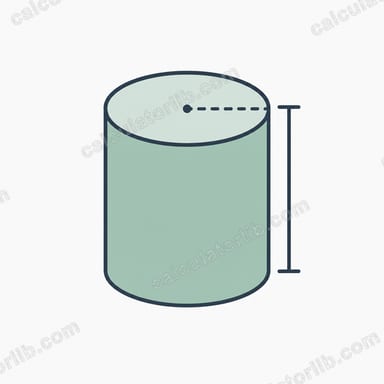
- Radius (\(r\)): the distance from the centre of the circular base to its edge.
- Height (\(h\)): the straight-line distance between the two circular ends.
Use the same unit for both fields. The volume comes out in those units cubed — if you enter centimetres, you get cubic centimetres (cm³); if you enter metres, you get cubic metres (m³).
The Formula Explained
The calculator applies the standard geometric formula:
$$V = \pi \times r^{2} \times h$$
The base of the cylinder is a circle with area \(\pi r^2\). Stacking that circular area through the full height \(h\) fills the cylinder, so multiplying the base area by the height gives the volume. Alongside this, the tool derives:
- Base area = \(\pi r^2\)
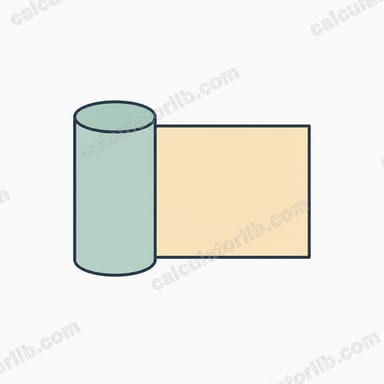
- Lateral surface area = \(2\pi r h\) (the curved side only)
- Total surface area = \(2\pi r (r + h)\) (both ends plus the side)
Worked Example
Suppose a cylindrical tank has a radius of 3 m and a height of 5 m.
- Volume = \(\pi \times 3^{2} \times 5 = \pi \times 9 \times 5 = 45\pi \approx\) 141.37 m³
- Base area = \(\pi \times 3^{2} \approx 28.27\) m²
- Lateral surface area = \(2\pi \times 3 \times 5 \approx 94.25\) m²
- Total surface area = \(2\pi \times 3 \times (3 + 5) \approx 150.80\) m²
Frequently Asked Questions
What if I only know the diameter? Divide the diameter by two to get the radius, then enter that value. A 10 cm diameter means a 5 cm radius.
How do I find the capacity in litres? Calculate the volume in cubic centimetres, then divide by 1,000 — since 1 litre equals 1,000 cm³. The 141.37 m³ example above equals 141,370 litres.
Does this work for tilted or oblique cylinders? No. This formula assumes a right cylinder where the side is square to the base. For slanted cylinders the volume formula differs, though the base-area-times-perpendicular-height principle still applies.