
What the Capsule Volume Calculator Does
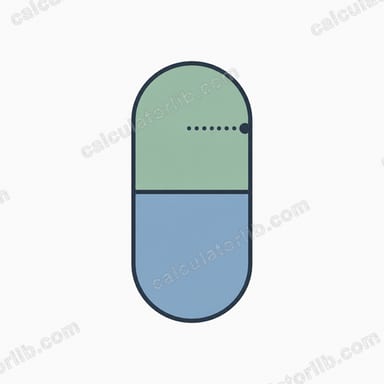
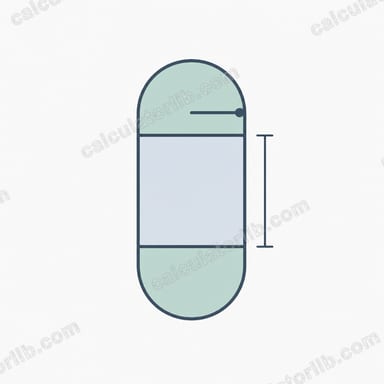
A capsule is a geometric shape made of a cylinder with a hemisphere capped on each end — exactly the silhouette of a pharmaceutical pill. This calculator works out the total volume of that shape from just two measurements: the base radius and the cylindrical height. It is useful for pharmaceutical formulation, packaging design, tank and pressure-vessel engineering, and any project that involves a rounded-end cylinder.
The Inputs You Provide
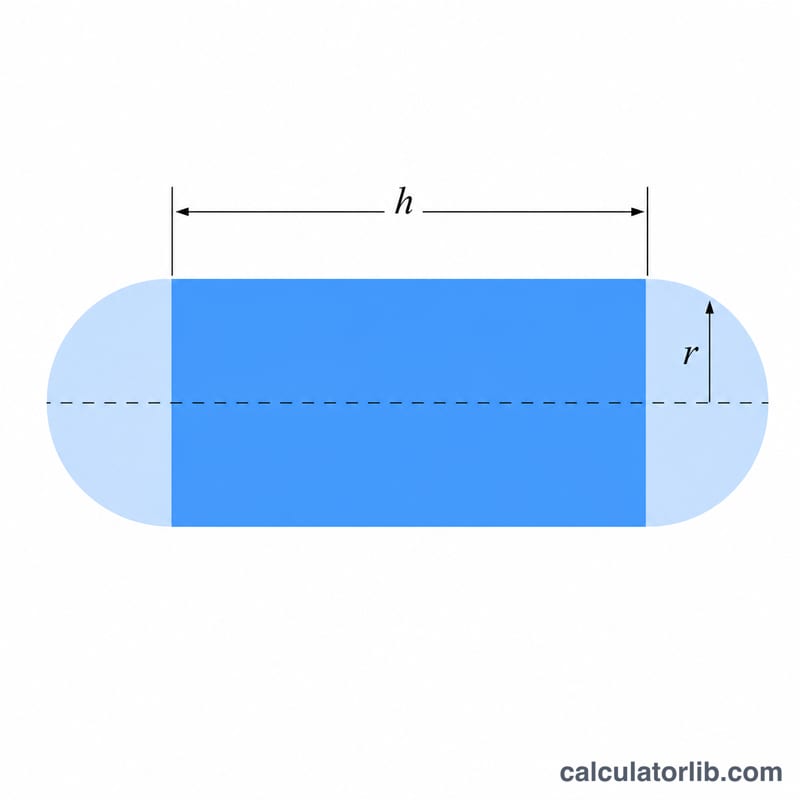
- Base Radius (r): the radius of the cylindrical body, which is also the radius of each hemispherical end. Both ends share this same radius.
- Height (h): the length of the straight cylindrical section only — not the total length of the capsule. The two hemispheres add their own length on top of this.
The Formula Explained
The calculator uses:
$$V = \pi r^{2}\left(\frac{4}{3}r + h\right)$$
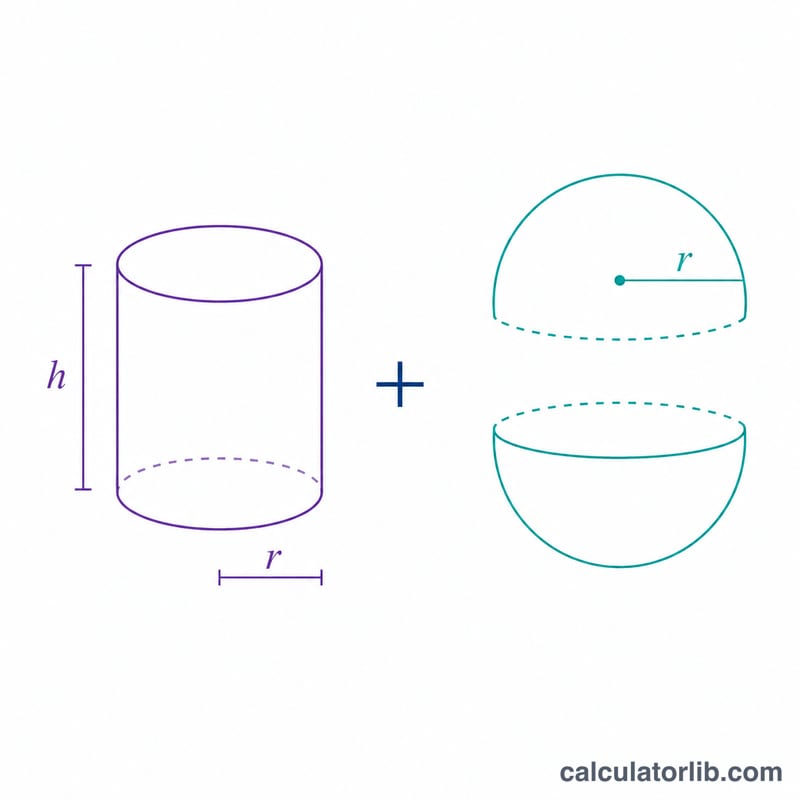
This combines two parts. The cylinder contributes \(\pi r^{2}h\). The two hemispheres together form one complete sphere, whose volume is \(\frac{4}{3}\pi r^{3}\). Factoring out \(\pi r^{2}\) gives the compact form above. The tool also reports the surface area using \(A = 2\pi r(2r + h)\), which adds the cylinder's lateral surface to the full sphere's surface.
Worked Example
Suppose a capsule has a base radius of \(r = 3\) units and a cylindrical height of \(h = 10\) units.
- Inner bracket: $$\frac{4}{3}(3) + 10 = 4 + 10 = 14$$
- Volume: $$\pi \times 3^{2} \times 14 = \pi \times 9 \times 14 \approx 395.84 \text{ cubic units}$$
- Surface area: $$2\pi \times 3 \times (2\times 3 + 10) = 6\pi \times 16 \approx 301.59 \text{ square units}$$
Keep your radius and height in the same unit, and the volume comes out in that unit cubed.
Frequently Asked Questions
Is the height the total length of the capsule? No. The height (h) is only the straight cylindrical middle. The total end-to-end length equals \(h + 2r\), because each hemispherical cap adds one radius.
What happens if I set the height to zero? With \(h = 0\) the two hemispheres meet and the capsule becomes a perfect sphere, and the formula correctly reduces to \(\frac{4}{3}\pi r^{3}\).
What units does the result use? The calculator is unit-agnostic. Enter millimetres, centimetres or inches and the volume returns in those units cubed (mm³, cm³, in³). For pharmaceutical capsule sizing, working in millimetres gives volumes directly in mm³ (microlitres).