
What the Cube Volume Calculator Does
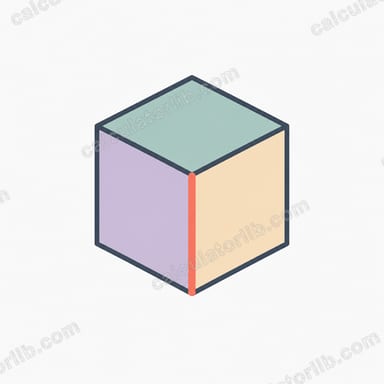
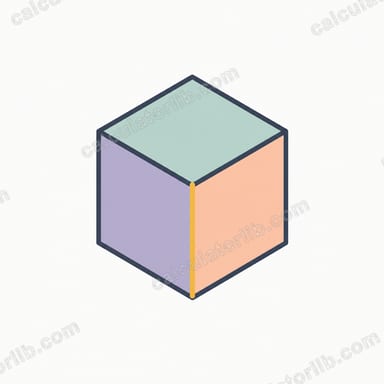
This calculator finds the volume of a cube — the amount of three-dimensional space enclosed inside it — from a single measurement. Because every edge of a cube is the same length, you only need to enter one value: the Side Length. From that single input, the tool instantly returns the cube's volume, and as helpful extras it also computes the total surface area and the space (body) diagonal.
The Formula Explained
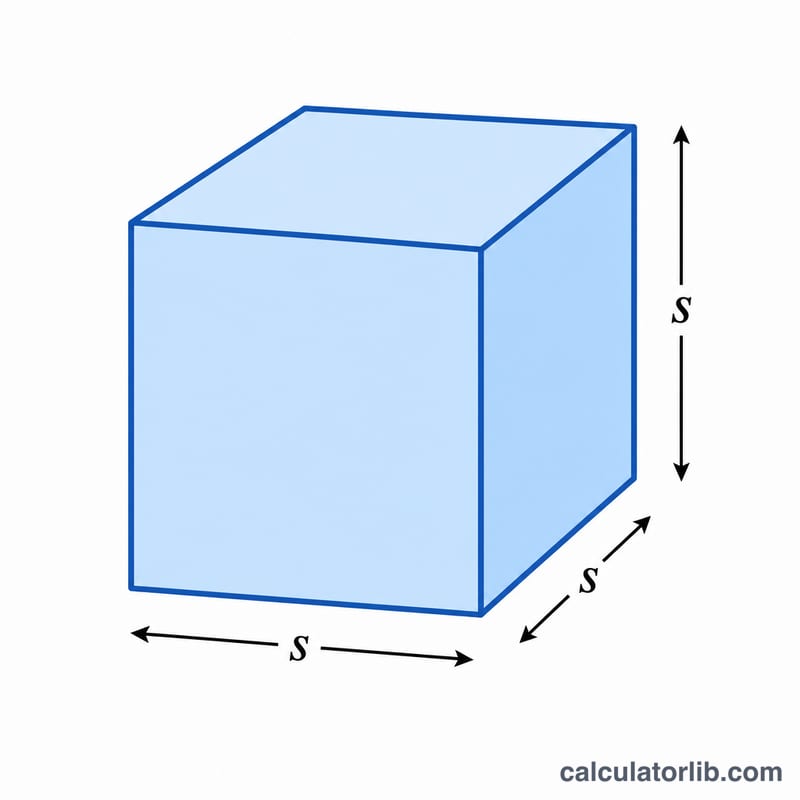
The core formula is:
- Volume: $$V = a^{3}$$ — the side length multiplied by itself three times.
The calculator also derives two related measurements from the same side length, a:
- Surface area: $$S = 6 \times a^{2}$$ — a cube has six identical square faces.
- Space diagonal: $$d = \sqrt{3} \times a$$ — the straight-line distance between two opposite corners through the cube's centre.
Whatever unit you use for the side length (cm, m, inches, feet) determines the output units: volume comes out in cubic units, surface area in square units, and the diagonal in the same linear unit.
How to Use It
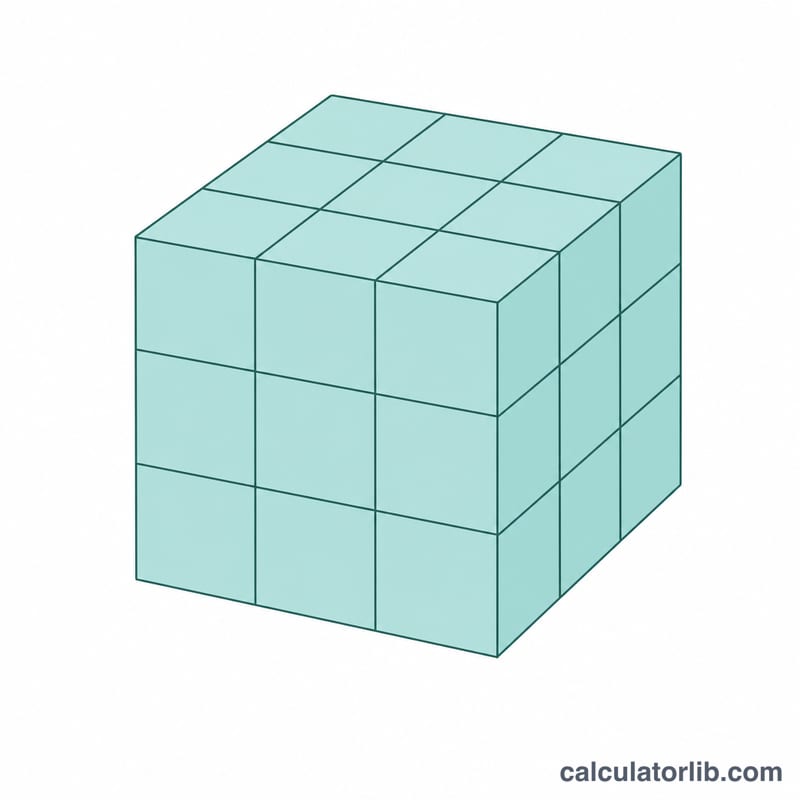
Enter the length of one edge in the Side Length field and submit. There is nothing else to set up — the cube's regular shape means one number defines everything.
Worked Example
Suppose you have a cube with a side length of 5 units:
- Volume = $$5^{3} = 5 \times 5 \times 5 = 125 \text{ cubic units}$$
- Surface area = $$6 \times 5^{2} = 6 \times 25 = 150 \text{ square units}$$
- Space diagonal = $$\sqrt{3} \times 5 \approx 1.732 \times 5 \approx 8.66 \text{ units}$$
So a cube measuring 5 cm on each edge holds 125 cubic centimetres of space.
Frequently Asked Questions
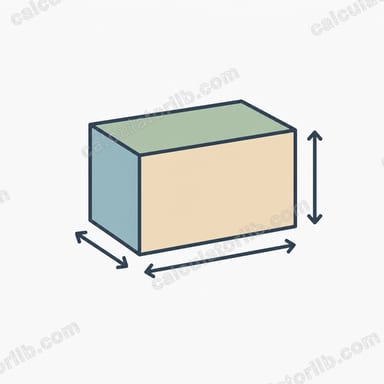
Why is the volume the side length cubed? A cube has equal length, width and height. Volume for any box is length \(\times\) width \(\times\) height, and since all three are the same value a, this simplifies to \(a \times a \times a = a^{3}\).
What units should I use? Any consistent unit works. The result follows your input — enter metres and you get cubic metres; enter inches and you get cubic inches. Just keep the unit in mind when reading the answer.
Can I use a decimal side length? Yes. The calculator accepts decimal values, so a side of 2.5 returns a volume of 15.625 cubic units. This is useful when working with precise real-world measurements.