
What This Tube Volume Calculator Does
This calculator finds the material volume of a hollow tube — the space the tube wall actually occupies, not the empty bore down its middle. By entering three measurements (outer diameter, inner diameter, and length) you instantly get the tube's volume, total surface area, and cross-sectional area. It works for any consistent unit (mm, cm, inches, metres), and your answer comes out in that unit cubed for volume and squared for area.
The Inputs You Provide
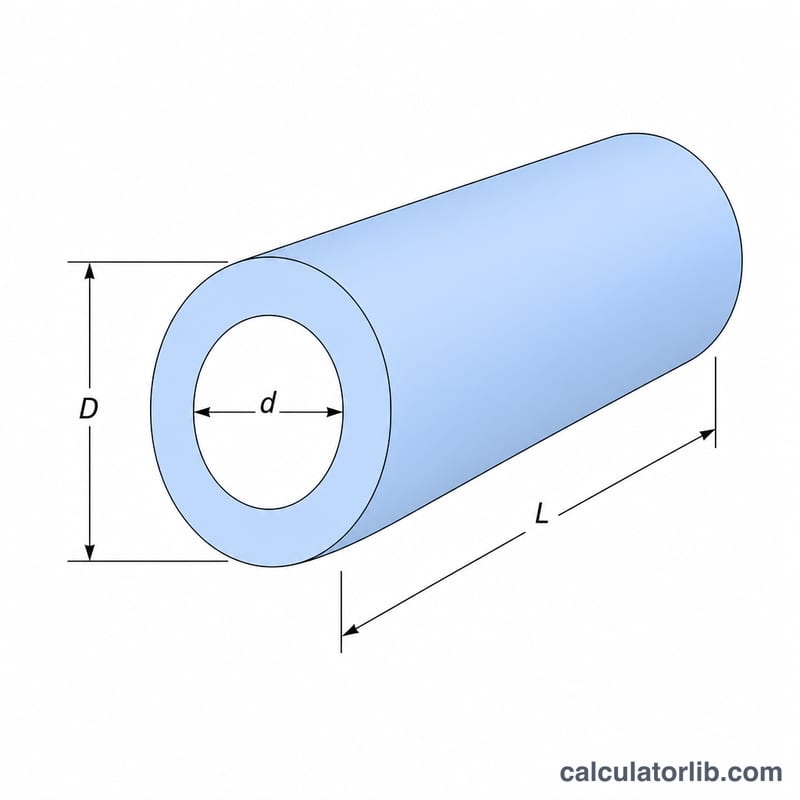
- Outer Diameter – the full width of the tube measured across the outside.
- Inner Diameter – the width of the hollow bore inside the tube.
- Length – how long the tube is end to end.
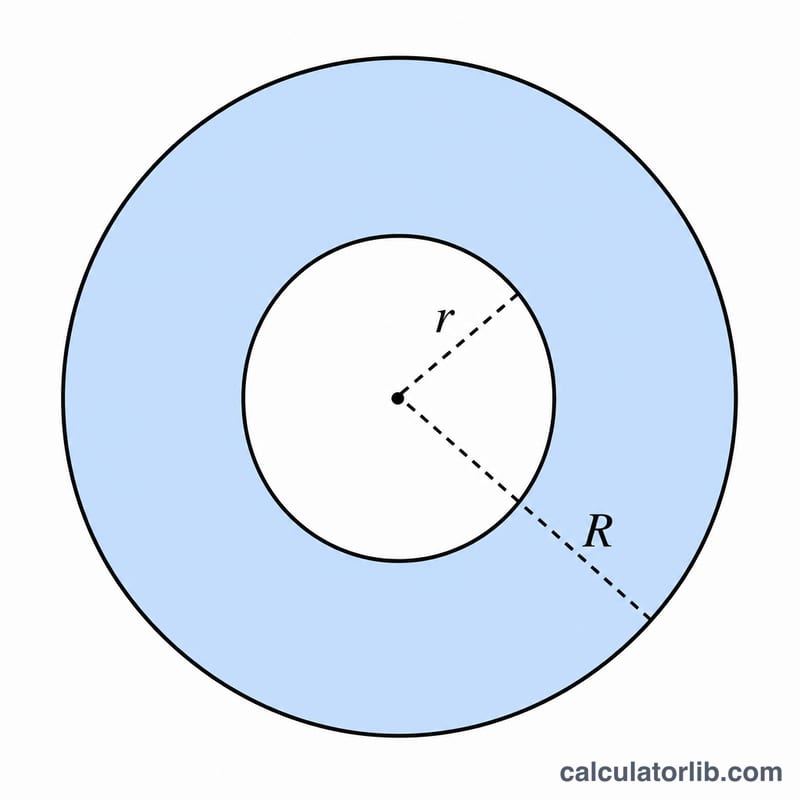
The calculator halves each diameter to get the outer and inner radius before doing the maths.
The Formula Explained
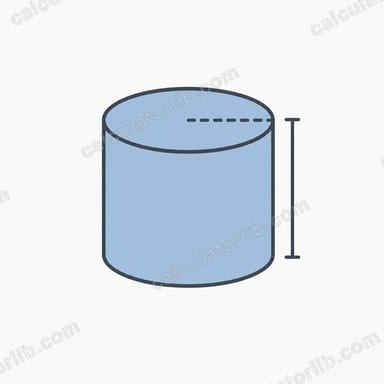
The volume of a hollow cylinder is the outer cylinder volume minus the inner (bore) volume:
$$V = \pi \left(r_{\text{outer}}^{2} - r_{\text{inner}}^{2}\right) \times L$$
It also returns:
- Cross-sectional area = \(\pi \left(r_{\text{outer}}^{2} - r_{\text{inner}}^{2}\right)\) — the ring-shaped end face.
- Surface area = \(2\pi \left(r_{\text{outer}} + r_{\text{inner}}\right) \times L + 2\pi \left(r_{\text{outer}}^{2} - r_{\text{inner}}^{2}\right)\) — the outer wall, inner wall, and both end rings combined.
Worked Example
Suppose a steel pipe has an outer diameter of 100 mm, an inner diameter of 80 mm, and a length of 500 mm. The radii are 50 mm and 40 mm.
- Cross-sectional area = \(\pi (50^2 - 40^2) = \pi (2500 - 1600) = 2827 \text{ mm}^2\)
- Volume = \(2827 \times 500 \approx 1{,}413{,}717 \text{ mm}^3\) (about 1.41 litres of steel)
- Surface area = \(2\pi (50 + 40) \times 500 + 2 \times 2827 \approx 288{,}398 \text{ mm}^2\)
FAQ
Does this give the volume of liquid the tube can hold? No — it gives the volume of the tube wall material. For the liquid capacity, use only the inner diameter as a solid cylinder.
What if I enter inner diameter as 0? The result becomes a solid cylinder, since there is no bore to subtract.
Which units should I use? Any, as long as all three inputs share the same unit. Volume returns in that unit cubed and areas in that unit squared.