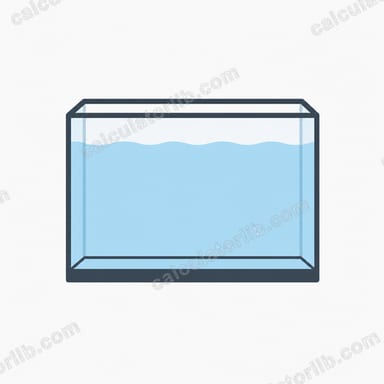

What This Calculator Does
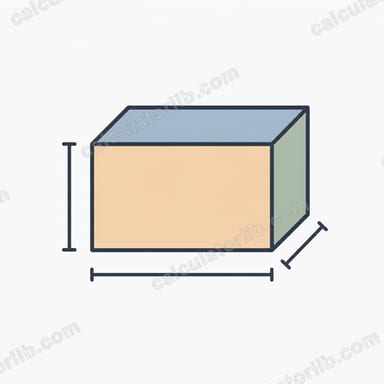
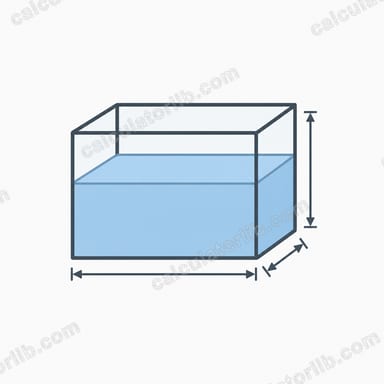
The Rectangular Tank Volume Calculator works out the internal capacity of any box-shaped (cuboid) tank from three simple measurements: its length, width, and height. It's handy for sizing water tanks, fuel storage, aquariums, shipping crates, and any container with flat sides and right-angled corners. As a bonus, it also returns the total surface area, which is useful for estimating material, paint, or insulation needs.
The Inputs You Provide
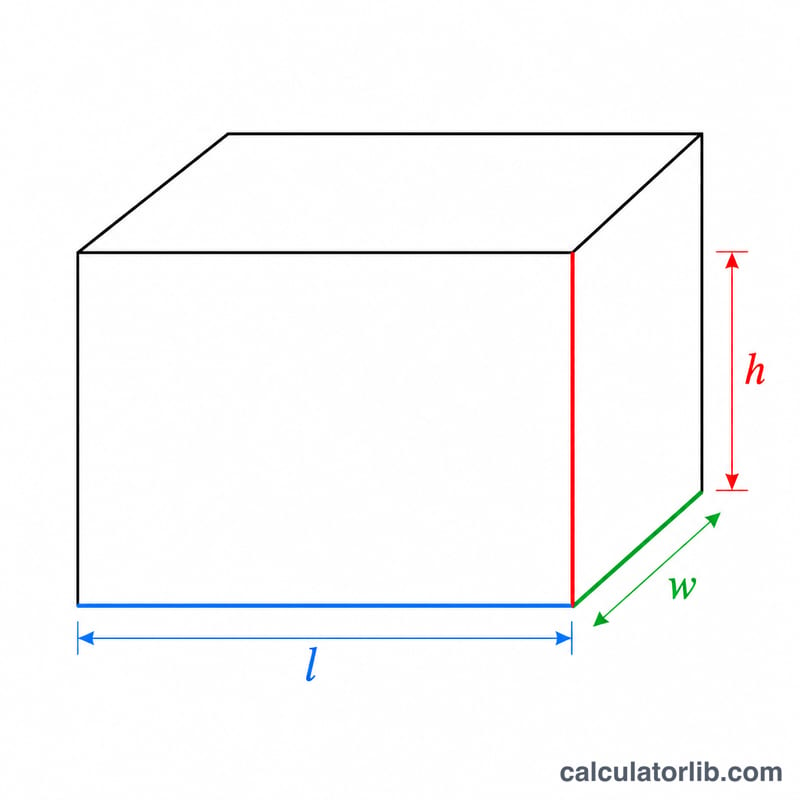
- Length (l) – the longest horizontal dimension of the tank.
- Width (w) – the shorter horizontal dimension across the base.
- Height (h) – the vertical dimension from base to top.
Use the same unit for all three values (for example all in metres, or all in centimetres). The volume comes back in that unit cubed, and the surface area in that unit squared.
The Formula
The volume is the straightforward product of all three dimensions:
$$V = l \times w \times h$$
The calculator also computes surface area using:
$$A = 2 \times (l\cdot w + l\cdot h + w\cdot h)$$
This sums the area of all six faces—top and bottom, front and back, two sides—and is reported alongside the volume.
Worked Example
Suppose you have a storage tank measuring 2 m long, 1.5 m wide, and 1 m high.
- Volume = \(2 \times 1.5 \times 1 = 3\) cubic metres (equal to 3,000 litres).
- Surface area = \(2 \times (2\times1.5 + 2\times1 + 1.5\times1) = 2 \times (3 + 2 + 1.5) = 2 \times 6.5 = 13\) square metres.
So the tank holds 3,000 L and has 13 m² of outer surface to coat or insulate.
Frequently Asked Questions
How do I convert cubic metres to litres? Multiply cubic metres by 1,000. The 3 m³ example above equals 3,000 litres. For US gallons, multiply litres by 0.264.
Can I use different units for each dimension? No—mix metres and centimetres and the result will be wrong. Convert everything to one consistent unit before entering values.
Does this work for cylindrical or irregular tanks? No. This formula only applies to rectangular (cuboid) tanks with flat sides and 90° corners. Round or sloped tanks need a different volume formula.