
What Is a Hemisphere's Surface Area?
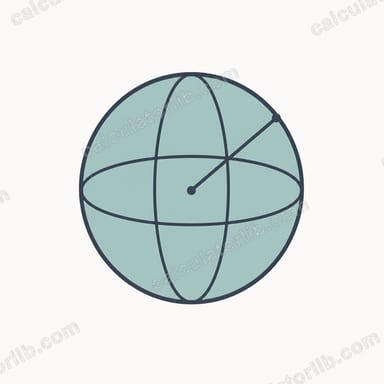
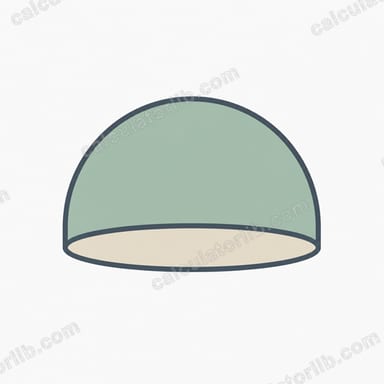
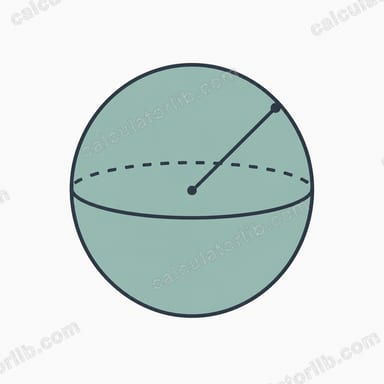
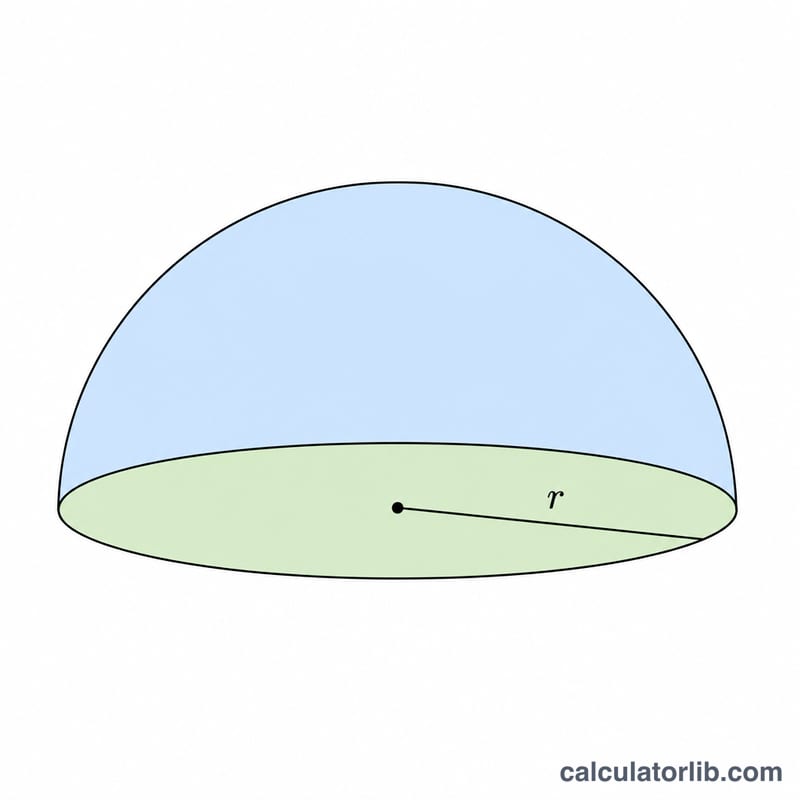
A hemisphere is exactly half of a sphere. A solid hemisphere has two distinct surfaces: the curved dome on the outside and the flat circular base where it was sliced. This calculator finds the total surface area of a solid hemisphere using only its radius.
How to Use This Calculator
Enter the radius r of the hemisphere in any unit of length (cm, m, inches, etc.) and the calculator instantly returns the total surface area along with the separate curved and base areas. The result is given in square units that match your input — if you enter centimeters, the area is in square centimeters.
The Formula Explained
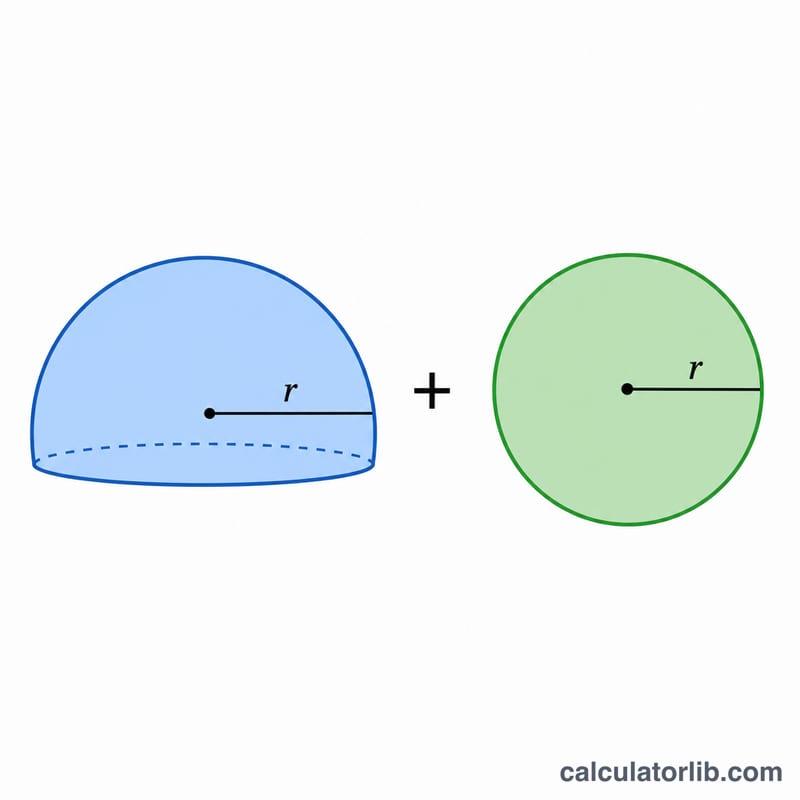
The curved part of a hemisphere is half of a sphere's surface area. A full sphere has area \(4\pi r^{2}\), so the curved (dome) portion is \(2\pi r^{2}\). The flat base is simply a circle of radius \(r\), with area \(\pi r^{2}\). Adding them together gives the total surface area of a solid hemisphere:
$$\text{Total SA} = 2\pi r^{2} + \pi r^{2} = 3\pi r^{2}$$
Note: if you only want the curved dome (an open or hollow hemisphere with no base), use \(2\pi r^{2}\) instead.
Worked Example
Suppose a solid hemisphere has a radius of 5 units. The curved surface is $$2\pi(5^{2}) = 2\pi\cdot 25 = 50\pi \approx 157.08.$$ The base is $$\pi(5^{2}) = 25\pi \approx 78.54.$$ The total surface area is $$3\pi(25) = 75\pi \approx 235.62 \text{ square units}.$$
FAQ
Does this include the flat base? Yes. The total uses \(3\pi r^{2}\), which includes both the curved dome (\(2\pi r^{2}\)) and the flat circular base (\(\pi r^{2}\)). If you need only the dome, use the curved-surface value shown.
What units does it use? Whatever unit you enter the radius in. The area comes out in that unit squared.
How is this different from a full sphere? A full sphere's surface area is \(4\pi r^{2}\). A solid hemisphere is \(3\pi r^{2}\) because you replace half the sphere's curved surface with a flat circular base.