What Is the Perimeter of a Pentagon?
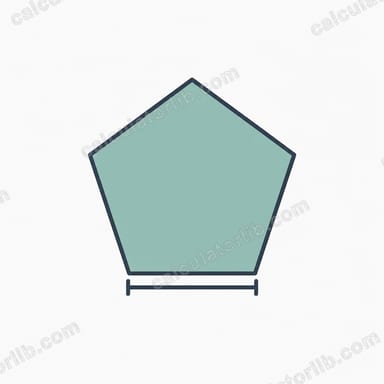
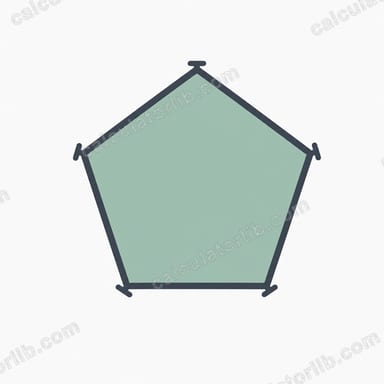
A pentagon is a five-sided polygon. The perimeter is the total distance around its outer edge — the sum of the lengths of all five sides. For a regular pentagon, where every side is equal in length, this calculation simplifies to a single multiplication: just multiply one side length by five.

How to Use This Calculator
Enter the length of one side of the regular pentagon and the calculator instantly returns the perimeter. The side length can be in any unit you like — centimeters, inches, meters, feet — and the result will be in that same unit. Make sure all measurements use the same unit before calculating.
The Formula Explained
The perimeter formula for a regular pentagon is:
$$P = 5 \times s$$
where P is the perimeter and s is the length of one side. Because all five sides of a regular pentagon are identical, adding them up \((s + s + s + s + s)\) is the same as multiplying \(s\) by 5. If your pentagon is irregular (sides of different lengths), you would instead add each individual side length together.

Worked Example
Suppose a regular pentagon has a side length of 8 cm. Plugging into the formula:
$$P = 5 \times 8 = 40 \text{ cm}$$
So the total distance around the pentagon is 40 centimeters.
Pentagon Perimeter for Common Side Lengths
For a regular pentagon (five equal sides), the perimeter is \(P = 5s\). The table below applies this to common side lengths. The unit of the perimeter is the same as the unit of the side (cm, m, in, and so on).
| Side length (s) | Calculation | Perimeter (P) |
|---|---|---|
| 1 | \(5 \times 1\) | 5 |
| 2.5 | \(5 \times 2.5\) | 12.5 |
| 5 | \(5 \times 5\) | 25 |
| 8 | \(5 \times 8\) | 40 |
| 10 | \(5 \times 10\) | 50 |
| 12 | \(5 \times 12\) | 60 |
| 20 | \(5 \times 20\) | 100 |
Because the perimeter is directly proportional to the side, doubling the side doubles the perimeter (for example, s = 5 gives 25, and s = 10 gives 50). This only applies to regular pentagons; for an irregular pentagon, add the five side lengths individually.
Unit Conversions for Perimeter
A perimeter is a length, so it converts like any other length. Convert the side or the final perimeter; the result is the same because the conversion is linear.
| Unit | Equivalent |
|---|---|
| 1 inch (in) | 2.54 cm (exact) |
| 1 foot (ft) | 12 in = 30.48 cm (exact) |
| 1 meter (m) | 100 cm = 3.28084 ft (rounded) |
| 1 yard (yd) | 0.9144 m (exact) |
| 1 kilometer (km) | 1000 m (exact) |
| 1 mile (mi) | 1.609344 km (exact) |
Example: cm to inches
A regular pentagon has side \(s = 12\) cm. Its perimeter is:
$$P = 5 \times 12 = 60\ \text{cm}$$
To convert to inches, divide by 2.54:
$$\frac{60}{2.54} \approx 23.62\ \text{in}$$
So the perimeter is about 23.62 inches.
Frequently Asked Questions
Does this work for irregular pentagons? No — the formula \(P = 5s\) assumes all sides are equal. For an irregular pentagon, add the five side lengths individually.
What units does the result use? The perimeter is returned in the same unit you used for the side length.
Can I find the side length from the perimeter? Yes — rearrange the formula to \(s = P \div 5\). For example, a perimeter of 35 means each side is \(35 \div 5 = 7\).