What this calculator does
This tool converts a fraction of an inch — such as 3/8", 11/16", or 1‑1/2" — into its decimal-inch value and into metric millimeters and centimeters. It is handy for woodworking, machining, sewing, 3D printing and any project where you need to translate fractional imperial measurements into precise decimal or metric figures.
How to use it
Enter the numerator (top number) and denominator (bottom number) of your fraction. If your measurement also has a whole-inch part, type it in the "Whole inches" field — otherwise leave it as 0. The calculator returns the decimal-inch equivalent, the millimeter value, and the centimeter value.
The formula explained
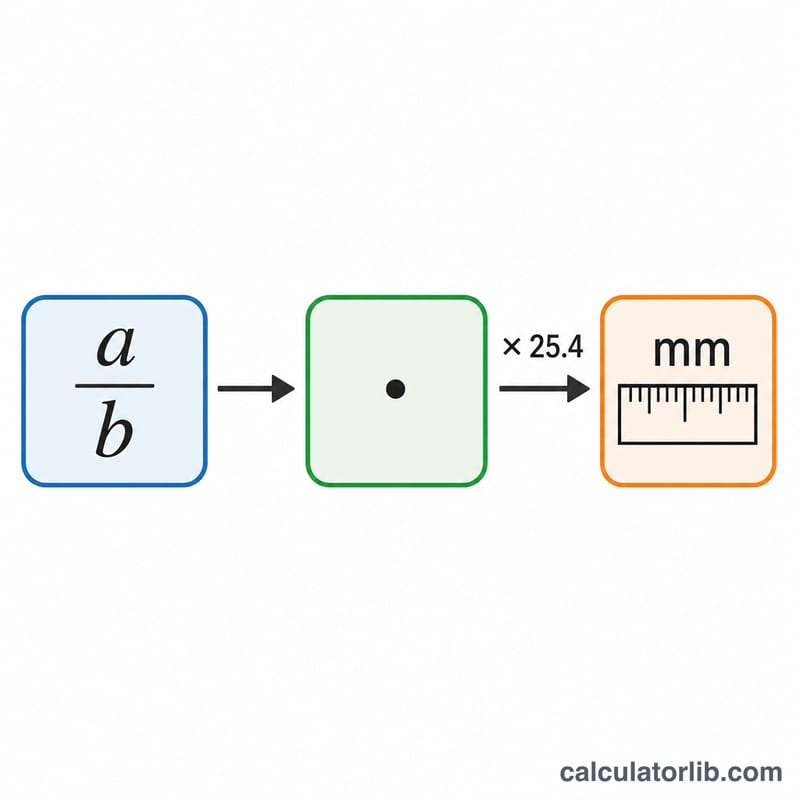
A fraction is simply a division: the fractional part equals the numerator a divided by the denominator b. Adding any whole inches w gives the total in decimal inches: $$\text{in} = w + \frac{a}{b}$$ Because one inch is defined as exactly 25.4 millimeters, the metric value is $$\text{mm} = \text{in} \times 25.4$$ and centimeters are simply \(\text{mm} \div 10\).
Worked example
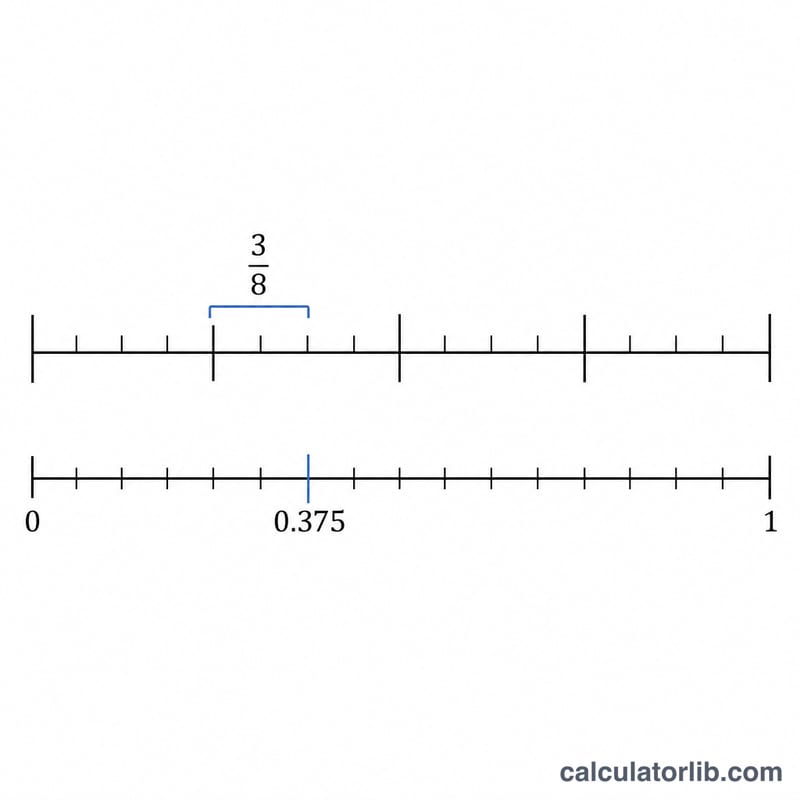
Convert 3/8 of an inch. The fraction $$3 \div 8 = 0.375$$ so the decimal value is 0.375 inches. In metric, $$0.375 \times 25.4 = 9.525 \text{ mm}$$ which is 0.9525 cm. For a measurement of 1‑1/2", enter whole = 1, numerator = 1, denominator = 2: that gives 1.5 in, or 38.1 mm.
Fraction of an Inch to Decimal and Millimeter Chart
This chart lists every 1/16-inch step from 1/16" to 1". The values are based on the international inch, which is defined as exactly 25.4 mm. Every decimal and millimeter value below is exact, with no rounding. To get decimal inches, divide the numerator by the denominator. To get millimeters, multiply the decimal inches by 25.4:
$$\text{mm} = \frac{\text{Numerator}}{\text{Denominator}} \times 25.4$$Each 1/16" step adds 0.0625 in, which is 1.5875 mm. For example, 3/8" works out to \(\frac{3}{8} = 0.375\) in, and \(0.375 \times 25.4 = 9.525\) mm.
| Fraction (in) | Decimal inches | Millimeters |
|---|---|---|
| 1/16 | 0.0625 | 1.5875 |
| 1/8 | 0.125 | 3.175 |
| 3/16 | 0.1875 | 4.7625 |
| 1/4 | 0.25 | 6.35 |
| 5/16 | 0.3125 | 7.9375 |
| 3/8 | 0.375 | 9.525 |
| 7/16 | 0.4375 | 11.1125 |
| 1/2 | 0.5 | 12.7 |
| 9/16 | 0.5625 | 14.2875 |
| 5/8 | 0.625 | 15.875 |
| 11/16 | 0.6875 | 17.4625 |
| 3/4 | 0.75 | 19.05 |
| 13/16 | 0.8125 | 20.6375 |
| 7/8 | 0.875 | 22.225 |
| 15/16 | 0.9375 | 23.8125 |
| 1 | 1.0 | 25.4 |
To convert to centimeters, divide the millimeter value by 10. For example, 1/2" = 1.27 cm. Smaller fractions follow the same pattern. Each 1/32" step is 0.03125 in (0.79375 mm), and each 1/64" step is 0.015625 in (0.396875 mm). For a whole number plus a fraction, add the whole inches first. For example, 2 3/4" = 2.75 in, and \(2.75 \times 25.4 = 69.85\) mm.
Common Fractions of an Inch Beyond 1 Inch and 1/32" Increments
The tables below use the international inch, defined as exactly 25.4 mm, so mm = inches × 25.4. Even 32nds reduce to simpler fractions (2/32 = 1/16, 4/32 = 1/8, and so on), so only the odd 32nds are listed.
| Fraction (in) | Decimal inches | Millimeters |
|---|---|---|
| 1/32 | 0.03125 | 0.79375 |
| 3/32 | 0.09375 | 2.38125 |
| 5/32 | 0.15625 | 3.96875 |
| 7/32 | 0.21875 | 5.55625 |
| 9/32 | 0.28125 | 7.14375 |
| 11/32 | 0.34375 | 8.73125 |
| 13/32 | 0.40625 | 10.31875 |
| 15/32 | 0.46875 | 11.90625 |
| 17/32 | 0.53125 | 13.49375 |
| 19/32 | 0.59375 | 15.08125 |
| 21/32 | 0.65625 | 16.66875 |
| 23/32 | 0.71875 | 18.25625 |
| 25/32 | 0.78125 | 19.84375 |
| 27/32 | 0.84375 | 21.43125 |
| 29/32 | 0.90625 | 23.01875 |
| 31/32 | 0.96875 | 24.60625 |
A few 64ths
| Fraction (in) | Decimal inches | Millimeters |
|---|---|---|
| 1/64 | 0.015625 | 0.396875 |
| 3/64 | 0.046875 | 1.190625 |
| 5/64 | 0.078125 | 1.984375 |
| 63/64 | 0.984375 | 25.003125 |
Mixed-number examples
| Mixed number | Decimal inches | Millimeters |
|---|---|---|
| 1-1/4" | 1.25 | 31.75 |
| 2-3/8" | 2.375 | 60.325 |
| 3-5/16" | 3.3125 | 84.1375 |
| 1-13/32" | 1.40625 | 35.71875 |
Worked substitution for 2-3/8": \(2 + \frac{3}{8} = 2.375\) in, and \(2.375 \times 25.4 = 60.325\) mm.
Key Terms: Numerator, Denominator, Mixed Number and International Inch
- Numerator: the top number of a fraction. It tells you how many equal parts you have (the 3 in 3/8).
- Denominator: the bottom number of a fraction. It tells you how many equal parts make one whole inch (the 8 in 3/8). It cannot be zero.
- Whole inches: the integer part of a measurement, such as the 2 in 2-3/8".
- Mixed number: a whole number plus a proper fraction, such as 1-1/4". Its decimal value is \(\text{whole} + \frac{\text{numerator}}{\text{denominator}}\).
- Decimal inch: the same length written in base 10, for example 3/8" = 0.375 in.
- International inch: the inch defined as exactly 25.4 mm. It was agreed in 1959 by the English-speaking countries' standards bodies and is the basis for all inch-to-metric conversion here. The older US survey inch differs very slightly and is not used in this calculator.
- Thousandths ("thou" or mil): a decimal subdivision, where 0.001 in = 1 thou = 0.0254 mm. Fractions split an inch into halves repeatedly (1/2, 1/4, 1/8 ... 1/64), while thou split it into 1000 equal parts. The two systems rarely match exactly: 1/64" is 15.625 thou.
Interpreting and Rounding Your Result
How many digits to keep depends on the job:
- Machining and metalworking: inch drawings commonly use 3 decimal places (thousandths of an inch). For example, 5/16" = 0.3125 in is usually written 0.313 in (or 0.3125 if four places are specified).
- General woodworking and construction: rounding millimeters to 0.1 mm or even 1 mm is normally enough. For instance, 3/4" = 19.05 mm, which is often treated as 19 mm.
- Smallest standard fractional step: on most fractional rulers and tape measures, 1/64" is the finest division. It equals 0.015625 in, or 0.396875 mm (about 0.4 mm), so reporting more than about 2 decimals in mm adds no real measuring precision for fractional work.
- Denominators that are not powers of 2: fractions such as 1/3 or 5/6 give repeating decimals (1/3 = 0.3333… in, which is 8.4667 mm to 4 decimals). The displayed value is rounded, so avoid re-converting a rounded figure back into a fraction when accuracy matters.
Fractions with denominators 2, 4, 8, 16, 32 and 64 always convert to exact, terminating decimals, so the values in the table above are exact. Tolerances on the actual part or material, and not the arithmetic, usually set how many digits are meaningful.
FAQ
Why is one inch exactly 25.4 mm? Since 1959 the international inch has been defined as precisely 25.4 millimeters, so the conversion is exact, not rounded.
Can I enter mixed numbers? Yes — put the whole number in the "Whole inches" field and the fraction in the numerator/denominator fields.
What if I enter 0 as the denominator? Division by zero is undefined, so the fraction is treated as zero to avoid an error; make sure the denominator is a real value like 2, 4, 8, 16, or 32.