
What Is a Fraction to Decimal Calculator?
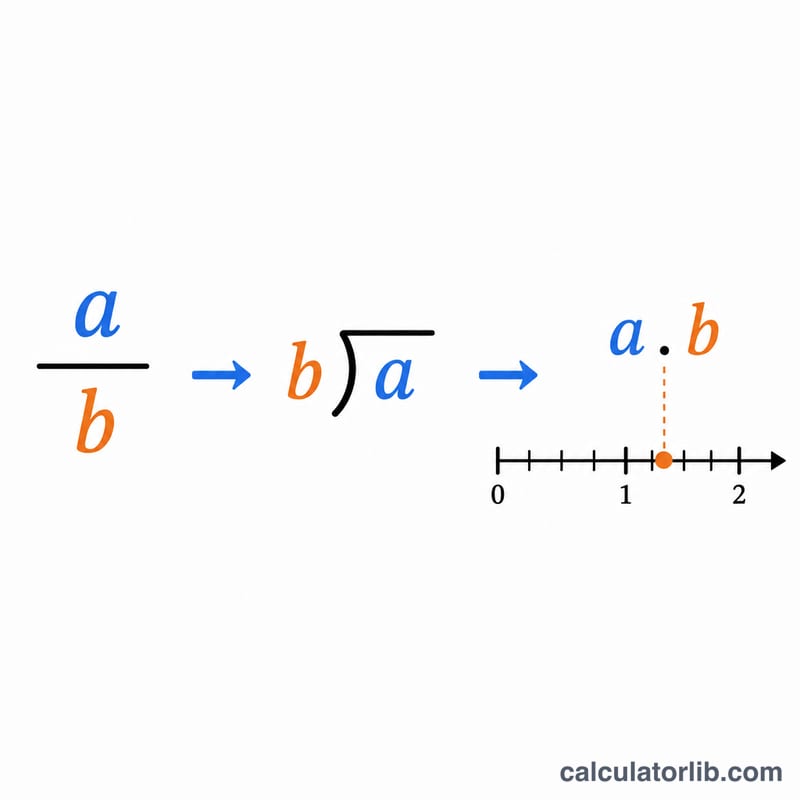
A fraction represents a part of a whole, written as a numerator (the top number) over a denominator (the bottom number). This calculator converts any such fraction into its decimal form by performing a simple division. It also shows the equivalent percentage so you can see the value in three common formats at once.
How to Use It
Enter the numerator in the first box and the denominator in the second box, then read off the decimal result. For example, the fraction 3/4 becomes 0.75. The denominator cannot be zero, since dividing by zero is undefined.
The Formula Explained
Converting a fraction to a decimal uses one operation: divide the numerator by the denominator.
$$\text{decimal} = \dfrac{\text{numerator}}{\text{denominator}}$$
To turn the decimal into a percentage, multiply by 100: \(\text{percent} = \text{decimal} \times 100\).
Worked Example
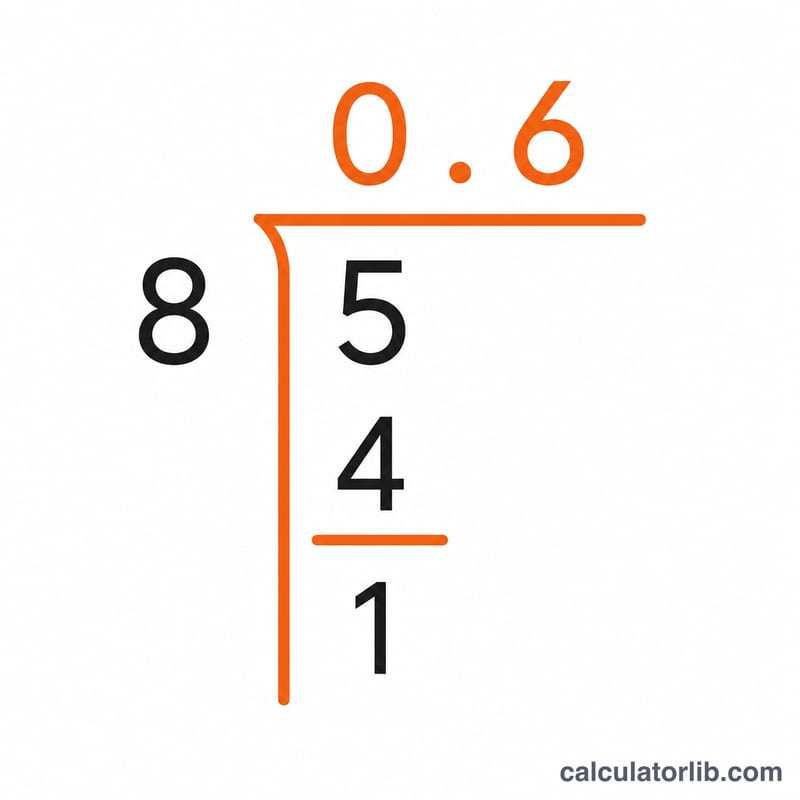
Take the fraction 5/8. Dividing the numerator 5 by the denominator 8 gives 0.625. Multiplying by 100 yields 62.5%. So $$\dfrac{5}{8} = 0.625 = 62.5\%.$$
FAQ
What if the decimal repeats? Some fractions, such as \(\tfrac{1}{3}\), produce repeating decimals (0.3333…). The calculator shows a rounded value, but the true decimal continues indefinitely.
Can the numerator be larger than the denominator? Yes. An improper fraction like \(\tfrac{7}{4}\) simply gives a result greater than 1, in this case 1.75.
Can I enter negative numbers? Yes. A negative numerator or denominator produces a negative decimal result, following normal sign rules.