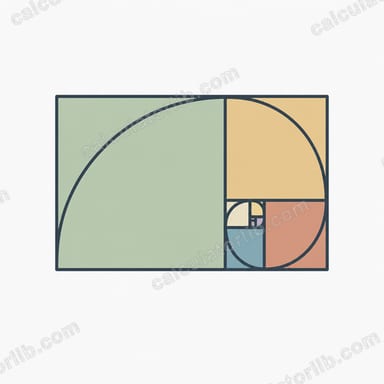

What is the Golden Ratio?
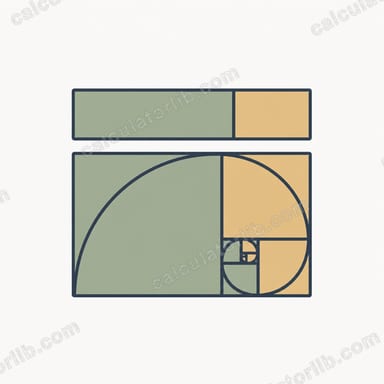
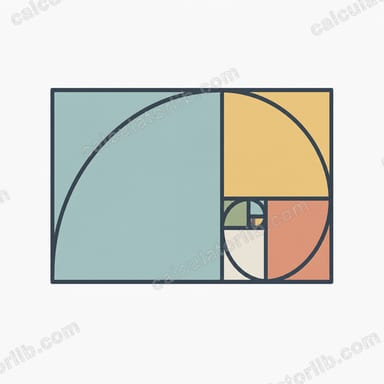
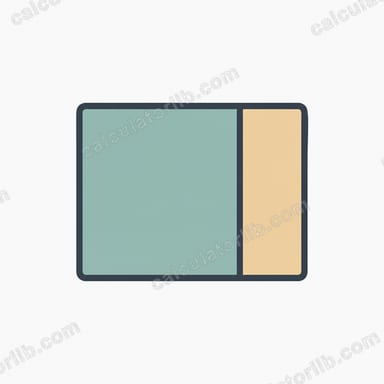
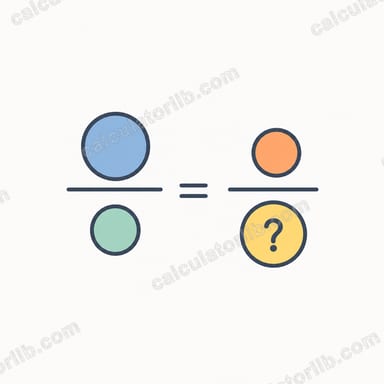
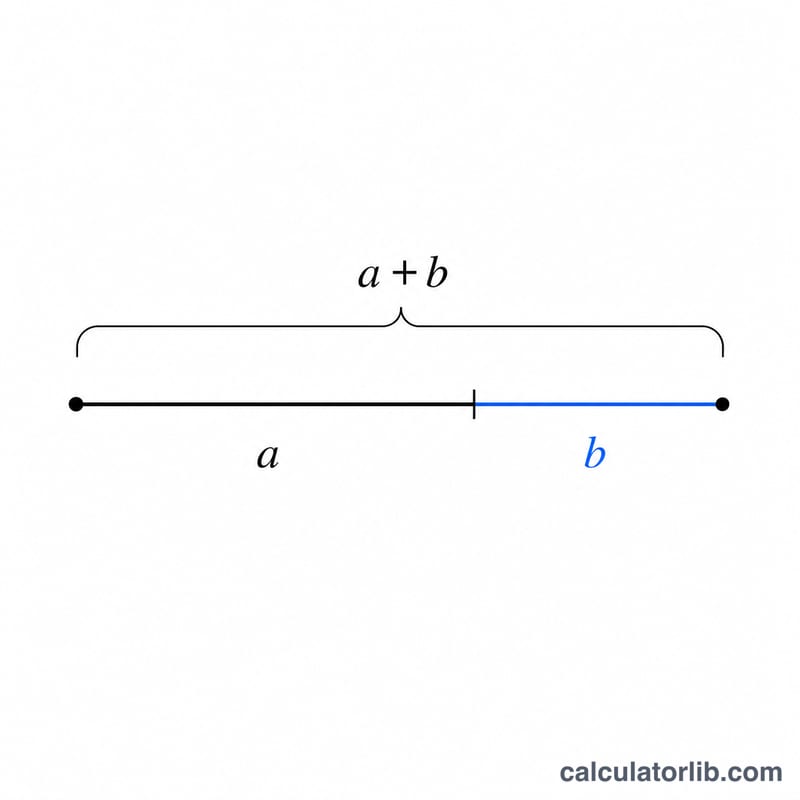
The golden ratio, written with the Greek letter phi (φ), is a special number approximately equal to 1.6180339887. It is defined exactly as \(\varphi = \frac{1 + \sqrt{5}}{2}\). Two quantities are in the golden ratio when the ratio of the larger part to the smaller part equals the ratio of the whole to the larger part: $$\frac{a}{b} = \frac{a+b}{a} = \varphi$$ This proportion appears throughout art, architecture, design, photography and nature, and is prized for its pleasing balance.
How to use this calculator
Choose whether you already know the longer part (a) or the shorter part (b) of your design, then enter its length. The calculator returns the matching part, the whole length (a + b), and confirms the constant \(\varphi\). For example, if you want to split a 100 cm line at the golden point, enter 100 as the longer part to see the shorter segment.
The formula explained
If you know the longer part a, the shorter part is \(b = a \div \varphi\). If you know the shorter part b, the longer part is \(a = b \times \varphi\). The whole length is simply \(a + b\). Because \(\varphi \times \varphi = \varphi + 1\), these segments always satisfy the self-similar golden relationship.
Worked example
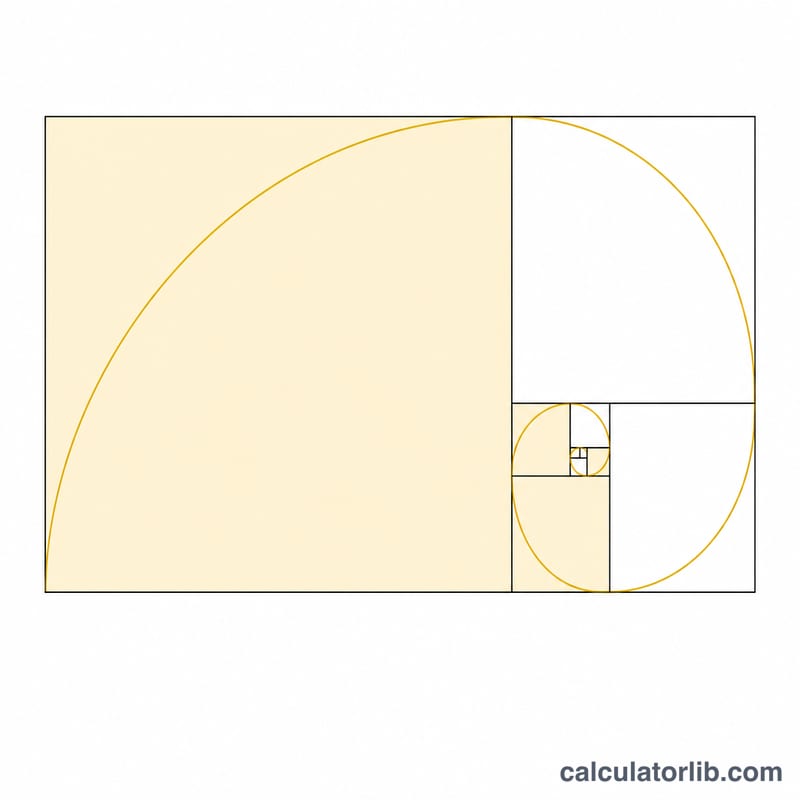
Suppose the longer part a = 100. Then the shorter part $$b = 100 \div 1.618034 \approx 61.8034,$$ and the whole is \(a + b \approx 161.8034\). Notice that \(100 \div 61.8034 \approx 1.618\) and \(161.8034 \div 100 \approx 1.618\) — both equal \(\varphi\), confirming the golden proportion.
FAQ
Is φ the same as the Fibonacci ratio? Yes — the ratio of consecutive Fibonacci numbers (e.g. 34/21, 55/34) converges toward \(\varphi\) as the numbers grow larger.
What units can I use? Any unit works (cm, inches, pixels) since the golden ratio is dimensionless; the output is in whatever unit you entered.
Why is the golden ratio considered beautiful? Its balanced, self-repeating proportion appears in shells, flowers, the Parthenon and modern logos, giving compositions a natural, harmonious feel.