
What is a Ratio Calculator?
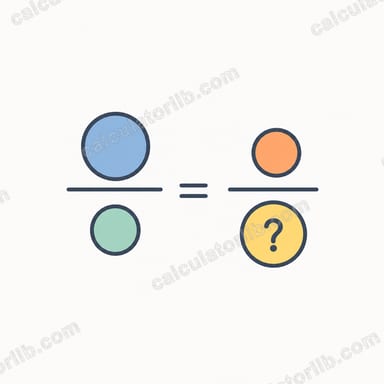
A ratio calculator solves proportions of the form \(A : B = C : D\). Given three of the four numbers, it finds the missing one, and it also reduces the ratio \(A : B\) to its simplest form. Ratios appear everywhere — recipe scaling, map scales, mixing fuel, aspect ratios, and financial analysis.
How to Use It
Enter values for \(A\), \(B\), and \(C\). Leave \(D\) blank and the calculator solves for it automatically using cross-multiplication. If you enter all four, it simply shows the simplified version of \(A : B\). Negative or decimal inputs are accepted.
The Formula Explained
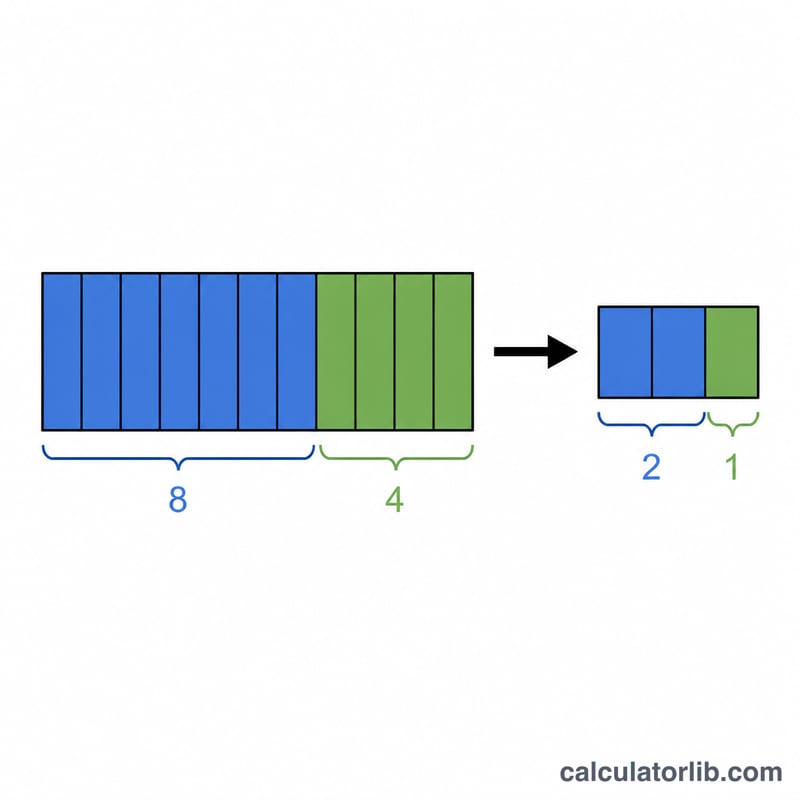
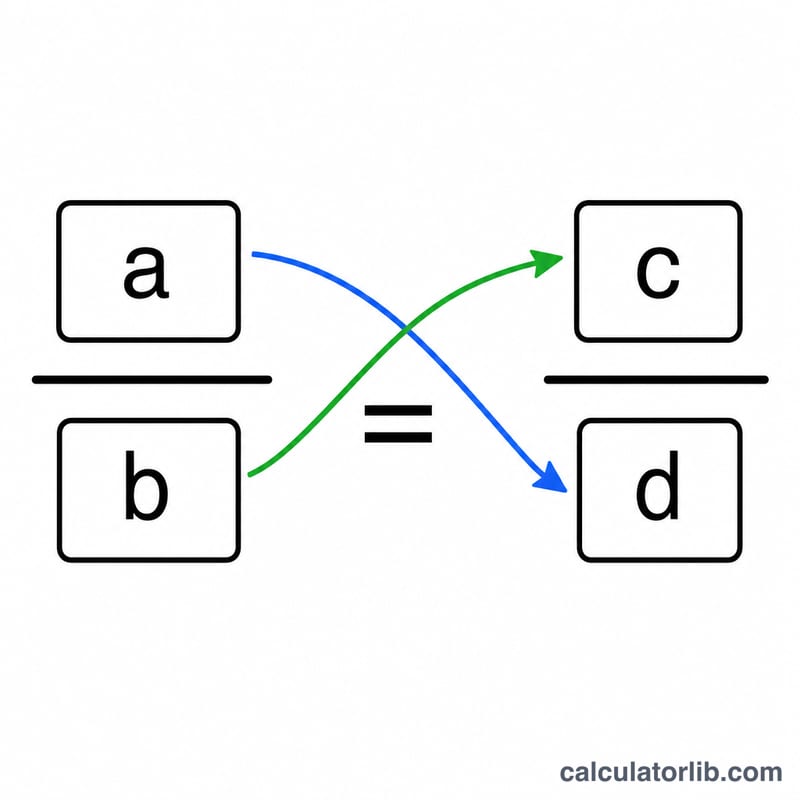
A proportion states that two ratios are equal: \(A/B = C/D\). Cross-multiplying gives \(A \times D = B \times C\), so the missing fourth term is $$D = \frac{B \times C}{A}$$ To simplify \(A : B\), divide both terms by their greatest common divisor (GCD). For example, \(12 : 8\) has a GCD of 4, giving \(3 : 2\).
Worked Example
Scaling a recipe with \(2 : 3 = 8 : D\). Compute $$D = \frac{3 \times 8}{2} = \frac{24}{2} = 12.$$ So 8 of the first ingredient needs 12 of the second. The simplified form of \(2 : 3\) is already \(2 : 3\) since their GCD is 1.
FAQ
What if A is zero? Division by zero is undefined, so the calculator returns 0 for \(D\) when \(A\) is 0. Use a non-zero \(A\).
Can I use decimals? Yes for solving \(D\). Simplification rounds the terms to whole numbers before reducing.
What does "simplest form" mean? A ratio is in simplest form when its two terms share no common factor other than 1.