

What Is a Mortgage Calculator?
A mortgage calculator estimates the fixed monthly payment you will make on a home loan, along with the total amount you will repay and how much of that is interest. It uses the standard amortization formula, which spreads your loan and its interest evenly across every month of the term so that each payment is identical.
How to Use It
Enter three values: the loan amount (the amount you borrow after any down payment), the annual interest rate as a percentage, and the loan term in years. The calculator instantly returns your monthly principal-and-interest payment, the total of all payments, and the total interest paid. Note that property taxes, homeowners insurance, and HOA fees are not included in this estimate.
The Formula Explained
The monthly payment is given by $$M = P \cdot \frac{r(1+r)^n}{(1+r)^n - 1}$$. Here \(P\) is the principal, \(r\) is the monthly interest rate (the annual rate divided by 12), and \(n\) is the total number of payments (years multiplied by 12). The exponential term reflects compound interest accruing each month on the remaining balance.
Worked Example
Suppose you borrow $300,000 at a 6.5% annual rate over 30 years. The monthly rate is \(0.065 / 12 \approx 0.00541667\) and the number of payments is 360. Plugging into the formula gives a monthly payment of about $1,896.20. Over 360 months you pay roughly $682,633 in total, of which about $382,633 is interest.
Mortgage Payment Scenarios Compared
The table below shows the monthly principal-and-interest payment, total interest paid over the life of the loan, and total amount repaid for a $300,000 loan amount. Figures use the standard amortization formula \(M = P \cdot \dfrac{r(1+r)^{n}}{(1+r)^{n}-1}\), where \(r\) is the monthly rate and \(n\) is the number of monthly payments. Values are rounded to the nearest dollar.
| Loan | Annual Rate | Term | Monthly P&I | Total Interest | Total Cost |
|---|---|---|---|---|---|
| $300,000 | 6.0% | 30 years | $1,799 | $347,515 | $647,515 |
| $300,000 | 6.0% | 15 years | $2,532 | $155,683 | $455,683 |
| $300,000 | 6.5% | 30 years | $1,896 | $382,633 | $682,633 |
| $300,000 | 6.5% | 15 years | $2,613 | $170,452 | $470,452 |
| $300,000 | 7.0% | 30 years | $1,996 | $418,527 | $718,527 |
| $300,000 | 7.0% | 15 years | $2,696 | $185,367 | $485,367 |
Two patterns stand out. First, a higher interest rate raises both the monthly payment and the total interest substantially — moving from 6.0% to 7.0% on the 30-year loan adds about $197 per month and roughly $71,000 in total interest. Second, the shorter 15-year term carries a higher monthly payment but dramatically reduces lifetime interest: at 6.5%, the 15-year loan costs about $212,000 less in total interest than the 30-year loan, despite the larger monthly outlay.
Key Mortgage Terms Defined
- Principal (P)
- The amount borrowed — the loan balance after any down payment. In the formula this is the starting figure on which interest is charged.
- Interest rate (nominal vs APR)
- The nominal rate is the stated annual interest rate used to compute the monthly periodic rate (\(r = \text{rate}/1200\)). The APR (annual percentage rate) is a broader figure that folds in certain lender fees and points, so it is usually slightly higher than the nominal rate and is meant to aid loan comparison. This calculator uses the nominal rate.
- Loan term
- The length of time over which the loan is repaid, here expressed in years and converted to monthly periods as \(n = 12 \times \text{years}\). Common terms are 15 and 30 years.
- Amortization
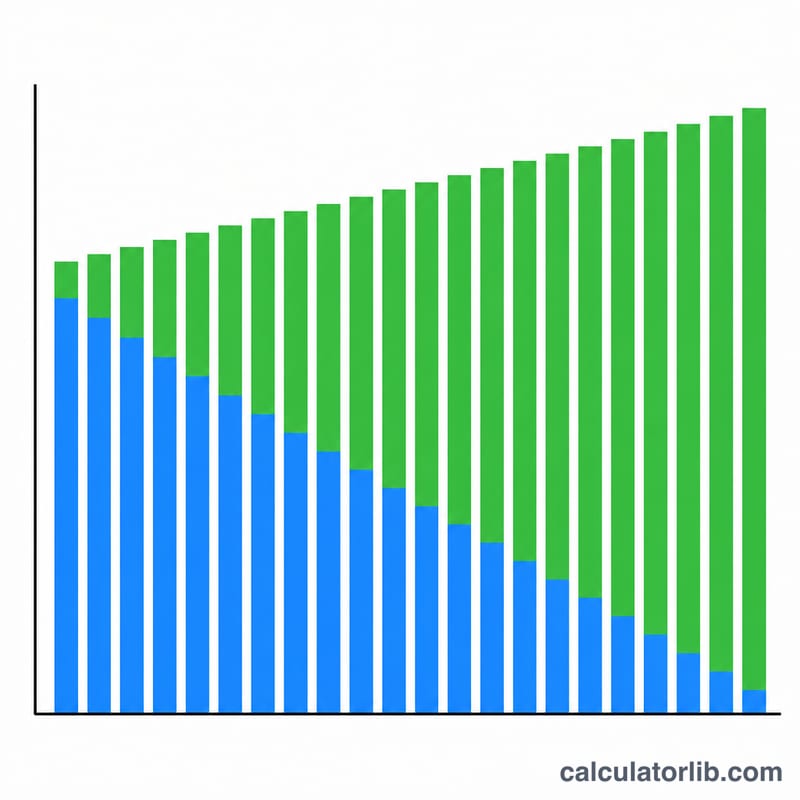
- The process of paying off a loan through equal periodic payments. Each payment covers the interest accrued that month, with the remainder reducing the principal; early payments are interest-heavy and later payments are principal-heavy.
- Monthly payment (P&I)
- The fixed monthly amount (\(M\)) that covers principal and interest only. It is the output of the amortization formula.
- Total interest
- The sum of all interest paid over the life of the loan, calculated as \(M \times n - P\).
- Total cost
- The total amount repaid over the full term, equal to \(M \times n\) — that is, principal plus total interest.
Understanding Your Payment Estimate
The payment shown by this calculator is principal and interest (P&I) only. It reflects what you repay the lender for borrowing the money, and nothing else.
Most real monthly housing payments are larger because they also include amounts collected for an escrow account and other recurring charges that this estimate does not cover:
- Property taxes — levied by local government and often collected monthly by the lender.
- Homeowners insurance — typically required by the lender.
- Private mortgage insurance (PMI) — commonly required on conventional loans when the down payment is less than 20% of the home's value.
- HOA dues — applicable if the property is part of a homeowners association.
A combined figure that includes these items is sometimes abbreviated PITI (principal, interest, taxes, and insurance). When budgeting, add your estimated escrow and HOA costs to the P&I figure here to approximate the full monthly housing cost.
As a factual benchmark, a long-standing lending guideline — the “front-end” debt-to-income ratio — suggests that total monthly housing costs stay at or below roughly 28% of gross monthly income, with total debt payments at or below about 36% (the so-called 28/36 rule). These thresholds are general industry reference points used in underwriting, not requirements, and actual lender criteria vary. This information is provided for general understanding only and is not personalized financial advice.
FAQ
Does this include taxes and insurance? No. It calculates only principal and interest. Your actual escrow payment may be higher.
What if the interest rate is 0%? With a 0% rate the payment is simply the loan amount divided by the number of months.
Can I use it for any loan? Yes — the same amortization math applies to auto loans, student loans, and personal loans.