
What This Calculator Does
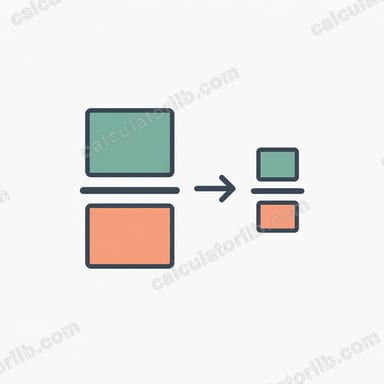
The Simplify Fractions Calculator reduces any fraction to its lowest terms. You enter a numerator and a denominator, and the tool returns the most reduced equivalent fraction — or a whole number when the fraction simplifies to one. It works with positive and negative integers, and it gracefully handles edge cases like a zero denominator.
The Inputs
- Numerator — the top number of your fraction (defaults to 4 if left blank).
- Denominator — the bottom number of your fraction (defaults to 12 if left blank).
Both fields accept whole numbers, including negatives. If the denominator is 0, the calculator returns "Undefined (division by zero)" because division by zero has no result.
The Formula
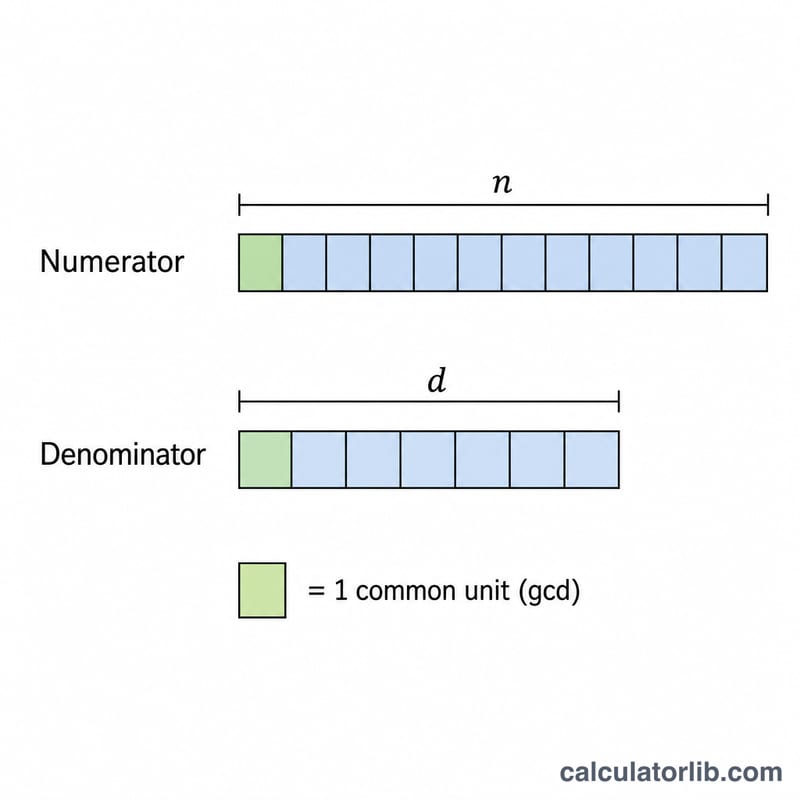
Simplifying a fraction means dividing both the numerator and denominator by their greatest common divisor (GCD):
Numerator / Denominator = (Numerator ÷ GCD) / (Denominator ÷ GCD)
The calculator finds the GCD using the Euclidean algorithm — repeatedly replacing the larger number with the remainder of dividing the two values until the remainder is zero. It then divides both parts by that GCD. The tool also tidies up signs: if the simplified denominator is negative, it flips the sign of both so the negative stays on top. When the simplified denominator equals 1, it shows just the whole number.
Worked Example
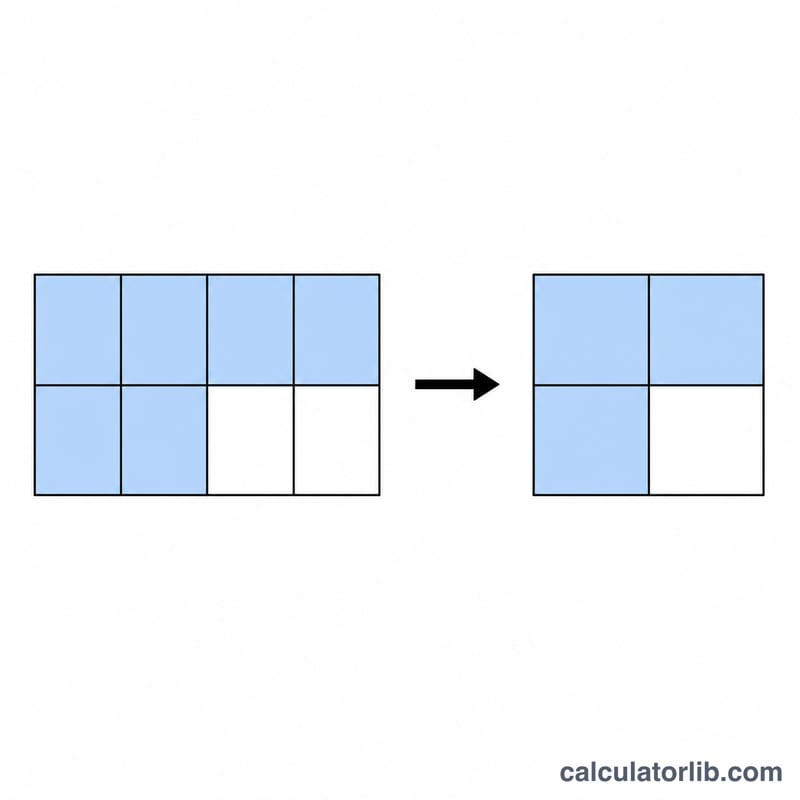
Take the default values: numerator 4, denominator 12.
- The GCD of 4 and 12 is 4.
- Numerator: 4 ÷ 4 = 1
- Denominator: 12 ÷ 4 = 3
- Result: 1/3
Another example: 8/2 has a GCD of 2, giving 4/1, which the calculator displays simply as 4.
FAQ
What happens if the fraction is already in lowest terms?
The calculator returns it unchanged and flags that no simplification was needed — for example, 3/5 stays 3/5.
Can I use negative numbers?
Yes. A fraction like -6/9 simplifies to -2/3. If the negative sign ends up on the denominator, the tool moves it to the numerator for a cleaner, standard format.
Why does it say "Undefined"?
A denominator of 0 means dividing by zero, which is mathematically undefined, so the calculator reports that instead of a fraction.