
What is the Golden Ratio?
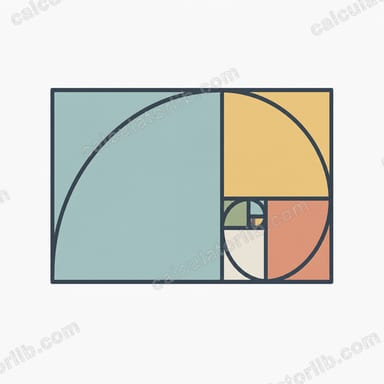
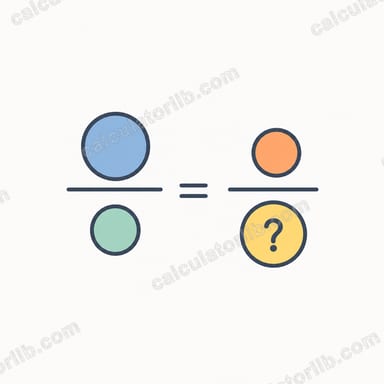
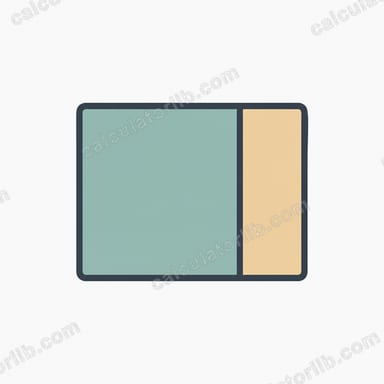
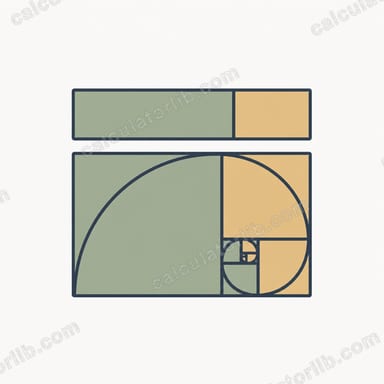
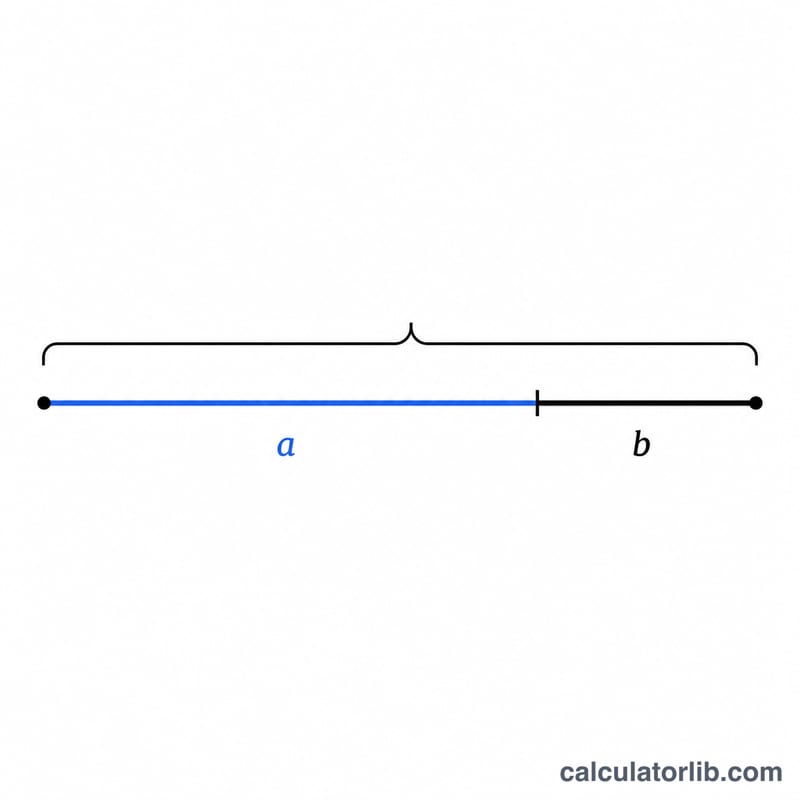
The golden ratio, written as the Greek letter φ (phi), is the special number \(\varphi = \frac{1+\sqrt{5}}{2} \approx 1.6180339887\). It appears when a line is divided into two parts so that the whole length divided by the longer part equals the longer part divided by the shorter part. This unique proportion is found throughout art, architecture, design, and nature — from the Parthenon to sunflower seed spirals.
How to Use This Calculator
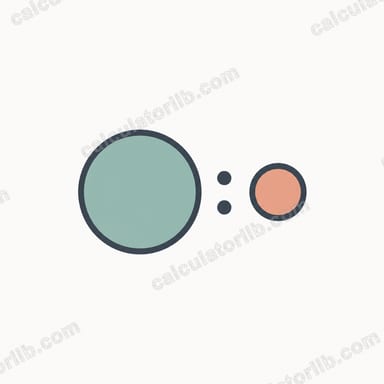
Enter the total length L you want to divide. The calculator returns the golden ratio constant φ along with the two golden segments: the longer segment \(a = L/\varphi\) and the shorter segment \(b = L - a\). The two segments always satisfy \(a:b = \varphi:1\) and \(L:a = \varphi:1\), so a and b are in perfect golden proportion.
The Formula Explained
First we compute the constant $$\varphi = \frac{1+\sqrt{5}}{2}.$$ To split a length, the longer piece is $$a = \frac{L}{\varphi}.$$ Because \(L = a + b\), the shorter piece is simply $$b = L - a.$$ You can verify the proportion holds: \(a / b \approx 1.618\) and \(L / a \approx 1.618\).
Worked Example
Suppose \(L = 100\). Then \(\varphi \approx 1.6180339887\), so $$a = \frac{100}{1.6180339887} \approx 61.8034$$ and $$b = 100 - 61.8034 \approx 38.1966.$$ Check: \(61.8034 / 38.1966 \approx 1.618\) ✓.
FAQ
Why is φ also called the divine proportion? Because artists and mathematicians historically considered its balanced division aesthetically pleasing and harmonious.
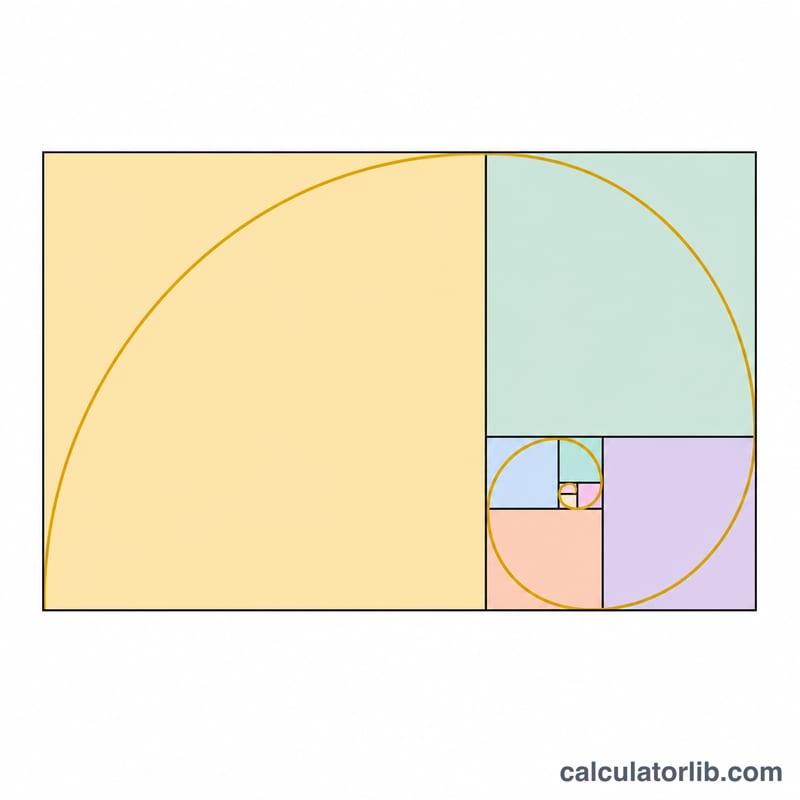
What is the relationship to the Fibonacci sequence? The ratio of consecutive Fibonacci numbers (1, 1, 2, 3, 5, 8, 13...) converges toward φ as the numbers grow larger.
Does the unit matter? No — the calculator is unit-agnostic. Whether you enter pixels, inches, or centimeters, the segments come back in the same unit.