
What this calculator does
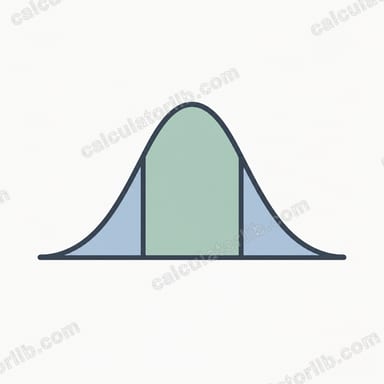
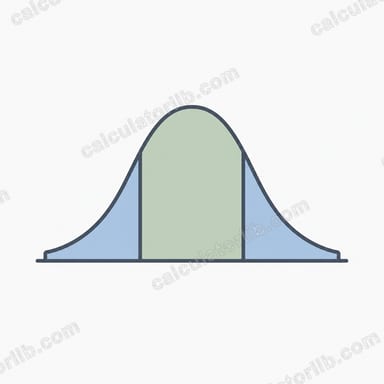
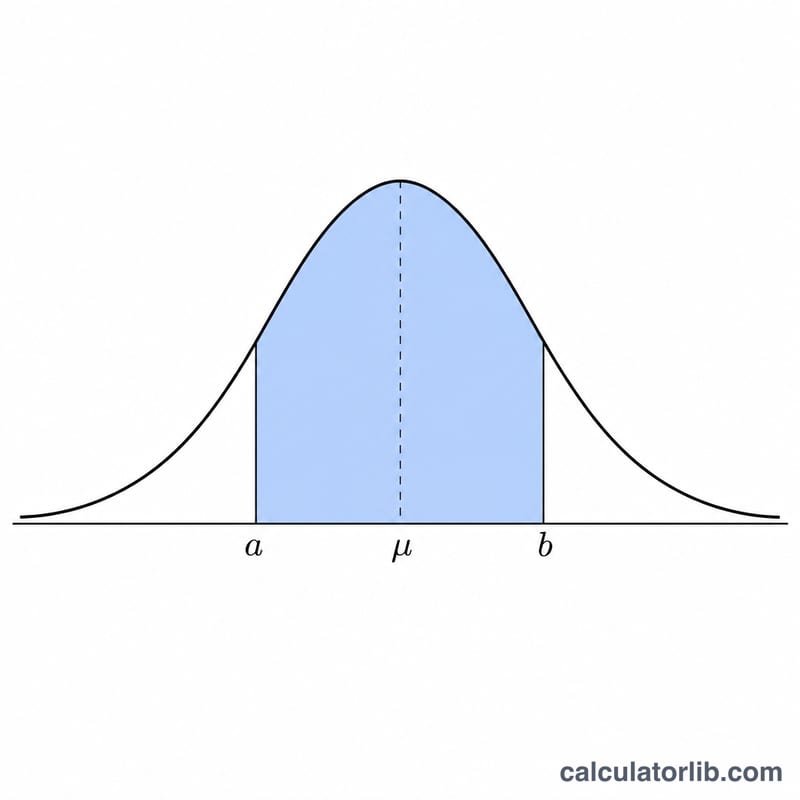
This tool computes the probability that a normally distributed random variable X falls between two values, a and b — written \(P(a < X < b)\). You supply the distribution mean (μ), standard deviation (σ), and the two boundary values. The calculator standardizes each boundary into a z-score and uses the standard normal cumulative distribution function Φ to return the exact area under the bell curve between them.
How to use it
Enter the mean and standard deviation of your distribution, then type the lower value a and the upper value b. Press calculate. The result shows the probability as a decimal (0 to 1) and as a percentage, along with the two z-scores. If you enter the values out of order, the calculator automatically treats the smaller one as a and the larger as b.
The formula explained
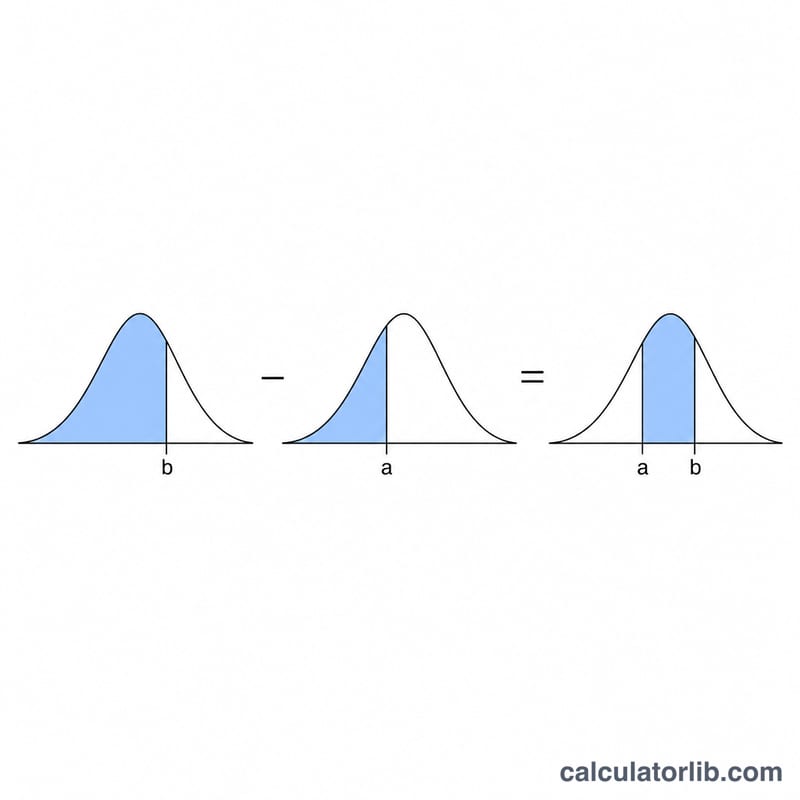
The probability between a and b equals the CDF at b minus the CDF at a: $$P(a < X < b) = \Phi\!\left(\frac{b-\mu}{\sigma}\right) - \Phi\!\left(\frac{a-\mu}{\sigma}\right).$$ The term \(\frac{x-\mu}{\sigma}\) converts a raw score into a z-score — the number of standard deviations from the mean. \(\Phi(z)\) gives the cumulative area to the left of z under the standard normal curve. Subtracting the two cumulative areas leaves the area strictly between a and b. This calculator evaluates \(\Phi\) using a high-accuracy error-function approximation.
Worked example
Suppose IQ scores are normal with \(\mu = 100\) and \(\sigma = 15\), and you want \(P(85 < X < 115)\). The z-scores are $$z_a = \frac{85-100}{15} = -1 \qquad z_b = \frac{115-100}{15} = +1.$$ \(\Phi(1) \approx 0.8413\) and \(\Phi(-1) \approx 0.1587\), so the probability $$\approx 0.8413 - 0.1587 = 0.6827,$$ or about 68.3% — the familiar one-standard-deviation rule.
FAQ
Does it matter if I use < or ≤? No. For a continuous normal distribution the probability at any single point is zero, so \(P(a < X < b)\) and \(P(a \le X \le b)\) are identical.
What if my standard deviation is 0? A standard deviation must be positive; with \(\sigma = 0\) the distribution is not defined, so the calculator returns 0.
How accurate is the result? The CDF is computed with the Abramowitz & Stegun approximation, accurate to roughly 7 decimal places — more than enough for typical statistics work.