What This Calculator Does
The Percentage of Questions Correct Calculator turns a raw score — the number of questions you answered correctly out of the total — into a percentage grade. Whether you are checking a quiz, a practice exam, or a homework set, this tool gives you an instant, accurate score along with the number of questions you missed.
How to Use It
Enter two numbers: the count of questions you got correct and the total number of questions on the assessment. The calculator divides the correct answers by the total and multiplies by 100 to produce your percentage score. It also shows how many answers were incorrect so you can see your full breakdown at a glance.
The Formula Explained
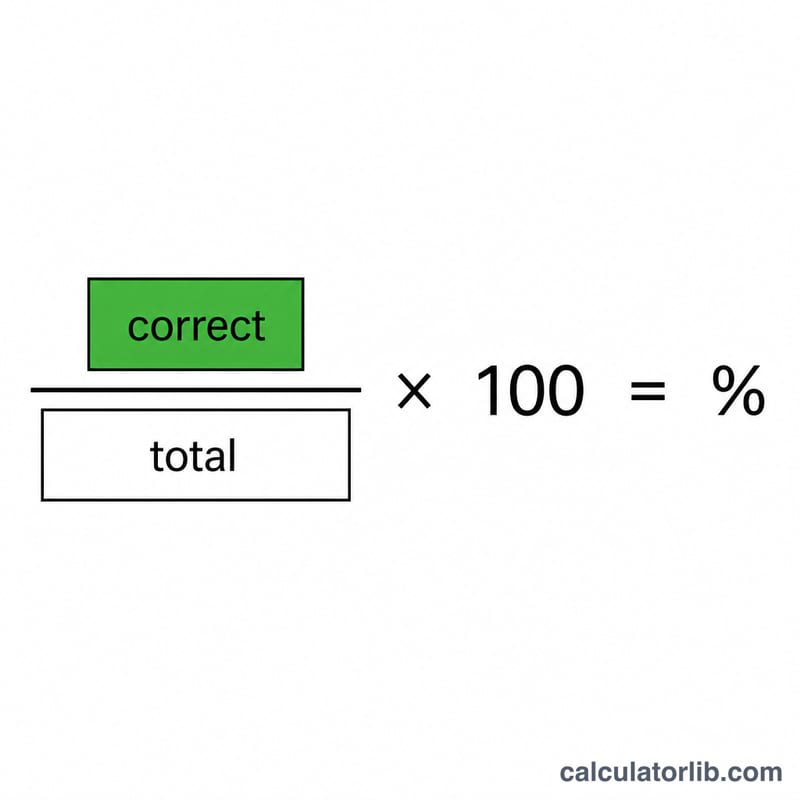
The calculation is simple proportion math:
$$\text{Percentage} = \frac{\text{Number Correct}}{\text{Total Questions}} \times 100\%$$
The fraction Correct ÷ Total expresses your score as a decimal between 0 and 1. Multiplying by 100 converts that decimal into a familiar percentage. For example, a decimal of \(0.9\) becomes \(90\%\).
Worked Example
Suppose you answered 18 questions correctly on a 20-question test. Divide 18 by 20 to get 0.9, then multiply by 100 to get 90%. The calculator also reports 2 incorrect answers (20 − 18).
$$\text{Percentage} = \frac{18}{20} \times 100\% = 90\%$$
Percentage to Letter Grade Reference Table
The table below shows the common US letter-grade scale, with typical plus/minus subdivisions and the unweighted 4.0 GPA points that usually go with them. This is a widely used convention, not a universal standard.
| Percentage | Letter grade | GPA points (4.0 scale) |
|---|---|---|
| 97–100% | A+ | 4.0 (some schools use 4.3) |
| 93–96% | A | 4.0 |
| 90–92% | A− | 3.7 |
| 87–89% | B+ | 3.3 |
| 83–86% | B | 3.0 |
| 80–82% | B− | 2.7 |
| 77–79% | C+ | 2.3 |
| 73–76% | C | 2.0 |
| 70–72% | C− | 1.7 |
| 67–69% | D+ | 1.3 |
| 63–66% | D | 1.0 |
| 60–62% | D− | 0.7 |
| Below 60% | F | 0.0 |
In short, the basic US bands are A 90–100%, B 80–89%, C 70–79%, D 60–69% and F below 60%.
Note: Grading scales vary by school, instructor and country. Some US schools use a 10-point scale with no plus/minus grades, some set the passing mark at 65% or 70%, and many countries use entirely different systems (for example numeric 1–10 scales, 0–20 scales or degree classifications). Always check the scale in your own course syllabus.
Score Comparison Across Common Test Lengths
Each row assumes every question is either right or wrong (unanswered questions count as incorrect). Letter grades use the common US plus/minus scale from the table above.
| Test length | Correct | Incorrect | Percentage | Letter grade |
|---|---|---|---|---|
| 10 questions | 8 | 2 | 80% | B− |
| 20 questions | 17 | 3 | 85% | B |
| 50 questions | 40 | 10 | 80% | B− |
| 100 questions | 85 | 15 | 85% | B |
| 10 questions (1 wrong) | 9 | 1 | 90% | A− |
| 20 questions (1 wrong) | 19 | 1 | 95% | A |
| 50 questions (1 wrong) | 49 | 1 | 98% | A+ |
| 100 questions (1 wrong) | 99 | 1 | 99% | A+ |
Example: 17 correct out of 20 gives 17 ÷ 20 = 0.85, and 0.85 × 100 = 85%.
Notice how much a single mistake costs on a short test: one wrong answer drops a 10-question test to 90%, but only to 99% on a 100-question test. The same number of errors has a smaller effect as the test gets longer.
FAQ
Can the percentage be over 100%? Only if you enter more correct answers than the total, which usually signals a typo. Make sure correct is never greater than total.
Does it handle partial or half points? Yes. The fields accept decimals, so you can enter scores like 17.5 correct out of 20.
What grade is my percentage? Grade scales vary by school, but a common US scale is A = 90–100%, B = 80–89%, C = 70–79%, D = 60–69%, and F below 60%.