
What is a reciprocal?
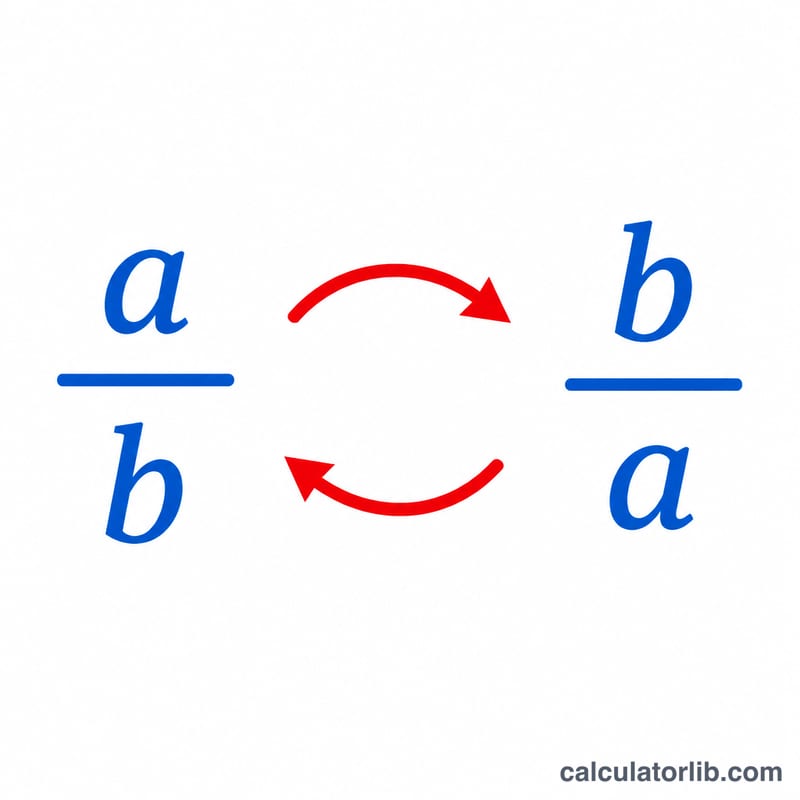
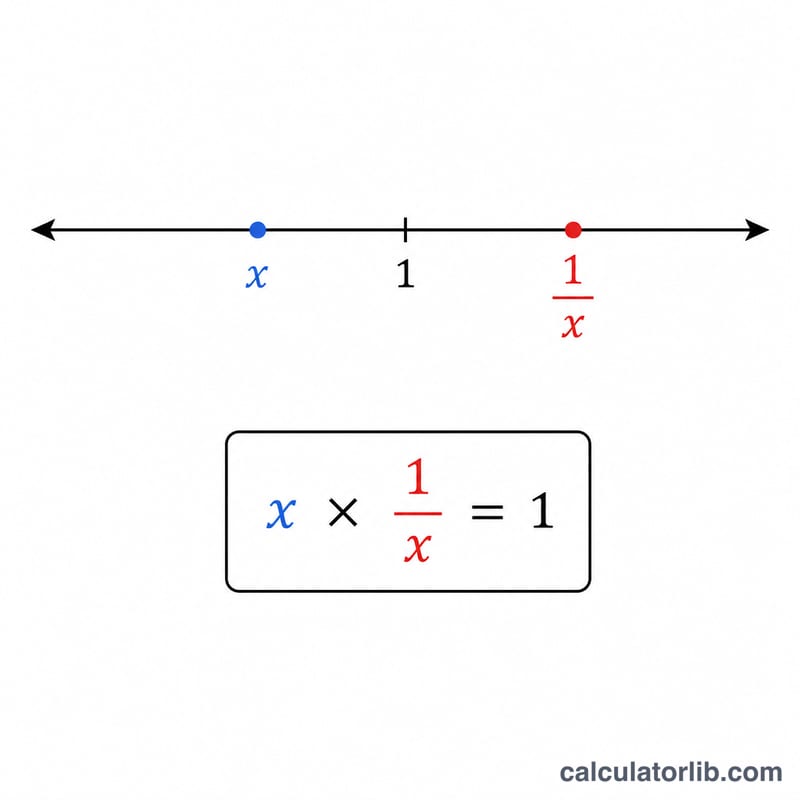
The reciprocal of a number is the value you multiply it by to get 1. It is also called the multiplicative inverse. For any non-zero number \(x\), the reciprocal is \(1/x\). For a fraction \(a/b\), the reciprocal is simply the fraction flipped upside down: \(b/a\). The number zero has no reciprocal because division by zero is undefined.
How to use this calculator
Choose whether you want to flip a single number or a fraction. For a number, type any value (whole, decimal, or negative) and we return 1 divided by it. For a fraction, enter the numerator and denominator separately and we swap them. The result is shown both as a tidy fraction and as a decimal so you can use whichever form fits your work.
The formula explained
For a single value the rule is $$\text{reciprocal}(x) = \frac{1}{x}$$ For a fraction the rule is $$\text{reciprocal}\left(\frac{a}{b}\right) = \frac{b}{a}$$ These are the same idea: a whole number \(x\) can be written as the fraction \(x/1\), so flipping it gives \(1/x\). Notice that the reciprocal of a reciprocal returns the original number, and the reciprocal of 1 is 1.
Worked example
Take the fraction \(3/4\). Swapping numerator and denominator gives \(4/3\). As a decimal, $$4 \div 3 \approx 1.333333$$ For a single number such as 5, the reciprocal is $$\frac{1}{5} = 0.2$$
FAQ
What is the reciprocal of a negative number? Keep the sign: the reciprocal of -4 is \(-\frac{1}{4} = -0.25\).
Does zero have a reciprocal? No. Because you cannot divide by zero, zero has no reciprocal and the calculator returns 0 to indicate it is undefined.
What is the reciprocal of a decimal like 0.25? \(1 \div 0.25 = 4\), which matches flipping the fraction \(1/4\) into \(4/1\).