What Is the Amps to Milliamps Calculator?
This calculator converts electric current measured in amperes (A) into milliamperes (mA). The ampere is the SI base unit of electric current, while the milliampere is a smaller unit equal to one-thousandth of an ampere. Because many electronic components, sensors, and small circuits operate in the milliamp range, converting between these units is a common everyday task for engineers, hobbyists, and students.
How to Use It
Enter the current value in amps into the input field and the calculator instantly returns the equivalent in milliamps. The conversion works for any positive or fractional value, such as 0.5 A or 12.75 A.
The Formula Explained
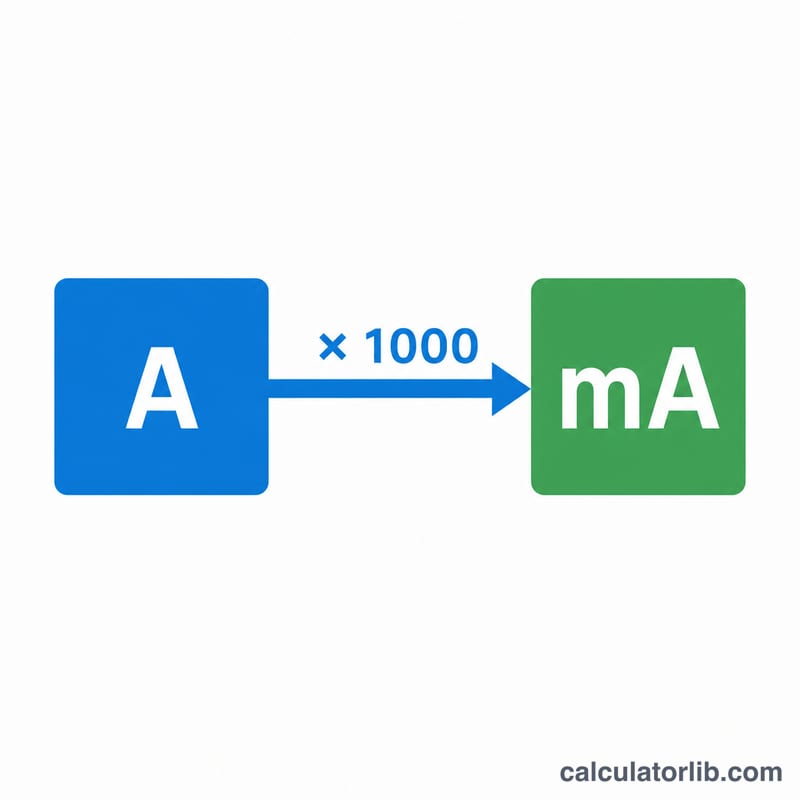
The conversion is based on the metric prefix "milli", which means one-thousandth. Since 1 ampere equals 1000 milliamperes, you simply multiply the amp value by 1000:
$$\text{mA} = \text{A} \times 1000$$
This is a direct, linear conversion — there are no other variables or constants involved.
Worked Example
Suppose a device draws 2.5 A of current. To find the value in milliamps, multiply by 1000:
$$2.5 \times 1000 = 2500 \text{ mA}$$So 2.5 amps equals 2,500 milliamps.
Typical Current Levels in Amps and Milliamps
Use \(\text{mA} = \text{A} \times 1000\) to move between units. The table lists typical current levels for common devices. These are approximate, device-dependent values, not guarantees: actual draw varies with model, load, voltage and operating mode, so always check the datasheet or rating label of your specific device.
| Device / source | Typical current (mA) | Typical current (A) |
|---|---|---|
| LED indicator | 10-20 mA | 0.01-0.02 A |
| Microcontroller (active, board-level) | 20-100 mA | 0.02-0.1 A |
| USB 2.0 port (standard downstream limit) | 500 mA | 0.5 A |
| USB 3.0 port (standard downstream limit) | 900 mA | 0.9 A |
| Smartphone charger | 1,000-3,000 mA | 1-3 A |
| Household circuit breaker (e.g. North American 15-20 A circuits) | 15,000-20,000 mA | 15-20 A |
Notes
- USB limits: The USB 2.0 specification allows a standard downstream port to supply up to 500 mA (5 unit loads of 100 mA) at 5 V. The USB 3.0 specification raises this to 900 mA (6 unit loads of 150 mA). Higher currents need extra standards such as USB Battery Charging or USB Power Delivery.
- Chargers: A charger's rating is the maximum it can supply. The phone draws only what it needs.
- Circuit breakers: A breaker rating is a protective trip threshold, not the current a circuit normally carries. Common ratings differ by country and wiring standard, so the 15-20 A range reflects typical North American household circuits.
- LEDs and microcontrollers: These figures depend heavily on LED color, resistor value, clock speed and sleep modes. Some microcontrollers draw microamps in sleep and well over 100 mA with radios active.
More Conversion Examples
The conversion uses one relationship: 1 A = 1,000 mA. To go from amps to milliamps, multiply by 1,000. To go from milliamps back to amps, divide by 1,000. The three examples below show each direction.
Example 1: A fractional current (0.035 A)
A small sensor draws 0.035 A. Find the current in milliamps.
- Write the formula: \(\text{mA} = \text{A} \times 1000\)
- Substitute the value: \(\text{mA} = 0.035 \times 1000\)
- Multiply: \(0.035 \times 1000 = 35\)
Result: 0.035 A = 35 mA.
Example 2: Reverse check (750 mA to A)
A device is rated at 750 mA. Find the current in amps by dividing by 1,000.
- Rearrange the formula: \(\text{A} = \text{mA} \div 1000\)
- Substitute the value: \(\text{A} = 750 \div 1000\)
- Divide: \(750 \div 1000 = 0.75\)
Result: 750 mA = 0.75 A. To confirm, multiply back: \(0.75 \times 1000 = 750\) mA, which matches the starting value.
Example 3: A larger current (12.75 A)
A circuit carries 12.75 A. Find the current in milliamps.
- Substitute into the formula: \(\text{mA} = 12.75 \times 1000\)
- Multiply: \(12.75 \times 1000 = 12{,}750\)
Result: 12.75 A = 12,750 mA.
Tip: Multiplying by 1,000 moves the decimal point three places to the right. Dividing by 1,000 moves it three places to the left.
FAQ
How many milliamps are in 1 amp? There are exactly 1000 milliamps in 1 amp.
How do I convert milliamps back to amps? Divide the milliamp value by 1000 (\(\text{A} = \text{mA} \div 1000\)).
Is this conversion exact? Yes. The relationship between amps and milliamps is defined exactly, so there is no rounding or approximation in the conversion factor.